How a Mobile Jaw Crusher Sorts and Recycles Brick-Concrete Demolition Waste in Old Community Renovation
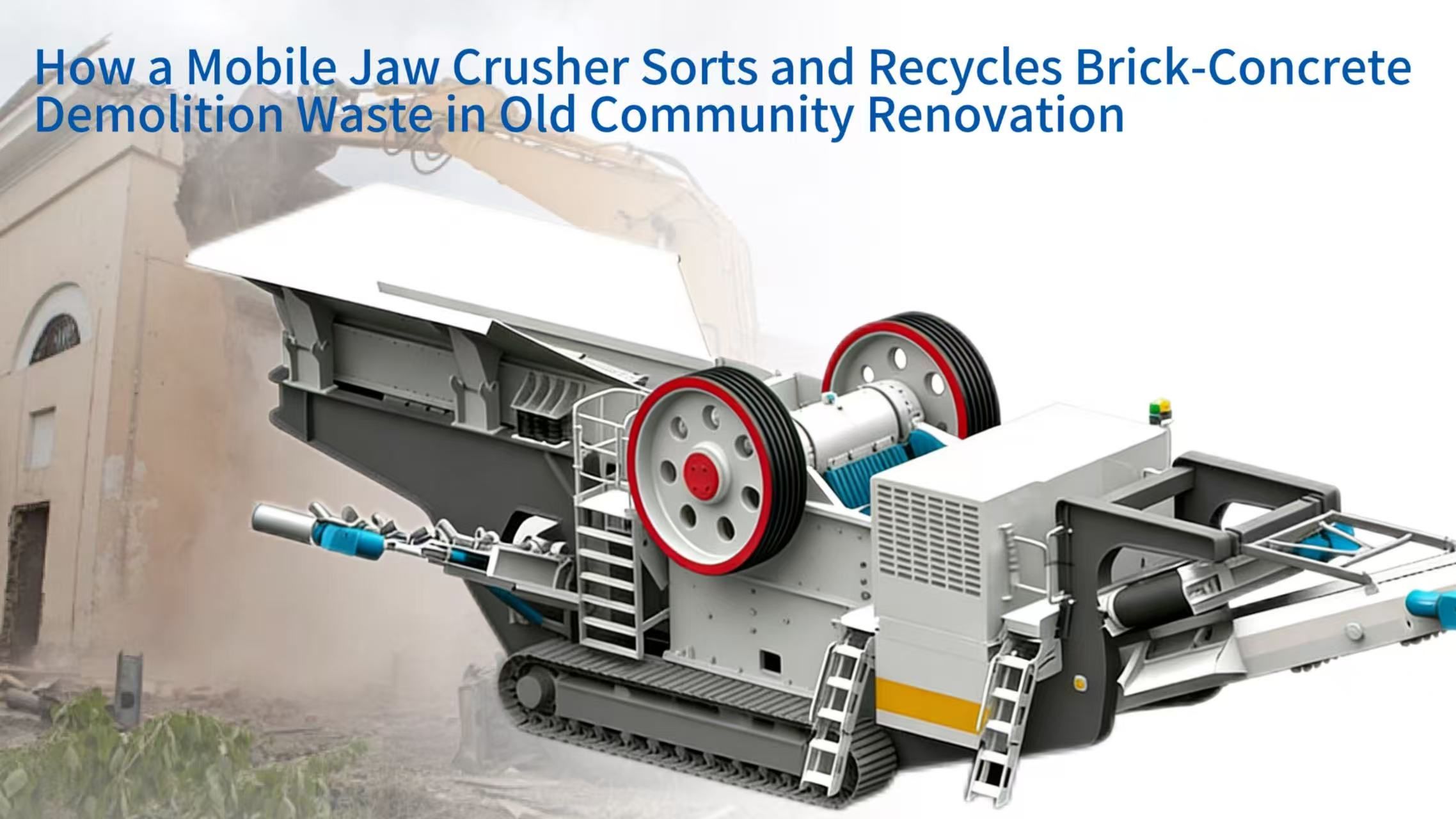
Old community renovation projects produce large amounts of brick-concrete demolition waste. This waste includes broken red bricks, concrete chunks, mortar layers, and embedded steel bars. In the past, most of this material was transported to landfills or dumping sites. That approach creates high fuel costs, road wear, and environmental problems. A mobile jaw crusher offers a different solution. This machine processes demolition waste directly at the renovation site. It crushes the brick-concrete mixture into smaller particles. It also separates steel reinforcement bars from the concrete and brick material. The final product is recycled aggregate that can replace natural stone in road bases, backfill, or low-strength concrete blocks. This page explains how the machine works, how to operate it on site, and what economic and environmental benefits it brings to old community renovation projects.
Material Characteristics of Brick-Concrete Demolition Waste and Disposal Challenges
Brick-Concrete Demolition Waste Composition & Transport Comparison
Waste Material Ratio
Truck Transport Trips (10,000 Tons Project)
400 Trips
80 Trips
| Item | Traditional Disposal | On-site Crushing |
|---|---|---|
| Truck Trips | 400 | 80 (80% Reduction) |
| Landfill Fee | $15-$30/ton | Fully Avoided |
Brick-concrete demolition waste from old communities has a mixed composition. The waste typically contains 40 to 60 percent red brick, 30 to 50 percent concrete, and 5 to 10 percent mortar and finish layers. Red brick has lower hardness and fractures easily under compression. Concrete is harder and requires greater force to break. The waste also contains steel reinforcement bars, plastic pipes, wood pieces, and insulation materials. These impurities create problems during crushing. Steel bars can wrap around crushing components. Wood and plastic may clog the discharge opening. Understanding this mixed composition is the first step toward effective on-site recycling.
Traditional disposal methods rely on long-distance truck transport to landfills or uncontrolled dumping sites. A medium-sized renovation project generating 10,000 tons of waste requires approximately 400 truck trips assuming 25 tons per load. Each trip consumes diesel fuel, generates carbon emissions, and adds road maintenance costs. Landfill fees range from 15 to 30 per ton in many regions. The total cost for transport and disposal often exceeds 50,000 for a single project. Beyond direct costs, illegal dumping remains a serious problem. Waste dumped in vacant lots or along rural roads contaminates soil and groundwater. Heavy metals from old paint and plumbing leach into the environment. These factors make traditional disposal both expensive and environmentally damaging.
On-site recycling using a mobile jaw crusher directly addresses these challenges. The machine processes waste exactly where demolition occurs. There is no need to transport raw waste to distant disposal sites. Crushed material becomes usable aggregate on the same property. The reduction in truck trips lowers fuel consumption and road damage. For a 10,000-ton project, on-site crushing can eliminate 80 percent of transport trips. The remaining 20 percent may involve removing steel bars or excess fine material. The mobile jaw crusher arrives on a low-bed trailer. It unfolds its hydraulic legs and starts working within hours. This speed of deployment matches the fast-paced schedule of old community renovation projects.
For more information on how different crusher types handle various feed materials, visit our feed size guide.
Working Principle and Mechanical Structure for Brick-Concrete Waste Processing
Mobile Jaw Crusher Working Flow
The mobile jaw crusher uses a simple but effective compression mechanism. A fixed jaw plate remains stationary. A moving jaw plate swings back and forth driven by an eccentric shaft. Brick-concrete waste enters the V-shaped crushing chamber from the top. As the moving jaw closes against the fixed jaw, the material is compressed and fractured. Red brick breaks easily because of its porous structure. Concrete requires more compression cycles before cracking. This difference in breakage behavior is called selective crushing. The machine naturally separates brick from concrete to some extent. The resulting particles fall by gravity to the discharge opening at the bottom.
Steel reinforcement bars present a special challenge in demolition waste. A standard jaw crusher handles steel bars differently than brittle materials. When a steel bar enters the crushing chamber, the jaw plates compress it but do not break it. The bar bends and flattens. The V-shaped chamber geometry allows the bent bar to move upward while concrete fragments fall downward. Eventually the bar works its way to the discharge opening in a flattened, folded shape. A suspension magnet installed above the discharge conveyor attracts the steel bars and pulls them away from the aggregate stream. The bars drop into a collection bin for recycling as scrap metal. This automatic separation prevents steel from contaminating the recycled aggregate.
Discharge opening adjustment controls the maximum particle size leaving the crusher. The operator uses a hydraulic system to change the gap between the bottom of the moving jaw and the fixed jaw. A wider gap of 80 millimeters produces coarse aggregate suitable for road base layers. A narrower gap of 40 millimeters produces medium aggregate for backfill. The smallest gap of 10 to 20 millimeters produces fine material that can be used in concrete block manufacturing. The adjustment takes only a few minutes using a remote control or manual hydraulic pump. The machine can change settings multiple times per day to produce different aggregate grades as needed for different applications on the same renovation site.
The mobile jaw crusher moves on heavy-duty rubber tracks. Each track has its own hydraulic motor. The operator uses a wireless remote control to drive the machine forward, backward, and turn in place. The turning radius is very small. This mobility allows the crusher to move between different demolition zones within an old community. The machine positions itself next to the waste pile, reducing loader travel distance. Dual power options are available. A diesel engine provides independence from the electrical grid. This is useful for sites without available power connections. An electric motor option reduces fuel costs and noise when a three-phase power supply is available. The choice depends on site conditions and local energy prices.
To understand how the crushing chamber design affects particle shape and throughput, read our crushing chamber analysis.
Key Application Steps for Sorting and Recycling Brick-Concrete Waste
Brick-Concrete Waste Recycling Steps
The first application step is feed material preparation. Before material enters the crusher, an excavator or wheel loader removes visible impurities. Large wood beams, plastic pipes, asphalt pieces, and textile materials are picked out by hand or machine. This pre-sorting step takes only a few minutes per loader bucket but greatly improves final aggregate quality. The cleaned waste is then fed into the crusher hopper at a steady rate. Overloading the hopper causes material to bridge and block the feed opening. Underloading reduces production efficiency. The best practice is to maintain a continuous flow where the feed level stays just below the top edge of the hopper. This ensures the crushing chamber remains full but not packed.
During crushing, the belt magnet continuously removes steel reinforcement. The magnet hangs above the main discharge conveyor. As crushed material passes underneath, the magnetic field attracts steel pieces. A rubber belt moves around the magnet body, carrying the steel to the side where it drops into a collection bin. The operator checks the collection bin every two to four hours. A full bin reduces magnet efficiency because captured steel blocks the magnetic field from reaching new material. Emptying the bin takes less than five minutes. The collected steel bars and wire sell as scrap metal. In a 10,000-ton demolition project, the steel content is typically 2 to 5 percent or 200 to 500 tons. At current scrap prices, this adds several thousand dollars in revenue that partially offsets crushing costs.
After crushing, the material often passes through a mobile vibrating screen. The screen separates particles into different size ranges. A triple-deck screen might produce 0 to 5 millimeter fine sand, 5 to 20 millimeter small aggregate, and 20 to 40 millimeter coarse aggregate. Each size has a different use. The fine sand mixes with cement to make low-strength concrete blocks for non-structural walls. The medium aggregate works well as pipe bedding or trench backfill. The coarse aggregate provides a stable base under new roads and parking areas. The screening operation runs alongside the crusher. A wheel loader moves crushed material from the crusher discharge pile to the screen feed hopper. Alternatively, a belt conveyor can connect the crusher directly to the screen for continuous production.
Dust and noise control are essential when working near occupied residential buildings. The mobile jaw crusher includes a water spray system. Nozzles located at the crusher feed opening, discharge point, and screen covers spray a fine mist. Water droplets capture dust particles before they become airborne. A foam suppression system is an alternative that uses less water. Foam bubbles surround dust sources and prevent escape. For noise control, the operator can reduce engine speed during idle periods. An acoustic enclosure around the diesel engine lowers sound output. When working within 50 meters of homes, a temporary barrier made of sound-absorbing panels reduces noise reaching residents. These measures keep the operation acceptable to the local community while maintaining production.
For heavy impurities that are not magnetic, such as wood chips and plastic fragments, additional separation may be needed. A simple air knife or fan mounted at the screen discharge blows light materials sideways into a collection area. The heavier aggregate falls straight down. This air separation removes most of the remaining organic material. In projects with very strict purity requirements, a water separation tank follows the air knife. Aggregate flows into a slow-moving water current. Wood and plastic float to the surface for skimming off. Clean aggregate sinks and is removed from the bottom. Water separation produces the highest quality recycled aggregate but requires space for settling ponds to remove fine silt before water reuse or discharge.
Learn about the relationship between feed material properties and machine output in our crushing capacity article.
Performance Characteristics When Processing Brick-Concrete Waste
The actual throughput of a mobile jaw crusher depends heavily on the brick-to-concrete ratio. When the feed contains 70 percent red brick and only 30 percent concrete, the machine produces up to 30 percent more tons per hour than its rated capacity for hard rock. Brick fractures easily with low energy input. The jaw moves through its cycle quickly because the material offers little resistance. When concrete content rises above 60 percent, throughput drops toward the rated capacity. Concrete requires more compression cycles to break into target size. The operator may need to reduce feed rate to prevent overloading the crusher drive. For a typical old community demolition project with mixed brick and concrete, the actual throughput usually falls between the brick-only and concrete-only extremes.
Recycled aggregate from a jaw crusher has a angular, blocky particle shape. This shape is beneficial for road base applications. Angular particles lock together under compaction. They resist movement better than rounded natural gravel. A standard test for road base material is the California Bearing Ratio. Recycled brick-concrete aggregate often achieves a ratio of 80 to 120 percent, which meets requirements for many pavement applications. The particle shape differs from that produced by an impact crusher. An impact crusher produces more cubical particles but also creates more fine dust. For most base and fill applications, the jaw crusher output is adequate. The slightly elongated particles in jaw crusher output do not cause problems because the material is not used in high-strength concrete where shape matters greatly.
Jaw plate wear life depends on the silica content of the brick and concrete. Red brick contains quartz sand as a tempering material. Quartz has high hardness and acts like sandpaper against the manganese steel jaw plates. Concrete contains sand and gravel of varying hardness. Processing 10,000 tons of brick-concrete waste typically wears 15 to 25 kilograms of jaw plate material per 1,000 tons. The wear rate increases when the waste contains concrete made with hard river pebbles or granite. It decreases when the waste consists mostly of soft brick. The operator measures jaw plate wear weekly by checking the tooth height. New plates have teeth 40 to 60 millimeters high. When tooth height drops below 15 millimeters, crushing efficiency declines and the plates need replacement. A set of jaw plates lasts 3,000 to 6,000 hours depending on material abrasiveness.
Steel bar wrapping and clogging are occasional problems. A steel bar that does not exit the crushing chamber can wrap around the moving jaw. The machine detects this condition through increased hydraulic pressure or slower jaw movement. The operator engages reverse mode, which turns the eccentric shaft backwards for a few seconds. This action unwinds the steel bar. The bar then falls to the discharge opening. If reverse mode does not clear the jam, the hydraulic relief system opens the discharge gap wider. The gap increases by 50 to 100 millimeters. The steel bar drops through the larger opening. After clearing, the gap automatically returns to its original setting. These automatic or semi-automatic features keep the machine running with minimal manual intervention.
Extreme temperatures affect machine performance. In hot weather above 35 degrees Celsius, hydraulic oil thins. The cooling fan runs at higher speed to maintain oil temperature below 80 degrees. The operator should check hydraulic oil level daily because thin oil leaks more easily past seals. In cold weather below zero degrees Celsius, the diesel engine needs winter-grade fuel to prevent gelling. Hydraulic oil should be changed to a low-viscosity grade. The water spray system must be drained after each shift to prevent freezing damage to pipes and nozzles. Frozen waste material causes additional problems. Frozen chunks do not break as easily because ice adds strength. The operator may need to reduce feed rate or wait for daytime warming to improve crushing efficiency.
For a detailed explanation of how the reduction ratio affects final product quality, see our crushing ratio guide.
Operation Guidelines and Maintenance for On-Site Work
On-site Operation & Maintenance Flow
Proper site setup is the first operation step. The operator drives the mobile jaw crusher to a flat, stable area near the waste pile. The ground must support the machine weight plus the weight of a loader feeding material. Soft ground requires steel plates or timber mats under the tracks. The operator then extends four hydraulic stabilizer legs. Each leg has a large circular foot. The legs lift the tracks slightly off the ground. This stabilizes the machine and prevents rocking during crushing. The operator checks that the machine is level using a bubble level or the control panel display. An unlevel machine causes uneven jaw plate wear and poor crushing performance. The entire setup process takes 10 to 15 minutes for an experienced operator.
The daily pre-start inspection follows a checklist. The operator walks around the machine looking for loose bolts, damaged hoses, and oil leaks. The main drive belt between the engine and crusher must have proper tension. A loose belt slips and reduces crushing force. A belt tension gauge measures deflection under a set force. The operator checks the toggle plate bolts. A loose toggle plate allows the movable jaw to shift sideways, damaging the crusher frame. The jaw plate bolts receive special attention because vibration loosens them over time. A torque wrench confirms each bolt is tightened to the specified value. The operator listens to the engine and hydraulic pump during startup. Any knocking or whining sound indicates a problem requiring shutdown and inspection.
Discharge opening adjustment during operation is done from the control panel. The operator selects the desired opening size on a digital display. A hydraulic cylinder pushes or pulls the toggle plate position. The moving jaw bottom moves accordingly. The actual opening size is confirmed with a lead ball or measuring tape during a brief machine stop. The operator should remeasure the opening every four to eight hours of operation. Jaw plate wear gradually increases the opening size even when the setting has not changed. A worn jaw plate with rounded teeth allows larger particles to escape. Compensating for wear by closing the setting by 5 to 10 millimeters maintains consistent product size throughout the jaw plate life.
End-of-day cleaning prevents material buildup. The operator runs the crusher empty for one to two minutes after the last feed. This pushes remaining material out of the crushing chamber. The discharge conveyor continues running until no material falls off the belt. The operator then stops the machine and opens the crusher inspection door. A visual check confirms the chamber is empty. Wet brick-concrete material left inside the chamber hardens overnight. Hardened material blocks the next startup and requires manual chiseling to remove. The operator also cleans the belt magnet. Small steel pieces stuck to the magnet face are removed with a plastic scraper. A clean magnet works at full efficiency when production resumes the next day.
Jaw plate replacement occurs when tooth height falls below the minimum specification. The operator locks out the crusher drive and disconnects the battery. The inspection door opens fully. Wedge blocks hold the moving jaw in a fixed position. The operator removes the holding wedges that lock the jaw plates in place. The worn plates slide out of their mounting grooves. New plates slide into the same grooves. The wedge system tightens to hold the new plates firmly. The gap between the fixed and moving plates at the bottom should match the manufacturer specification. A feeler gauge measures the gap at several points across the width. Uneven gap indicates improper seating of the new plates. The operator repeats the seating process until the gap is uniform. The entire replacement takes two to four hours for two people.
Understanding how discharge size affects downstream processes is covered in our discharge size article.
Economic and Environmental Value for Old Community Renovation Projects
Economic Benefits (10,000 Tons Project)
| Cost Item | Traditional Disposal | On-site Recycling |
|---|---|---|
| Transport Trips | 400 Trips | 80 Trips |
| Landfill Cost | $150,000-$300,000 | $0 (Avoided) |
| Scrap Steel Revenue | $0 | $30,000-$150,000 |
Transport cost reduction is the most direct economic benefit. A 10,000-ton demolition project generates approximately 400 truck loads if waste is sent to a landfill. On-site crushing reduces this to 80 loads for exporting steel and excess fines. The saving of 320 truck trips eliminates 320 times the round-trip distance in fuel, driver wages, and vehicle wear. For a 50-kilometer round trip, the saving is 16,000 kilometers of truck travel. At typical operating costs per kilometer, the transport saving ranges from 10,000 to 20,000. Landfill fees of 20 per ton for 10,000 tons represent another 200,000 in avoided costs. The combined saving often exceeds 250,000 for a single medium-sized project. This saving pays for the mobile crusher rental or purchase within one to two projects.
Purchased aggregate cost reduction provides a second source of savings. The recycled material replaces natural crushed stone for many applications. A typical renovation project needs 5,000 to 8,000 tons of backfill, road base, and pipe bedding material. At a delivered price of 15 per ton for natural aggregate, the purchase cost would be 75,000 to 120,000. The project produces its own recycled aggregate from demolition waste. There is no purchase cost. The only cost is crushing and screening, which typically runs 3 to 5 per ton for fuel, wear parts, and operator wages. The net saving compared to buying natural aggregate is 10 to 12 per ton or 50,000 to 100,000 per project. The project also avoids the environmental impact of quarrying natural stone, including habitat destruction and dust emissions from the quarry and transport trucks.
Scrap steel recovery adds a smaller but meaningful revenue stream. The 2 to 5 percent steel content in brick-concrete waste yields 200 to 500 tons of scrap per 10,000 tons of waste. Scrap steel prices vary by region and market conditions. A typical price range is 150 to 300 per ton for prepared scrap. The revenue from steel sales is 30,000 to 150,000 per project. This revenue directly offsets the operating cost of the mobile crusher. In some projects, steel revenue covers all fuel and wear part expenses. The remaining savings from avoided transport and aggregate purchases become pure profit. The project manager should monitor scrap prices and time the sale of collected steel for when prices are favorable.
Project schedule compression brings indirect economic benefits. Traditional disposal requires waiting for trucks to haul waste away and waiting for new aggregate to arrive. Each truck cycle takes one to two hours. Moving 10,000 tons off site and bringing 5,000 tons back on site requires weeks of scheduling and coordination. On-site crushing eliminates both waits. The demolition crew works ahead of the crusher. The crusher processes waste continuously. The backfill crew follows behind the crusher using the fresh aggregate. The entire sequence flows without interruption. Total project duration shortens by 20 to 30 percent. Shorter project duration reduces equipment rental costs for excavators and loaders. It also reduces site overhead costs for security, fencing, and temporary utilities. The contractor can move the crew to the next project sooner, increasing annual revenue capacity.
Green construction certification is an emerging environmental and marketing benefit. Many local governments offer incentives for projects that recycle a high percentage of demolition waste. On-site recycling with a mobile jaw crusher achieves recycling rates above 90 percent by weight. The only waste sent off site is non-recyclable material like certain plastics and treated wood. The project earns points toward green building certification systems. Certified projects receive faster permit processing, reduced inspection fees, or public recognition. The contractor uses the certification in marketing materials to attract environmentally conscious clients. Community relations also improve when neighbors see waste being recycled instead of trucked past their homes. Fewer trucks mean less noise, less dust, and lower risk of accidents on local streets. These community benefits make future project approvals easier to obtain.
Our company has fifteen years of experience manufacturing and supporting mobile crushing equipment. We have helped hundreds of contractors successfully implement on-site recycling for demolition projects of all sizes. Our team provides site assessment, operator training, and ongoing technical support to ensure each project achieves its economic and environmental goals. To learn how our equipment can work on your next old community renovation project, contact our application specialists for a customized crushing plan.
For a complete overview of mobile crusher types and their specific applications, visit our mobile crusher types page.