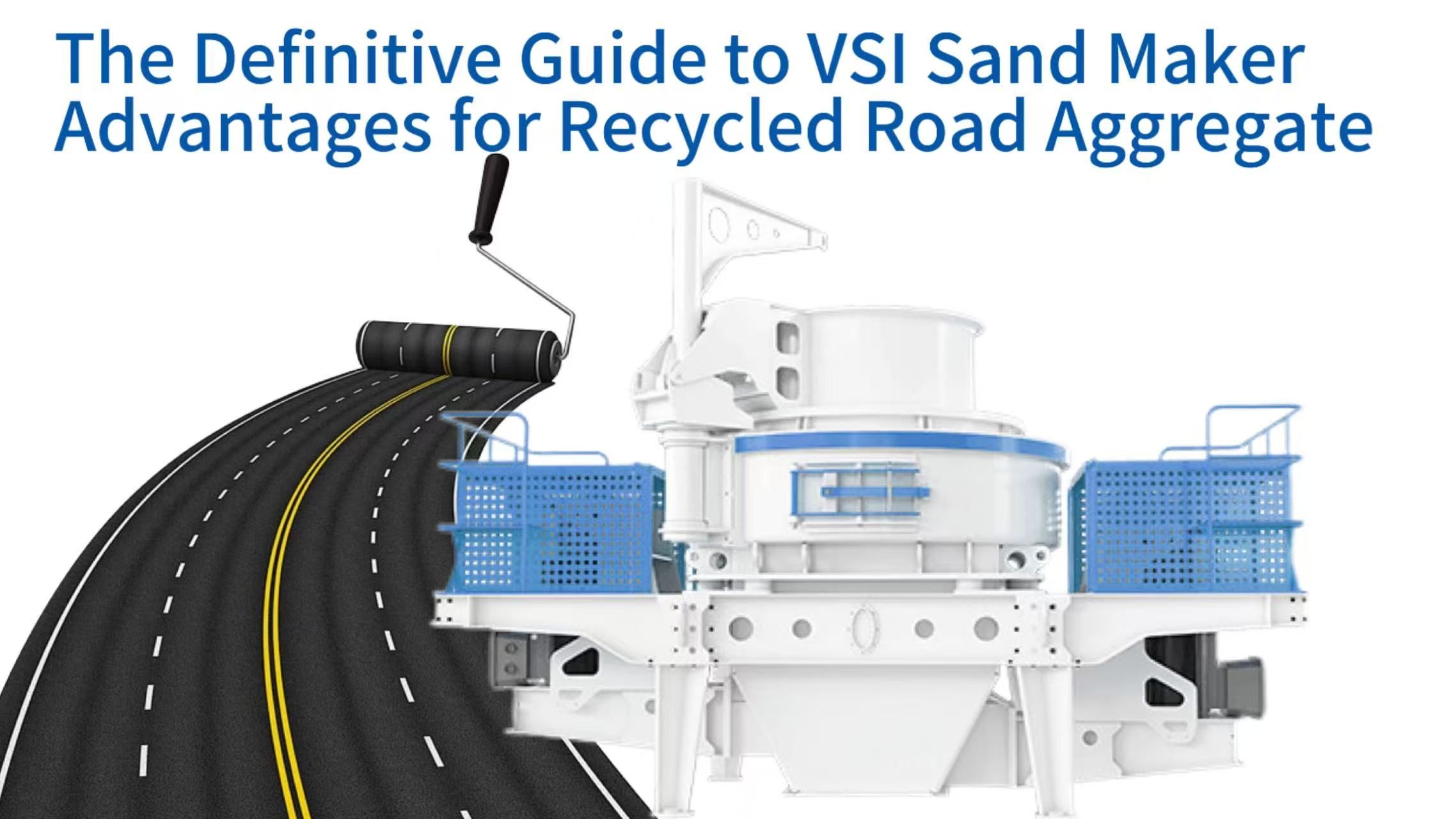
The Definitive Guide to VSI Sand Maker Advantages for Recycled Road Aggregate
VSI Sand Maker - Recycled Road Aggregate Processing Flow
Recycled Materials
(Concrete/RAP/C&D Waste)
VSI Crushing
(Rock-on-Rock/Steel)
Aggregate Refinement
(Shape/Gradation/Cleanliness)
High-Quality Road Aggregate
(Meets Highway Standards)
Core Advantages: Cubical particle shape (flakiness index < 10%), precise gradation control, 15-25% energy saving, up to 50:1 reduction ratio
The global construction industry faces a pressing challenge. Natural sand and gravel resources are diminishing, and environmental regulations are becoming more stringent. This situation has created a growing demand for recycled materials in road building. Using construction debris, old concrete, and reclaimed asphalt to produce road aggregate is now a key practice in sustainable development. Older crushing equipment often struggles with these recycled materials, producing particles with poor shapes, inconsistent size distribution, and excessive dust. These shortcomings make it difficult to meet the strict quality standards required for modern highways. The VSI sand making machine, which operates on the principle of vertical shaft impact, offers a powerful solution. Its unique rock-on-rock and rock-on-steel crushing actions provide significant benefits in shaping particles, optimizing size distribution, and removing contaminants. This article provides a comprehensive explanation of how VSI crushers improve the quality and economic viability of recycled road aggregate, guiding recovery operations toward greater efficiency and sustainability.
Defining the VSI Sand Making Machine and Its Fundamental Operating Principles
VSI Crusher vs Traditional Crushers Comparison
| Feature | VSI Crusher | Cone Crusher | Hammer Crusher |
|---|---|---|---|
| Crushing Principle | Kinetic energy impact (rock-on-rock/steel) | Compression force | Metal hammer impact |
| Primary Function | Particle shaping + fine crushing | Size reduction for hard rocks | General crushing |
| Wear Part Cost | Low (0.5-1.5 currency/ton) | Medium | High |
| Reduction Ratio | Up to 50:1 | 10:1 - 20:1 | 15:1 - 25:1 |
VSI Crusher Operating Modes
Rock-on-Rock Mode
Key Benefits: Excellent particle shape, low wear cost, ideal for road aggregate
Rock-on-Steel Mode
Key Benefits: Higher crushing force, suitable for hard materials
Understanding what a VSI crusher is and how it functions is essential before exploring its specific advantages in recycling. The VSI, or Vertical Shaft Impactor, operates on a principle fundamentally different from other crushing machines. Its design focuses on imparting kinetic energy to materials to achieve size reduction and shape refinement. This section explains the core identity and working mechanisms of this important equipment.
What Exactly is a VSI Sand Making Machine
A VSI sand making machine is a type of crusher that uses a high-speed rotor to throw materials against a hard surface inside a crushing chamber. The full name is Vertical Shaft Impactor. This machine is distinct from traditional compression crushers like jaw crushers or cone crushers. Those machines squeeze rocks to break them. The VSI, however, relies on kinetic energy. It accelerates each piece of material to a high speed and then directs it to impact against other materials or metal surfaces. This process is highly effective for the later stages of crushing, where fine aggregates and precisely shaped particles are needed. In a recycling plant for road materials, the VSI typically serves as the final crusher, taking material that has already been through primary and secondary crushing and refining it into a product that meets road construction specifications. Different models of VSI crushers are engineered to handle various capacities and feed sizes.
The Core Operating Modes: Rock-on-Rock and Rock-on-Steel
The VSI crusher operates in two primary modes, each suited for different objectives. The first is the rock-on-rock mode. In this configuration, material thrown from the rotor impacts a curtain or bed of other material that has accumulated within the crushing chamber. This material lining protects the machine's metal parts from wear. More importantly, the impact between rocks tends to break them along natural weaknesses, producing particles with excellent cubical shapes. This mode is preferred for applications where particle shape is the main priority. The second mode is rock-on-steel. Here, the accelerated material strikes metal anvils or impact plates fixed inside the chamber. This action generates greater crushing force and is effective for processing harder materials or when a higher reduction ratio is required. For producing recycled road aggregate, the rock-on-rock mode is often selected because it yields the best particle shape with lower wear costs.
The Drive System and Rotor Design Engineering
The effectiveness of a VSI crusher depends heavily on its drive system and the design of its rotor. A powerful electric motor provides the necessary energy, typically connected to the rotor via a system of V-belts or a direct drive coupling. The rotor is the mechanical heart of the machine. It is designed to accelerate the incoming material efficiently. Modern rotors feature deep chambers and carefully engineered internal passages that minimize energy loss as material flows through. The speed of the rotor is a critical variable. Some VSI models incorporate variable frequency drives, allowing operators to adjust the rotor speed based on the characteristics of the feed material. This adjustability provides direct control over the final particle size and the gradation curve of the product. The wear components within the rotor, such as the tips and anvils, are manufactured from extremely durable materials like high-chromium iron or ceramic composites to ensure a long operational life. The individual components of a VSI crusher work together to achieve this efficient acceleration.
How the VSI Differs from Other Crushing Machines
The VSI occupies a unique place in the family of crushing equipment. When compared to a cone crusher, the VSI's primary function is different. A cone crusher uses compression to break material and is excellent for reducing the size of hard, abrasive rocks. A VSI, however, is less about brute force reduction and more about particle shaping and producing fine materials. Compared to a hammer crusher, the VSI typically has lower wear part consumption. Hammer crushers rely on the impact of metal hammers, which wear down relatively quickly, especially with abrasive materials. The VSI's rock-on-rock principle significantly reduces metal-to-rock contact. In the sequence of a crushing plant, the cone crusher is often used in the secondary stage to reduce material from 150-200mm down to 30-50mm. The VSI then takes over in the tertiary stage, taking that 30-50mm material and refining it into the specific sizes needed for road construction, often below 20mm. The VSI can achieve a reduction ratio as high as 50 to 1, meaning it can turn larger feed into much smaller product in a single pass, simplifying the overall plant layout.
The Primary Application Advantages of VSI Crushers in Road Aggregate Recycling
VSI Crusher Key Performance Metrics
| Performance Indicator | VSI Crusher | Industry Standard |
|---|---|---|
| Flakiness Index | < 10% | < 15% |
| Reduction Ratio | Up to 50:1 | 20:1 - 30:1 |
| Energy Saving | 15-25% | 0% |
| Wear Part Cost (Currency/Ton) | 0.5-1.5 | 2.0-4.0 |
| Aggregate Gradation Control | Precise | Basic |
Applying VSI technology to the production of recycled road aggregate brings several distinct and measurable benefits. These advantages go beyond simple size reduction. They directly improve the physical properties of the aggregate, enhance the efficiency of the production process, and contribute to lower overall costs. This section details the key improvements that make the VSI a valuable asset in this specific field.
Optimizing Particle Shape and Increasing Cubicity
The shape of individual aggregate particles is critically important for road construction. Pavement layers, both the base and the surface, rely on angular, cubical particles to interlock tightly with each other. This interlock provides the structural strength to bear heavy traffic loads. Flat or elongated particles, often called flaky or needle-shaped pieces, are weak and can break under pressure. They also do not pack together as well, leaving voids that weaken the pavement. The VSI crusher excels at producing cubical particles. The high-energy impacts cause the material to fracture along natural grain boundaries, which tends to produce more equidimensional pieces. The rock-on-rock action effectively chips away sharp protrusions and breaks flat pieces into more cubical shapes. Data from processing plants shows that recycled aggregate processed through a VSI can have its flakiness index reduced to below 10 percent. This level of particle quality meets the stringent requirements for use in high-grade asphalt and concrete pavement layers, far exceeding what is typically achieved with older impact or hammer mills.
Precise Control Over Aggregate Gradation
Road specifications define very precise ranges for the size distribution, or gradation, of aggregate used in each structural layer. For example, a base course material must contain specific percentages of stone from large gravel down to fine sand to achieve maximum density and stability. The VSI crusher gives operators excellent control over this final gradation. By adjusting the rotor speed and the configuration of the crushing chamber, the operator can influence how much fines are produced and the proportions of different size fractions. Increasing the rotor speed generally results in a finer product, while a lower speed yields a coarser output. When the VSI is combined with downstream screening equipment, a recycling plant can consistently produce multiple stockpiles of precisely graded materials, such as 0 to 5 millimeter sand, 5 to 10 millimeter chips, and 10 to 20 millimeter gravel. This capability allows a single plant to supply aggregate for different purposes, from the lower sub-base to the upper wearing course of a road. Understanding the crushing ratio helps in predicting the final product gradation.
Effective Removal of Contaminants and Improved Cleanliness
Recycled materials, especially those from construction and demolition waste, often contain unwanted substances. Common contaminants include pieces of clay brick, fragments of asphalt, wood chips, and soft particles. These impurities are detrimental to road performance. Bricks are generally weaker than concrete, and wood can rot, leaving voids. The VSI crusher helps to address this problem through a process often called selective crushing. The high-velocity impacts preferentially break the weaker, more brittle contaminants like brick and asphalt. The stronger, more desirable concrete particles are more resistant and tend to remain intact. This action effectively liberates the contaminants from the sound aggregate. After the VSI, it becomes much easier for downstream processes, such as air sifting or washing, to separate these crushed impurities from the clean aggregate. The result is a higher quality recycled product with a composition and cleanliness that approaches that of virgin quarried stone.
High Reduction Ratio and Improved Energy Efficiency
The VSI crusher is capable of a very high reduction ratio in a single machine. It can take material with a particle size of 50 to 80 millimeters, which is typical output from a secondary crusher, and reduce it to a final product size of under 25 millimeters, with a significant portion in the sand range. This high reduction ratio can simplify crushing circuits. It may eliminate the need for a separate tertiary crushing stage, reducing the number of machines, conveyors, and transfer points in a plant. Fewer machines translate to lower capital investment and reduced maintenance. Furthermore, the VSI's crushing mechanism is energy-efficient. The conversion of rotational energy into kinetic energy for the rocks is a relatively direct process. When operated in rock-on-rock mode, the energy is used almost entirely for breaking rock, with minimal energy lost to heating metal parts. Field data indicates that VSI crushers can consume 15 to 25 percent less energy per ton of product compared to some traditional fine crushing technologies, leading to significant savings in operational costs over time.
The Types of Recycled Materials Processed by VSI Crushers
Recycled Materials Processed by VSI Crushers
Recycled Concrete Aggregate (RCA)
Separates stone from cement paste
Produces rough, textured surface
Ideal for road bases/sub-bases
Reclaimed Asphalt Pavement (RAP)
Minimizes asphalt smearing/clumping
Preserves aggregate integrity
Suitable for hot/cold mix asphalt
C&D Waste
Handles concrete, bricks, tiles
Low clogging risk
Reduces front-end sorting requirements
Metal Contaminants
Magnetic separation pre-processing
Hardened wear parts for protection
Automatic safety shutdown system
A road recycling facility receives materials from various sources, each with its own unique composition and physical characteristics. The ability of a VSI crusher to handle this diversity is a key reason for its widespread adoption. This machine can adapt its processing to suit different feedstocks, optimizing the output for each type. This section explores how the VSI interacts with the most common recycled materials found in road construction.
Processing Recycled Concrete Aggregate (RCA)
Recycled concrete aggregate is one of the most abundant materials in the recycling stream. It consists of natural stone gravel or crushed rock bound together by hardened cement paste. When this material enters a VSI crusher, the high-speed impacts work to separate the stone particles from the cement paste. The force breaks the bond at the interface between the stone and the cement. This process results in a clean aggregate particle with a rough, textured surface. This rough surface is a significant advantage for road construction. It provides an excellent grip for asphalt binder or cement paste, creating a stronger bond within the new pavement mix. The particles produced from RCA in a VSI are typically angular and have fresh, fractured faces, which are ideal for achieving high stability in road bases and sub-bases. Effective C&D waste recycling relies on this ability to liberate clean aggregate from cementitious materials.
Processing Reclaimed Asphalt Pavement (RAP)
Reclaimed Asphalt Pavement, commonly known as RAP, is old asphalt removed from roads during resurfacing projects. It contains both the stone aggregate and the aged asphalt binder. Processing RAP requires care. Traditional compression crushers can squeeze the material, causing the soft, sticky asphalt to smear and form clumps or flat discs of coated material. This agglomeration is undesirable because it prevents the material from being accurately screened and blended in new mixes. The VSI crusher processes RAP differently. The impact action shatters the material along the boundaries between aggregate particles, effectively separating them without excessive smearing of the asphalt. It breaks the pavement back into its constituent parts. This preserves the integrity of the individual aggregate pieces and keeps the aged asphalt as a separate, fine component. The resulting RAP has a well-defined gradation and can be more easily incorporated into new hot-mix or cold-mix asphalt, maximizing the value of the recovered materials.
Processing Mixed Construction and Demolition Waste
A recycling plant often receives mixed loads of construction and demolition debris. This waste stream is highly heterogeneous, containing concrete, bricks, tiles, ceramics, and sometimes small amounts of wood or plastic. The VSI crusher demonstrates strong adaptability when faced with this mix. Its impact crushing mechanism is effective on both the harder concrete pieces and the softer brick fragments. The machine does not rely on a fixed closed setting like a jaw or cone crusher, so it is less prone to clogging from variable feed sizes. The operator can tune the rotor speed to optimize the breakdown of the softer, more contaminating brick fraction, while still effectively shaping the harder concrete particles. This ability to handle a mixed feed stream simplifies the front-end sorting requirements of a recycling plant, allowing for the processing of a wider range of incoming materials and increasing the overall recycling rate.
Dealing with Incidental Contaminants Like Metal
Despite best efforts at sorting, some metallic contaminants, such as wire mesh, nails, or small rebar fragments, can find their way into the crusher feed. These materials pose a risk to most crushing equipment. VSI crushers are designed with features to mitigate this risk. Most crushing plants integrate powerful overhead magnetic separators on the conveyors feeding the VSI to remove ferrous metals before they enter the machine. For the small pieces that evade magnetic separation, the VSI's rotor design offers some protection. The internal wear parts, such as the rotor tips and distributor plate, are made of extremely hard materials that can withstand occasional contact with small metal objects. Furthermore, some VSI models incorporate safety systems that detect abnormal loads or vibrations and can automatically shut down the feed or the motor to prevent major internal damage if a significant piece of metal enters the chamber.
Detailed Explanation of Key VSI Crusher Technologies and Design
Key VSI Crusher Technologies & Design Features
Rotor Structure
60-80 m/s material speed
CFD optimized flow paths
High-chromium wear tips
Crushing Chamber
Rock-on-rock/steel modes
Self-forming protective liner
Adjustable impact zones
Hydraulic Opening System
Quick maintenance access
Hinged upper assembly
Reduces downtime by 80%
Intelligent Control
Real-time parameter monitoring
Automatic feed rate adjustment
Closed-loop gradation control
The performance of a VSI crusher in demanding recycling applications is a direct result of its sophisticated engineering. Several key technological features and design choices contribute to its efficiency, durability, and ease of operation. Understanding these elements provides deeper insight into why the machine performs so well. This section examines the critical technologies that define a modern VSI crusher.
The Rotor Structure and Material Acceleration Process
The rotor is the single most critical component of the VSI crusher. Material enters the center of the spinning rotor through a feed hopper. Inside the rotor, a distributor cone divides the material evenly into several passages or ports. As the material travels through these radial ports, centrifugal force from the rotor's high-speed rotation accelerates it to tremendous speed, often between 60 and 80 meters per second. The design of these internal passages is crucial. Modern rotors use computational fluid dynamics and discrete element modeling in their design to create smooth, optimized flow paths. This reduces turbulence and wear inside the rotor and ensures that the material is ejected with maximum velocity and in the correct trajectory. The ejecting tips at the rotor's periphery, where the material leaves the rotor, are subject to intense wear and are made from the most durable materials available, designed for quick replacement when they eventually wear out.
Crushing Chamber Design and Wear Control
The chamber surrounding the rotor is where the actual crushing takes place. Its shape and configuration are designed to maximize the number of effective impacts. In a typical VSI, the rotor throws material against a stationary surface. This surface can be either a bed of material (rock-on-rock) or a set of metal anvils (rock-on-steel). In the rock-on-rock configuration, the chamber is designed with shelves or a cascade system that allows material to accumulate and form a natural protective lining. This lining is dynamic, constantly being replenished as old material is knocked away and new material is added. This self-forming liner is the key to the VSI's low wear costs in this mode. It protects the metal structure of the machine from the abrasive action of the rock. The chamber may also incorporate adjustable features that allow the operator to fine-tune the impact zone and the material flow, influencing the final product characteristics. The design of the crushing chamber directly affects throughput and product quality.
Hydraulic Opening System for Maintenance Access
A machine that processes abrasive materials will inevitably require maintenance and replacement of wear parts. The VSI crusher is designed with this reality in mind. One of the most important features for operational uptime is the hydraulic opening system. The upper part of the crusher, including the hopper and the upper chamber section, is hinged. Powerful hydraulic cylinders can lift this entire upper assembly, swinging it clear of the lower section. This action exposes the rotor, the distributor cone, and the upper wear plates for inspection and replacement. This system reduces a maintenance task that could take hours with a crane and manual labor to just a few minutes. Quick and easy access encourages regular inspection and timely replacement of worn parts, which keeps the crusher running at peak efficiency and prevents unexpected breakdowns. The hydraulic system is a critical enabler of productive operation.
Intelligent Control Systems and Automated Operation
Modern VSI crushers are equipped with sophisticated control systems that enhance performance and protect the machine. These systems use programmable logic controllers and sensors to monitor the crusher's condition continuously. Key parameters such as motor amperage, rotor speed, bearing temperatures, and vibration levels are constantly tracked. The information is displayed on a user-friendly touchscreen interface. Operators can set target operating parameters, and the control system can automatically adjust the feed rate to maintain optimal conditions. For example, if the motor load drops, the system can increase the feed rate to maximize production. If the load becomes too high, it can reduce the feed to prevent overloading. More advanced systems can integrate with online particle size analyzers on the product conveyor, creating a closed-loop control system that automatically adjusts crusher settings to maintain a consistent product gradation, compensating for variations in the feed material.
The Core Functions of a VSI Crusher in Road Aggregate Production
VSI Crusher Core Function Weighting
Within the larger context of a recycling plant, the VSI crusher performs several distinct and essential functions. These functions collectively transform raw, crushed debris into a high-value construction material. Each function addresses a specific requirement of the final product, from its physical geometry to the safety and environmental impact of its production. This section details these core operational roles.
The Function of High-Efficiency Particle Shaping
While all crushers reduce size, the VSI's ability to shape particles is its most defining function. The high-speed impacts in the crushing chamber do not just break rocks into smaller pieces; they also refine their geometry. As particles collide with each other, sharp edges are knocked off, and flat pieces are fractured along their weaker dimension. This process results in a final product where the vast majority of particles are roughly equidimensional, or cubical. These cubical particles are the building blocks of a durable road. They pack together tightly, leaving minimal air voids. Their angular faces interlock, providing mechanical strength to resist shearing forces from traffic. This shaping function is what allows recycled aggregate to perform on par with, or sometimes even better than, some natural aggregates in certain pavement applications. The VSI fine crusher is specifically optimized for this final shaping and refining stage.
The Function of Precise Gradation Adjustment
A second key function of the VSI is its ability to fine-tune the particle size distribution of the product. The gradation of an aggregate is a critical quality parameter. A road base material, for instance, requires a well-graded mix of coarse and fine particles to achieve maximum density. The VSI provides the operator with tools to control this gradation. By varying the rotor speed, the operator changes the energy of impact. Higher speeds impart more energy, leading to more breakage and a finer overall product. By adjusting the feed rate and the configuration of the crushing chamber, the operator can also influence the shape of the gradation curve. This adjustability means a single VSI model can be configured to produce a coarse material for a drainage layer one day and a finer, sand-rich material for an asphalt mix the next, providing great operational flexibility to the recycling plant.
The Function of Overload Protection and Safe Operation
Operating a heavy industrial machine safely is a primary concern. The VSI crusher is equipped with multiple systems designed to protect both the equipment and the personnel around it. Electronic sensors constantly monitor the machine's vital signs. If the control system detects an overload condition, such as a sudden spike in motor amperage from an excessive feed rate, it can automatically reduce or stop the feed to the crusher. Vibration sensors can detect imbalance in the rotor, which might indicate uneven wear or a foreign object stuck inside, and shut down the machine before damage occurs. Bearing temperature sensors prevent overheating and potential bearing failure. Some VSI models are also built with pressure relief panels designed to open in the unlikely event of an internal explosion from combustible dust, safely venting the pressure and protecting the main structure of the machine. These safety functions ensure continuous and reliable operation.
The Function of Dust Suppression and Environmental Control
Processing dry, crushed rock inevitably generates dust, which is both an environmental concern and a health hazard. Modern VSI crushers are designed with features to minimize this problem. The machine itself is typically fully enclosed, with sealing gaskets at flange joints to prevent dust leakage. The crushing chamber operates under negative pressure when connected to a central dust collection system, which pulls dusty air away from the process. For operations without a central system, many VSI installations include water spray bars at the feed point and at discharge points. A fine mist of water suppresses dust at its source. The design of the machine also aims to reduce noise pollution. Features like rubber linings in chutes and impact zones, as well as the use of sound-dampening materials on the machine housing, help to lower operational noise levels. This makes the VSI a more environmentally friendly option, particularly for recycling facilities located near urban areas.
The Strategic Value and Return on Investment for Recycling Companies
VSI Crusher Financial Metrics (300,000 Tons/Year Operation)
| Financial Indicator | Value (Currency Units) | Notes |
|---|---|---|
| Total Investment | 200,000 - 300,000 | VSI + screens + conveyors |
| Additional Annual Profit | 80,000 - 120,000 | Price premium + cost savings |
| Price Premium for VSI Aggregate | 20 - 40% | vs unprocessed recycled material |
| Payback Period | 2 - 3 Years | Can be < 18 months (high demand) |
Investing in a VSI crusher is a significant financial decision for any recycling company. The justification for this investment lies not just in the machine's technical capabilities, but in the tangible economic value it can generate. A VSI can transform a low-value waste product into a high-specification construction material, while also reducing production costs. This section analyzes the financial and strategic benefits that a VSI crusher brings to a recycling business. Aggregate processing solutions like the VSI are central to improving profitability.
Increasing Product Value and Accessing Premium Markets
Recycled aggregate that has been processed through a VSI crusher is a premium product. Its superior particle shape, consistent gradation, and improved cleanliness make it a direct substitute for natural aggregates in many applications. This quality allows it to command a higher price in the market. While basic crushed concrete might be suitable only as fill material, VSI-shaped aggregate can be sold for use in high-value applications such as highway base courses, drainage layers, and even as a component in new asphalt and concrete mixes. The price premium for this high-quality recycled aggregate can be significant, often 20 to 40 percent higher than unprocessed or poorly shaped recycled material. This enables a recycling company to move beyond competing on price alone and to access more lucrative markets, improving profit margins on every ton of material processed.
Reducing Operational Costs Through Efficiency and Lower Wear
The VSI crusher contributes to lower operational costs in several ways. Its high reduction ratio can simplify the crushing circuit, potentially allowing a company to achieve its production goals with fewer machines. Fewer machines mean lower power consumption, less maintenance labor, and reduced capital tied up in equipment. The wear costs of operating a VSI in rock-on-rock mode are notably low. By using a bed of material to protect the metal surfaces, the machine minimizes the consumption of expensive wear parts. Data from operating plants shows that wear part costs for a VSI in aggregate production can be in the range of 0.5 to 1.5 units of currency per ton of material produced. This is significantly lower than the wear costs associated with machines that rely on metal-to-rock impact. The combination of energy efficiency and low wear translates directly to a lower cost per ton, a fundamental metric of profitability in the recycling industry. Different VSI crusher types offer varying levels of wear resistance and efficiency.
Reducing Labor Requirements with Automation
Automation technology built into modern VSI crushers reduces the need for constant operator attention. The intelligent control system manages the feed rate and monitors the machine's health automatically. Instead of requiring a dedicated operator at the crusher station, one or two plant supervisors can oversee the entire operation, including the VSI, from a central control room. This reduces direct labor costs. Furthermore, automated systems improve product consistency. By maintaining optimal operating conditions automatically, the system ensures that the product quality remains stable, reducing the amount of material that might be rejected for being out of specification. This reduction in waste and rework further improves the plant's overall efficiency and profitability. The investment in automation pays for itself through these savings in labor and improved product consistency.
Analyzing the Investment Payback Period
The financial case for a VSI crusher is often compelling. Consider a typical recycling operation processing around 300,000 tons of material per year. The investment in a VSI crusher and the necessary supporting equipment, such as screens and conveyors, might be in the range of 200,000 to 300,000 units of currency, depending on the scale and specifications. The combination of a higher selling price for the improved product and lower production costs can generate an additional profit of 80,000 to 120,000 units of currency per year. Based on this, the payback period for the investment is often between two and three years. In regions where natural aggregate prices are high or where there is strong demand for premium recycled materials, the payback period can be even shorter, sometimes less than 18 months. This rapid return on investment makes the VSI crusher not just a piece of equipment, but a strategic tool for business growth. Companies like MSW Technology, building on fifteen years of focused experience in crushing technology, provide the expertise to guide this integration.