On-Site Demolition Waste Crushing: The Advantages of Using a Mobile Crusher
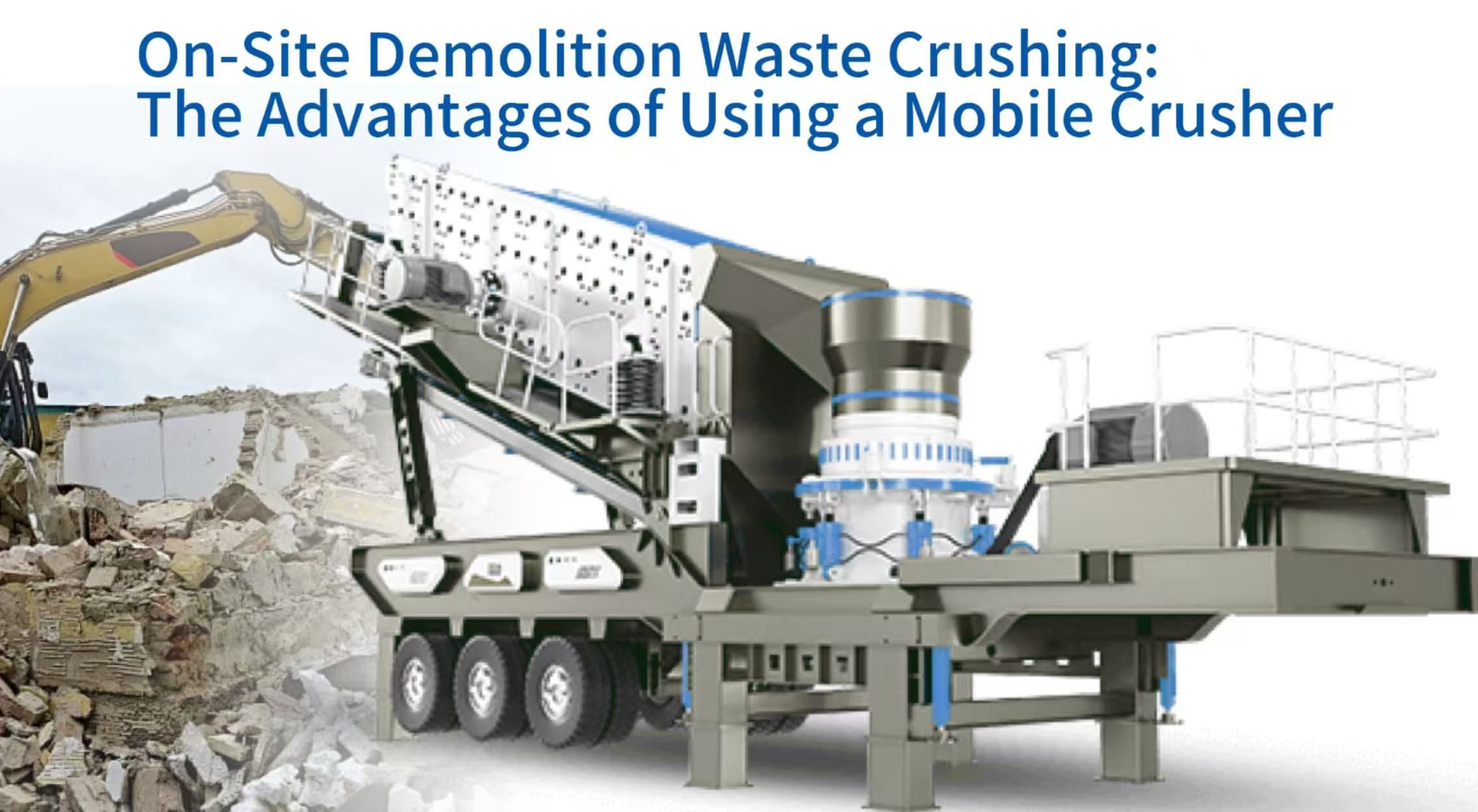
The demolition industry today stands at a crossroads shaped by accelerating urban renewal and increasingly stringent environmental regulations. Traditional demolition practices have long followed a linear sequence of explosive dismantling, waste haulage, and off-site landfilling or processing. This conventional model carries significant burdens including high transportation expenses, considerable environmental pollution, and substantial waste of potentially reusable materials. As the volume of construction and demolition waste continues to rise, landfill capacity grows ever tighter, and the principles of circular economy gain widespread acceptance, the industry faces a pressing need to process and reuse demolition debris directly at the source. The emergence of mobile crushers provides a direct answer to this challenge. These machines integrate a powerful crushing unit onto a mobile chassis, allowing them to be driven directly onto demolition sites where they transform waste concrete, bricks, and stones into high-quality recycled aggregates on the spot. This creates a seamless workflow that combines demolition, crushing, and material reuse into one integrated operation. This article systematically examines the seven core advantages of applying mobile crushers in demolition projects, including the elimination of transportation costs, immediate material reuse on site, enhanced operational efficiency, improved safety, reduced environmental impact, adaptability to confined spaces, and significant economic returns. It aims to provide demolition contractors with professional technical insights and decision-making support as they transition toward greener, more sustainable practices.
Fundamental Definition and Core Operating Principles of Mobile Crushers
Mobile Crusher Core System Architecture
Mobile Chassis
Crawler/wheeled undercarriage
All-terrain mobility
On-site maneuverability
Power Unit
High-horsepower diesel engine
Electric motor option
Hydraulic power supply
Crushing Unit
Impact crusher (reinforced concrete)
Jaw crusher (large chunks)
Adjustable crushing settings
Support Systems
Pre-screening feed system
Magnetic metal separation
PLC control & automation
Core Advantage: Unlike stationary crushers requiring concrete foundations and permanent installation, mobile crushers integrate all subsystems into a single mobile unit that can be operational within hours of arriving on site, with full remote control capability and real-time performance monitoring.
A mobile crusher is a complete crushing system that integrates a crusher unit, feeding mechanism, conveyors, and power source onto a crawler‑mounted or wheeled chassis, specifically engineered for field operations in remote or temporary locations. Unlike stationary crushers that require concrete foundations and permanent installation, mobile crushers can drive directly onto a job site and be operational within hours. Their core value proposition lies in reversing the traditional logistics model: instead of hauling materials to a fixed crusher, the crusher itself travels to the material, fundamentally transforming the economics and efficiency of demolition waste processing.
The technical architecture of a mobile crusher comprises several essential subsystems. The power unit, typically a high‑horsepower diesel engine or an electric motor, supplies the energy needed for both travel and crushing. The crushing unit itself is selected based on the material characteristics; demolition sites most commonly employ mobile impact crushers for processing reinforced concrete and mobile jaw crushers for handling large concrete chunks. The feeding system often includes a vibrating feeder and a pre‑screening device that removes fines and contaminants before they enter the crushing chamber. The conveying system, comprising a main belt, side discharge belts, and magnetic separators, sorts the finished product and automatically extracts metal reinforcements. The entire machine is coordinated through hydraulic systems and a PLC control unit, allowing an operator to manage travel, crushing parameters, and adjustments via a remote control or an in‑cab panel.
Integrated Mobile Chassis and Crushing Unit
The heart of a mobile crusher is the deep integration between its traveling undercarriage and the crushing mechanism. Heavy‑duty crawler tracks provide exceptional ground pressure distribution, enabling the machine to move steadily over the uneven piles of rubble that cover a demolition site. The tracks can be steered independently, allowing the crusher to turn in place and navigate through narrow passages that would be inaccessible to wheeled vehicles. This mobility means the crusher can always position itself at the optimal distance from the excavator feeding it, minimizing cycle times and maximizing productivity.
At the same time, the crusher unit itself is engineered with weight reduction in mind. Manufacturers use high‑strength steels and optimized structural designs to maintain crushing force while keeping the overall machine weight within legal limits for road transport. The result is a machine that combines the ruggedness of a stationary crusher with the agility of a mobile vehicle. For demolition contractors, this means they can bring heavy‑duty processing capability directly to the point of demolition, eliminating the need for intermediate material handling and reducing the overall equipment fleet required on site.
Advanced Control and Automation Systems
Modern mobile crushers are equipped with sophisticated electronic control systems that continuously monitor and adjust the machine's performance. Sensors track parameters such as engine speed, hydraulic oil temperature, crusher load, and conveyor belt speed. The control system uses this data to automatically regulate the feed rate, ensuring that the crusher operates at its optimal capacity without becoming overloaded. If the system detects an impending blockage or an uncrushable object entering the chamber, it can reverse the feed or stop the belt to prevent damage.
This level of automation reduces the need for constant operator intervention and allows a single person to manage the entire crushing process. Many mobile crushers also feature remote monitoring capabilities, enabling fleet managers to track machine performance, fuel consumption, and maintenance needs from a central office. The integration of smart controls transforms the mobile crusher from a simple mechanical tool into an intelligent processing unit that adapts to changing feed conditions, maximizing throughput while protecting itself from harm.
Feed System with Pre‑Screening Capability
One of the key design features that sets mobile crushers apart from their stationary counterparts is the inclusion of a robust feed system that often incorporates a vibrating grizzly feeder. As material is dumped into the hopper, the feeder moves it forward while the grizzly section separates fines and small particles before they reach the crusher. This pre‑screening function serves multiple purposes: it removes dirt and debris that could contaminate the final product, it bypasses material that is already small enough, thereby increasing overall capacity, and it reduces the amount of material entering the crusher, lowering wear on the crushing chamber.
The vibrating feeder also helps to meter the material flow, ensuring a steady and consistent feed to the crusher. This is particularly important for demolition waste, which can vary widely in size and composition. By smoothing out the surges, the feeder allows the crusher to operate at a steady state, improving efficiency and reducing the risk of blockages. Some mobile crushers also incorporate an independent pre‑screen unit that can be hydraulically lowered for maintenance or raised for transport, adding to the machine's versatility.
Magnetic Separation and Metal Recovery
Demolition concrete almost always contains steel reinforcement, which must be removed before the crushed material can be reused as aggregate. Mobile crushers address this need through integrated magnetic separation systems. A powerful over‑belt magnet is suspended above the main discharge conveyor; as the crushed material passes underneath, the magnet attracts and lifts any ferrous metals, which are then diverted to a side discharge conveyor. This process automatically separates clean scrap metal from the crushed concrete, producing two valuable product streams from one operation.
The recovered steel is clean and ready for sale to scrap metal recyclers, adding a significant revenue stream to the demolition project. Meanwhile, the remaining concrete aggregate is free of metal contaminants, making it suitable for a wide range of applications in construction and civil engineering. The integration of magnetic separation directly into the mobile crusher eliminates the need for separate sorting equipment and reduces manual handling, further streamlining the on‑site processing workflow.
Eliminating Demolition Waste Haulage Costs: Achieving Zero Transportation Expense
Haulage Cost Comparison: Traditional vs Mobile Crushing
50,000 Ton Demolition Project
Total Savings: $1.75M - $8M
20,000 m² Building Demolition
Typical Concrete Rubble:
30,000+ Tons
Haulage Cost Eliminated: $600,000 - $2.4M
Fill Material Savings: $150,000 - $900,000
Combined Savings: $750,000+
In traditional demolition projects, the cost of hauling away debris often accounts for a substantial portion of the overall budget. Contractors must organize fleets of dump trucks to transport crushed concrete, bricks, and rubble to landfills or processing facilities that may be tens of kilometers away, paying both transportation fees and disposal charges. Simultaneously, new construction on the same site often requires the purchase of imported aggregates for backfill, road base, or other applications, creating a double expense: paying to remove waste and paying again to bring in virgin material. On‑site crushing with a mobile crusher completely overturns this costly equation.
When a mobile crusher is deployed on a demolition site, the waste material that would otherwise require trucking is transformed directly into usable aggregate. Consider a typical urban demolition project involving a 20,000‑square‑meter building; the resulting concrete rubble can amount to tens of thousands of tons. Under the traditional haul‑and‑dump model, transportation alone could cost hundreds of thousands of dollars. With a mobile crusher on site, that same material is crushed and screened on the spot, eliminating the need for any haulage whatsoever. The transportation cost effectively falls to zero, and the crushed aggregate can be immediately reused for site backfill, temporary road construction, or later phases of the project, also eliminating the cost of purchasing imported fill.
Calculating the Savings: How Much Haulage Really Costs
The financial impact of haulage extends beyond the simple cost per ton of trucking. Each dump truck movement generates expenses for fuel, driver wages, vehicle maintenance, and insurance. In urban areas, traffic congestion can further increase cycle times, requiring more trucks to maintain the same disposal rate. Moreover, landfills and recycling centers charge tipping fees that can range from tens to hundreds of dollars per ton depending on the region and the type of waste. When all these factors are added together, the total cost of off‑site disposal often reaches figures that surprise contractors who have not previously analyzed them in detail.
Mobile crushers eliminate these variable costs entirely. Once the machine is on site, the only costs associated with waste handling are the operation of the crusher itself and the excavator that feeds it. Because the finished aggregate remains on site, there are no tipping fees and no transportation expenses. For a project generating 50,000 tons of demolition waste, the savings in avoided haulage and disposal can easily exceed one million dollars. This direct, quantifiable benefit is often the single most compelling reason for demolition contractors to invest in mobile crushing equipment.
Overcoming Urban Traffic Restrictions and Night Work Limitations
Many large cities impose strict regulations on the movement of dump trucks to reduce traffic congestion and noise during nighttime hours. Trucks may be banned from certain routes during peak times or restricted to overnight operations, which complicates logistics and increases labor costs because drivers must work night shifts. These restrictions can significantly extend the duration of a demolition project, as waste removal becomes a bottleneck that only operates during limited windows.
On‑site crushing with a mobile crusher is completely independent of urban traffic rules. The machine operates entirely within the boundaries of the demolition site, processing waste 24 hours a day if needed, without ever entering public roads. This freedom allows the project schedule to be driven by demolition and crushing capacity alone, not by the availability of trucking windows. For projects in densely populated areas, this can shorten the overall timeline by weeks and eliminate the community complaints that often accompany nighttime truck movements.
Avoiding Spillage, Dust, and Secondary Pollution During Transport
Even when trucks are permitted to haul waste, the process itself creates environmental nuisances. Loaded trucks can spill debris on public roads, requiring cleanup and potentially causing hazards for other vehicles. The repeated passage of heavy trucks can damage road surfaces, leading to repair costs that may be charged back to the project. Dust generated during loading and unloading can drift into neighboring properties, prompting complaints and regulatory scrutiny.
By eliminating truck movements entirely, on‑site crushing avoids all of these secondary impacts. The material is loaded once by an excavator directly into the crusher hopper, and the crushed product is stockpiled on site. There is no opportunity for spillage on public roads, no dust from multiple loading points, and no wear and tear on municipal infrastructure. For demolition contractors working in environmentally sensitive or highly regulated areas, this aspect of mobile crushing can be the deciding factor in winning a contract.
Reducing the Carbon Footprint of Demolition Projects
Sustainability has become a major consideration in construction and demolition, with project owners increasingly requiring carbon footprint calculations as part of their procurement processes. The transportation of demolition waste by diesel‑powered trucks generates significant greenhouse gas emissions, particularly when landfills are located far from urban centers. A study in Europe found that transportation can account for more than half of the total carbon emissions associated with demolition waste management.
On‑site crushing with a mobile crusher drastically cuts these emissions. The only fuel consumed is that used by the crusher itself and the excavator feeding it, which is typically far less than what would be burned by a fleet of trucks making dozens or hundreds of round trips. This reduction in carbon footprint can be a powerful marketing tool for demolition contractors, enabling them to offer a green alternative to traditional methods and to qualify for projects that require sustainability certifications.
Immediate On‑Site Resource Recovery: Transforming Demolition Waste into Valuable Materials
Demolition Waste Resource Recovery & Utilization
Recycled Material Value & Applications
| Material Type | Value (per ton) | Primary Applications |
|---|---|---|
| Recycled Concrete Aggregate | $5 - $25 | Road base, backfill, pipe bedding, new concrete |
| Recovered Steel Reinforcement | $100 - $400 | Scrap metal recycling, steel production |
| Crushed Brick/Stone | $3 - $15 | Landscaping, drainage layers, lightweight fill |
Steel Recovery Example: 50,000 tons of reinforced concrete (3-5% steel content) = 1,500-2,500 tons of scrap steel = $150,000-$1,000,000 in additional revenue.
The most profound change brought by mobile crushers is the way they redefine the nature of demolition waste itself. Under the traditional view, concrete rubble and broken bricks are liabilities—materials that must be paid to remove. When a mobile crusher is introduced, these same materials become assets, capable of generating revenue or offsetting costs. This transformation happens instantly at the demolition site, without the delays and added expenses of hauling material to a centralized recycling facility.
The crushed product from a mobile crusher can be put to immediate use in a wide range of applications. Properly processed recycled concrete aggregate meets the specifications for many construction uses, including road base, backfill for utility trenches, and even as aggregate in new concrete when carefully controlled. In Germany, a government office building was recently demolished and rebuilt on the same site; the contractor used a mobile impact crusher to process the demolition debris, and more than 90 percent of the resulting material was reused in the construction of the new building, creating a closed‑loop material flow that would have been impossible without on‑site processing.
Production of High‑Quality Recycled Aggregates for Immediate Use
Modern mobile crushers, especially those equipped with impact crushers, are capable of producing aggregates that meet stringent specifications. The material can be crushed to a desired gradation, typically 0‑40 millimeters, which is ideal for use as a base course under temporary roads or as fill material behind retaining walls. When combined with a mobile screen, the crusher can produce multiple product sizes in a single pass, such as 0‑20 mm for fine fill and 20‑40 mm for drainage layers. This on‑demand production eliminates the need to stockpile waste and then later import aggregates, saving both time and money.
The quality of recycled aggregates from demolition concrete is often comparable to that of natural crushed stone. Studies have shown that the physical properties, such as density, water absorption, and Los Angeles abrasion loss, are within acceptable ranges for many construction applications. By adjusting the crusher settings and incorporating screening, contractors can produce material that meets local road authority specifications, allowing it to be used in permanent works rather than just temporary fills.
Recovery of Scrap Metal as a Secondary Revenue Stream
Demolition concrete typically contains steel reinforcement that represents a significant embedded value. In traditional demolition, this steel is often lost when the concrete is hauled to a landfill or is difficult to separate even if the concrete is processed off‑site. Mobile crushers solve this problem by integrating magnetic separation directly into the material flow. As the crushed concrete exits the crusher, an overhead magnet lifts out the steel reinforcement, which is then diverted to a stockpile via a side conveyor. The recovered steel is clean and free of concrete, commanding a higher price from scrap dealers.
The revenue from scrap steel can be substantial. Typical reinforced concrete contains between 3 and 5 percent steel by weight. For a project generating 50,000 tons of concrete rubble, this translates into 1,500 to 2,500 tons of scrap steel. At current market prices, that adds up to a significant sum that can offset a portion of the crushing costs or contribute directly to project profit. In some cases, the value of the recovered steel alone can cover a significant fraction of the mobile crusher's operating expenses.
Reducing Dependence on Virgin Quarried Materials
Every ton of recycled aggregate used on site is a ton of natural aggregate that does not need to be quarried, transported, and processed. This has both economic and environmental benefits. Quarrying consumes energy, disturbs landscapes, and generates its own environmental impacts. By substituting recycled material, demolition contractors help conserve natural resources and reduce the overall environmental footprint of construction. This aligns with the principles of the circular economy, where materials are kept in use for as long as possible.
For project owners, using recycled aggregates can contribute to green building certifications such as LEED or BREEAM, which award points for materials reuse and waste reduction. As such certifications become more common in both public and private construction, the ability to supply recycled material on site gives demolition contractors a competitive advantage. They are not just disposing of waste; they are supplying a valuable raw material that helps their clients meet sustainability goals.
Eliminating the Environmental Burdens of Landfilling
Landfilling demolition waste carries environmental consequences beyond the simple loss of material. Landfills occupy land that could otherwise be used for productive purposes, and they can generate leachate and methane if not properly managed. In many regions, landfill capacity is limited and tipping fees are high, reflecting the true cost of disposal. By diverting demolition waste from landfills through on‑site crushing, contractors help extend the life of existing landfills and reduce the demand for new ones.
Furthermore, on‑site crushing eliminates the environmental risks associated with transporting waste to landfills. Every truck journey carries the possibility of accidents, spills, or emissions that affect local communities. By processing material where it is generated, these risks are avoided entirely. For demolition projects in environmentally sensitive areas or near residential neighborhoods, this can be a decisive factor in gaining permits and maintaining community support.
Significantly Enhancing Demolition Site Efficiency and Compressing Project Timelines
Demolition Workflow & Productivity Comparison
Traditional Workflow (Batch Processing)
Key Issues: Multiple material handlings, truck waiting times, traffic delays, 400-800 tons/day maximum processing rate.
Mobile Crushing Workflow (Continuous Flow)
Key Benefits: Single material handling, no truck delays, 1,800+ tons/day processing rate (European contractor data), 30-50% faster project completion.
Productivity & Efficiency Metrics
30-50%
Project Timeline Reduction
80%
Reduction in Material Handling
1,800+
Tons Processed Per Day
40-60%
Fuel Consumption Reduction
Time is money in demolition projects, and the traditional sequence of demolish‑haul‑fill often creates inefficiencies that stretch schedules unnecessarily. The haulage phase, in particular, is prone to delays caused by traffic, weather, and the limited availability of trucks. Mobile crushers address this bottleneck by integrating crushing directly into the demolition workflow, allowing material to be processed as fast as it is produced.
With a mobile crusher on site, the operation becomes a continuous flow: an excavator feeds the crusher, which discharges crushed material onto a conveyor that stockpiles it in a designated area. There is no waiting for trucks to return from the landfill, no accumulation of rubble that blocks access to the working face, and no need to coordinate multiple subcontractors. This streamlined workflow maximizes the utilization of both the excavator and the crusher, ensuring that every hour on site contributes to progress.
Creating a Continuous Flow from Demolition to Processed Stockpile
When demolition and crushing are synchronized, the site operates like a production line rather than a batch process. As the excavator pulls down a section of the building, it immediately feeds the resulting rubble into the crusher hopper. The crusher processes it, and the finished aggregate is stockpiled just a few meters away. This continuous loop eliminates the need for intermediate stockpiles, which take up valuable space and require double handling. It also keeps the working area clear, allowing the demolition to proceed without interruption.
Data from demolition contractors who have adopted mobile crushing shows that this integrated approach can significantly increase overall productivity. One European contractor reported that using a mobile impact crusher in tandem with an excavator allowed them to process up to 1,800 tons of material per day, which matched the output rate of their demolition activities. This meant that at the end of each day, the site was clear of debris and ready for the next phase of work, avoiding the accumulation that often slows down traditional projects.
Eliminating Multiple Material Handlings
In the traditional model, demolition waste is handled multiple times: it is loaded onto a truck, unloaded at the landfill or recycling center, possibly loaded again for processing, and then the processed material may be loaded again for return to the site if it is to be reused. Each handling step adds cost and increases the risk of damage to equipment or injury to workers. Mobile crushers reduce this to a single handling: material is loaded once by the excavator into the crusher, and after that it is moved only by conveyors or front‑end loaders for final placement.
This reduction in handling has a direct impact on project costs. Fewer loaders and trucks are required, fuel consumption is lower, and labor costs are reduced. Moreover, the risk of accidents decreases because fewer machines are operating on site and material is not being moved on public roads. The simplicity of the workflow also makes it easier to manage, allowing a smaller supervisory team to oversee the entire operation.
Integrating Crushing and Screening in a Single Pass
Advanced mobile crushers now offer the ability to integrate a screening unit directly onto the same chassis, creating a closed‑circuit crushing and screening plant. In this configuration, the crushed material is conveyed to a screen that separates it into two or more size fractions. Oversize material is returned to the crusher for further reduction, while the finished products are stockpiled separately. This integration eliminates the need for a separate screening plant and the additional conveyors that would otherwise be required.
The ability to produce multiple precisely sized products in one pass is particularly valuable on demolition sites where the recycled aggregate will be used for different purposes. For example, a contractor might produce 0‑20 mm material for pipe bedding and 20‑40 mm material for drainage layers, all from the same feed. This flexibility allows the project to source its own materials on site, eliminating the need to purchase and import different aggregate grades.
Reducing Fuel Consumption Through Simplified Logistics
The fuel saved by eliminating truck haulage is substantial, but mobile crushers also contribute to fuel efficiency in other ways. Because the crusher stays close to the demolition face, the excavator's travel distance between the pile and the crusher is minimized. This reduces the excavator's cycle time and the amount of fuel it burns. Similarly, the crusher's own engine is designed to operate at optimal efficiency under varying loads, with electronic controls that adjust fuel delivery to match demand.
When all these factors are combined, the overall fuel consumption per ton of material processed can be significantly lower than in traditional methods. This not only reduces operating costs but also lowers the project's carbon footprint, contributing to environmental goals. For contractors who track fuel usage as a key performance indicator, mobile crushing often proves to be the most fuel‑efficient way to handle demolition waste.
Effectively Reducing Dust and Noise for a Greener Demolition Site
Environmental Impact Comparison: Dust & Noise
Green Building Certification Benefits
LEED Certification Points
Waste Diversion (2-4 points)
Recycled Content (1-2 points)
Reduced Transportation Impacts (1 point)
Total: 4-7 additional points
BREEAM Certification Credits
Waste Management (6-8 credits)
Materials & Resources (3-5 credits)
Pollution Control (2-3 credits)
Total: 11-16 additional credits
Environmental regulations are tightening around the world, and demolition sites are increasingly subject to scrutiny from regulators and nearby residents. Dust and noise are the two most common sources of complaints, and they can lead to fines, work stoppages, and damage to a contractor's reputation. Mobile crushers are designed with these concerns in mind, incorporating features that minimize emissions and keep the site cleaner and quieter than traditional operations.
The key difference lies in the containment of dust and the reduction of traffic‑related noise. In a traditional demolition project, dust is generated at multiple points: during loading of trucks, during transport on unpaved site roads, and during dumping at the landfill. Each of these sources is difficult to control. With a mobile crusher, all processing occurs at a single point, where dust suppression measures can be focused and effective. The elimination of truck movements also removes the primary source of noise on many sites, as a single crusher is far quieter than a fleet of trucks coming and going.
Enclosed Crushing Chambers and Integrated Dust Suppression
Modern mobile crushers feature fully enclosed crushing chambers that contain dust generated during the breaking of concrete. The material is crushed inside a heavy‑d steel housing, and any dust that escapes is captured by a series of water spray nozzles positioned at key points: the crusher inlet, the discharge conveyor, and any transfer points. These sprays create a fine mist that binds dust particles and prevents them from becoming airborne. The water consumption is carefully controlled to provide effective suppression without saturating the material.
Some mobile crushers also incorporate foam dust suppression systems that use a mixture of water and foaming agent to create a blanket over the material. Foam is particularly effective at controlling dust from dry, fine materials and can reduce water consumption compared to traditional sprays. These integrated systems mean that a mobile crusher can operate in compliance with even the most stringent air quality regulations, allowing demolition to proceed in areas where traditional methods would be prohibited.
Reducing Noise Compared to Truck Fleets
The noise generated by a single mobile crusher is often less noticeable than the cumulative noise of multiple trucks arriving, loading, and departing throughout the day. Trucks produce noise from their engines, from the beeping of backup alarms, and from the impact of material being dumped into the bed. A mobile crusher, by contrast, produces a steady, low‑frequency sound that is easier to attenuate with barriers and less likely to disturb neighbors. Many modern crushers are also equipped with sound‑deadening panels around the engine and crusher, further reducing noise emissions.
For projects in residential areas, this difference can be critical. Contractors using mobile crushers have reported fewer noise complaints and have been able to work longer hours because the noise level remains within acceptable limits. In some cases, regulators have granted permits for on‑site crushing that would not have been allowed for traditional haul‑and‑dump operations, recognizing that the environmental impact is lower.
Controlling Dust at the Source Rather Than Along Transport Routes
In a traditional demolition project, dust is not only generated at the site but also along the truck routes leading away from it. Even if the site itself is well managed, trucks can pick up dust on their tires and deposit it on public roads, or the wind can blow dust from uncovered loads. This secondary dust is difficult to control and often leads to complaints from residents living along the haul route. On‑site crushing eliminates this problem entirely because no trucks leave the site carrying loose material.
The only potential dust sources are the crusher itself and the stockpiles of finished material. Stockpiles can be controlled with water sprays or covered with tarps if necessary. By concentrating all dust‑generating activities in one location, the contractor can implement effective control measures that would be impractical for a dispersed set of sources. This focus simplifies compliance with environmental regulations and reduces the risk of fines or shutdowns.
Meeting Green Building and Sustainability Certification Requirements
Green building certifications such as LEED and BREEAM award points for construction waste management and the use of recycled materials. Projects that achieve high levels of certification can command higher rents or sale prices, and they are increasingly preferred by tenants and buyers. Demolition contractors who can demonstrate that they processed waste on site and supplied recycled aggregate for the new construction contribute directly to these certification goals.
On‑site crushing with a mobile crusher allows the project team to document the waste diversion rate accurately, since all material is processed and tracked on site. This documentation is essential for certification applications. Moreover, the use of recycled aggregate reduces the demand for virgin materials, which also earns points. For demolition contractors, the ability to support their clients' sustainability objectives is a valuable differentiator that can open doors to higher‑value projects and long‑term partnerships.
Flexible Adaptation to Complex Demolition Sites and Confined Spaces
Mobile Crusher Mobility & Space Utilization
Key Mobility Features
Crawler Track Undercarriage
Even ground pressure distribution, operation on uneven rubble, 15-20° slope capability, 360° in-place turning.
Compact Design
Width: 2.5-3.5m (same as standard dump truck), height: 3-4m, navigation through narrow urban passages and alleyways.
Underground Capability
Specialized models for tunnels/basements, remote control operation, low-emission engines, reinforced safety features.
Rapid Repositioning
Self-propelled (no tow truck needed), reposition in < 10 minutes, follow demolition face as it advances.
Space Utilization Comparison
Traditional Site (Batch Processing)
Mobile Crushing Site (Continuous Flow)
Key Benefits:
• 60% reduction in required stockpile space
• 45% more working space for demolition activities
• 70% reduction in material handling paths
• Crushed material volume reduced by 30-40% vs raw rubble
Urban demolition projects often take place in challenging environments: buildings crowded together, narrow streets, limited space for equipment staging, and sites that change as demolition progresses. Traditional stationary crushers are ill‑suited to these conditions because they require a large, level area for installation and are difficult to relocate. Mobile crushers, by contrast, excel in precisely these situations, offering the flexibility to move with the job and to operate in spaces that would be impossible for fixed plants.
The crawler‑mounted design of most mobile crushers allows them to traverse rough terrain, climb moderate slopes, and position themselves exactly where they are needed. They can follow the demolition face as it advances, staying within a short distance of the excavator to minimize haulage. In sites with limited space, the compact footprint of a mobile crusher means it can be placed in a corner or against a wall, leaving the rest of the area clear for other activities.
Navigating Narrow Passages and Tight Urban Sites
Many city demolition sites are hemmed in by adjacent buildings, fences, and roads, leaving only a narrow corridor for equipment access. Mobile crushers, particularly those with a compact design, can navigate these confined spaces thanks to their articulated tracks and ability to turn in place. Some models are no wider than a standard dump truck, allowing them to pass through gates and along alleys that would block larger equipment. Once inside, they can position themselves to receive material from the excavator without blocking the only access route.
This maneuverability is a game‑changer for contractors working in historic districts or other areas where space is at a premium. Instead of having to stage material outside the site and then bring it back in for reuse, they can process everything inside the perimeter. This keeps the surrounding streets clear and avoids the need for traffic disruptions that might be required for truck loading.
Adapting to Multistory Demolition and Progressive Site Changes
When a multistory building is demolished floor by floor, the working face moves downward and the layout of the site changes constantly. Rubble accumulates at the base of the structure, and the excavator may need to move to different positions to maintain a safe working distance. A stationary crusher would quickly become too far away, requiring long hauls by loader. A mobile crusher, however, can be repositioned as often as needed, following the work to maintain a short feed distance.
Some contractors position the crusher in a central location and move it only when the distance to the active demolition face becomes too great. Others prefer to move it daily or even multiple times per shift, taking advantage of the machine's ability to travel under its own power. This dynamic positioning keeps the excavator's cycle time short and ensures that the crusher is always fed at its maximum rate, optimizing overall productivity.
Operating in Underground and Tunnel Applications
Demolition is not limited to surface structures; tunnels, basements, and other underground spaces also require waste processing. Mobile crushers can be driven into these spaces, provided there is adequate clearance and ventilation. In tunnel boring projects, the excavated rock (muck) can be crushed on site and reused as aggregate for shotcrete or other tunnel support applications. This eliminates the need to haul the muck to the surface and then bring aggregate back down, saving significant time and cost.
Manufacturers have developed specialized versions of mobile crushers for underground use, with features such as remote control operation, low emissions engines, and reinforced structures to withstand the confined environment. These machines allow tunneling projects to operate more efficiently and with less surface disruption, making them a preferred choice for urban infrastructure projects where space above ground is limited.
Minimizing Stockpile Space Through Continuous Processing
One of the hidden benefits of on‑site crushing is the reduction in space needed for material storage. In a traditional project, rubble accumulates in large piles that occupy valuable real estate and must be managed to maintain access. With a mobile crusher processing material continuously, the pile never grows large; instead, material is fed directly from the excavator to the crusher, and the crushed product is stockpiled in a compact, organized area. This frees up the rest of the site for demolition activities and improves safety by reducing the number of moving machines.
The crushed product itself occupies less volume than the raw rubble, further reducing storage requirements. Because it can be used immediately for backfill or road construction, it often does not need to be stored at all; it goes straight from the crusher to its final placement. For sites where space is extremely tight, this continuous flow can be the deciding factor that makes the project feasible.
Economic Returns and Investment Value of Mobile Crushers for Demolition Contractors
For a demolition contractor, the decision to purchase or rent a mobile crusher is ultimately an investment decision, and the numbers must make sense. Fortunately, the economics of on‑site crushing are compelling, with multiple revenue streams and cost savings combining to deliver a rapid return on investment. From direct savings on haulage and disposal to new revenue from recycled aggregates and scrap metal, the financial case for mobile crushing is strong.
The payback period for a mobile crusher varies depending on the volume of material processed and local market conditions, but many contractors report recovering their investment within one to two years. For high‑volume operators, a single large project can generate enough savings to pay for the machine. Thereafter, every ton processed contributes directly to profit. This section breaks down the various economic benefits and shows how they add up to make mobile crushing a financially sound decision.
Direct Cost Savings: Haulage, Disposal, and Imported Fill
The most immediate financial benefit of on‑site crushing is the elimination of haulage and disposal costs. Depending on the region, these can range from $20 to $100 per ton or more. For a project generating 50,000 tons of demolition waste, that translates into savings of $1 million to $5 million. At the same time, the project avoids the cost of purchasing imported fill, which can be $10 to $30 per ton. If half of the crushed material is reused on site, that adds another $250,000 to $750,000 in savings. Together, these two items alone can cover the cost of a mobile crusher many times over.
Contractors who track these numbers often find that the savings from just one or two projects are sufficient to pay for the equipment. After that, the crusher becomes a profit center, generating positive cash flow on every subsequent job. This is why many of the largest demolition contractors have invested heavily in mobile crushing fleets; they see it as a core part of their business model, not just an optional add‑on.
Revenue from Recycled Aggregates and Scrap Metal
In addition to cost savings, mobile crushers can generate direct revenue. Recycled aggregates have market value, particularly in regions where natural aggregates are scarce or expensive. Contractors can sell the crushed material to other construction projects or use it themselves, effectively internalizing the value. The scrap metal recovered by the magnetic separator is another revenue stream; prices for clean scrap steel fluctuate but are often high enough to make a meaningful contribution to project profitability.
Some contractors have developed business models around mobile crushing, offering on‑site processing as a service to other demolition firms or construction companies. They charge a fee per ton processed, which can be highly profitable once the machine is paid off. Others use the crusher to produce aggregates for their own construction projects, eliminating the need to purchase material from third parties. Both approaches turn the crusher into a revenue‑generating asset rather than a cost center.
Accelerated Project Timelines and Reduced Overhead
Faster project completion translates directly into lower overhead costs. Each day that a project is active, the contractor incurs expenses for site supervision, equipment rental, security, and other fixed costs. By eliminating the delays associated with haulage, mobile crushing allows projects to finish sooner, reducing these overheads. The ability to produce fill material on site also means that backfilling can begin immediately after demolition, rather than waiting for imported material to arrive, further compressing the schedule.
For contractors who work on a fixed‑price basis, finishing early can free up resources to take on additional projects, increasing overall revenue. For those working on time‑and‑material contracts, faster completion reduces costs and improves profit margins. In either case, the time savings from on‑site crushing have a direct and measurable impact on the bottom line.
Long‑Term Competitive Advantage and Market Positioning
As sustainability becomes a higher priority for project owners, the ability to offer on‑site recycling is becoming a competitive differentiator. Contractors who own mobile crushers can bid on projects that require waste diversion or the use of recycled materials, while those without such capability may be excluded. This trend is likely to continue as regulations tighten and green building standards become more widespread. Investing in mobile crushing now positions a contractor for future success.
Choosing a reliable and experienced equipment manufacturer is critical to realizing these benefits. With 15 years of industry experience, MSW Technology has developed a deep understanding of the challenges faced by demolition contractors. Their mobile crushers are engineered for durability, efficiency, and ease of maintenance, ensuring that contractors can maximize uptime and profitability. From pre‑sales consultation to after‑sales support, MSW Technology partners with customers to deliver solutions that meet their specific needs. For demolition firms looking to invest in mobile crushing, partnering with an experienced manufacturer like MSW Technology can make the difference between a good investment and a great one.