Strategic Integration of Mobile Impact Crushers into Established Material Processing Lines
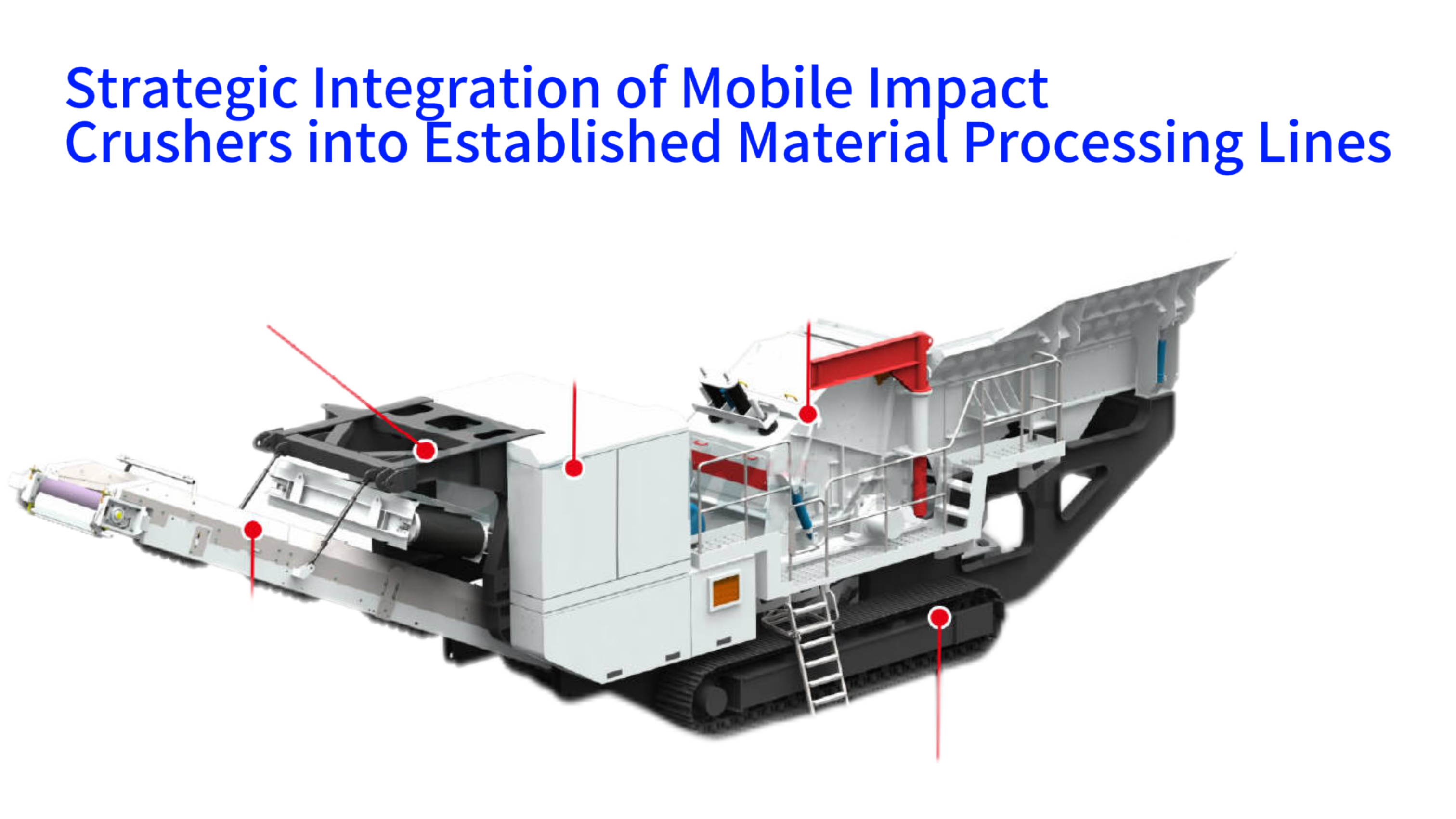
Core Steps for Integrating Mobile Impact Crushers
Identify bottlenecks & clarify crusher function
Analyze material, output & site requirements
Choose rotor, power & conveyor configurations
Physical integration + ongoing maintenance
The enhancement of a stationary aggregate or mining production line through the addition of a mobile impact crusher represents a significant operational decision. This process requires a methodical approach that extends beyond simple equipment procurement. Success depends on a thorough analysis of the existing system's constraints, a precise definition of the new unit's role, and a meticulous selection process ensuring seamless physical and operational integration. This guide provides a structured framework for this evaluation, covering the initial assessment of production bottlenecks, the technical specification matching for the crusher itself, the critical planning for system interoperability, and the long-term considerations for maintenance and economic return on investment. By following this logical progression, operators can make informed choices that leverage the inherent flexibility of mobile crushing technology to optimize overall plant throughput, product quality, and operational adaptability.
Defining the Integration Objective and Operational Challenge
Core Functions & Application Scenarios
Pre-Crushing
Reduce oversized feed for primary jaw crushers
Relieve bottlenecks in upstream processing
Improve overall plant capacity utilization
Secondary/Tertiary Crushing
Produce cubical aggregate for high-grade concrete
Optimize particle size distribution
Enhance product quality & market value
C&D Waste Recycling
Process construction/demolition waste separately
Support sustainable waste management
Create value from recycled materials
The initial phase involves a clear diagnostic of the current production line's performance to establish a concrete justification for integration. This step moves from observing general inefficiencies to identifying specific, quantifiable limitations that a mobile impact crusher is uniquely positioned to address. A holistic review of the entire process flow, from primary crushing through final screening, is essential to pinpoint the true constraint rather than treating symptoms.
Identifying Systemic Bottlenecks and Capacity Gaps
Production bottlenecks often manifest as persistent queues at certain stages or the consistent underutilization of others. A detailed analysis might reveal that the primary jaw crusher is overwhelmed by feed volume, limiting downstream screens and secondary crushers. Alternatively, the system may lack the capability to produce a specific, high-demand aggregate specification efficiently. The mobile impact crusher's role must be defined to directly relieve this identified pressure point, thereby increasing the overall system's balanced capacity rather than simply adding standalone throughput.
Clarifying the Primary Function of the Mobile Unit
The intended function dictates all subsequent selection criteria. The unit may serve as a dedicated pre-crusher to reduce oversized feed material before the primary station, enhancing its efficiency. It could function as a secondary or tertiary crusher to improve the final product's cubical shape for critical applications like high-grade concrete. Another key function is processing construction and demolition waste separately, a task for which the robust design of an impact crusher is particularly well-suited, supporting sustainable C&D waste recycling initiatives within the fixed plant's workflow.
Leveraging Inherent Advantages Over Stationary Counterparts
The core advantage of a mobile impact crusher in this context is its strategic mobility. It can be positioned at the optimal point in the material flow—directly after a primary crusher or before a critical screening stage—without permanent structural modifications. This eliminates costly truck haulage between fixed plant sections and allows for rapid reconfiguration of the production circuit to adapt to changing feed stock or product requirements, a level of flexibility impossible with static installations.
Evaluating Impact on Long-Term Operational Strategy
The integration must be evaluated within the broader operational timeline. Will the crusher serve as a permanent capacity boost, or is it needed for a specific, time-bound project such as processing a stockpile of reclaimed concrete? This distinction influences decisions regarding capital expenditure, the permanence of linking conveyors, and the level of control system integration required. A permanent addition necessitates more robust interfacing, while a temporary role emphasizes quick-connection features and standalone operation.
Conducting a Comprehensive Technical and Site Requirement Analysis
Material Characteristics & Technical Requirements
| Material Property | Measurement Metric | Required Crusher Feature | Operational Impact |
|---|---|---|---|
| Abrasiveness | Los Angeles Abrasion Test | Hardened blow bars/liners | Directly impacts wear rate & maintenance cost |
| Moisture Content | % by weight | Specialized hopper/apron feeders | High moisture causes bridging & reduced flow |
| Fines Content | % passing 75μm sieve | Integrated pre-screening module | Reduces effective crushing capacity by 10-30% |
| Environmental Compliance | 85 dB noise limit / PM10/PM2.5 regulations | Sound-dampening / dust suppression system | Mandatory for operation in populated areas |
With a clear objective defined, the next stage involves translating operational goals into a precise set of technical and environmental requirements. This phase grounds the selection process in measurable data, focusing on the material to be processed, the desired output, and the physical realities of the installation site. This empirical analysis forms the critical foundation for all equipment specification decisions.
Analyzing Fundamental Material Characteristics
The physical and chemical properties of the feed material are paramount. Abrasiveness, measured by indices like the Los Angeles test, directly determines the wear rate on blow bars and liners. Moisture content influences material adhesion and flow; sticky, high-moisture feed may require specialized hopper designs or apron feeders to prevent bridging. The presence of natural fines or soil contaminants can reduce effective crushing capacity and final product purity, often necessitating a pre-screening module on the mobile unit itself to ensure optimal operation.
Establishing Target Output Specifications
The required final product specifications are driven by market demand or the needs of the next stage in the production line. This includes not only the top size, controlled by the adjustable gap between the rotor and the impact aprons, but also the particle size distribution and grain shape. Producing high-quality, cubical aggregate for asphalt or concrete requires different rotor speeds and crushing chamber designs than simply producing a general fill material. Precise targets enable the selection of a crusher with the appropriate crushing ratio and internal configuration.
Assessing Spatial and Infrastructural Site Constraints
Every installation site presents unique physical limitations. Accurate measurements must account for the mobile crusher's full operational footprint, including the swing radius of its feed and discharge conveyors. The location and height of existing feed hoppers and receiving conveyors must be assessed to ensure the mobile unit's discharge conveyor can reach the required transfer point. Furthermore, the availability and capacity of on-site power grids must be verified if an electric-driven model is preferred over a diesel-hydraulic system.
Accounting for Environmental and Regulatory Compliance
Modern operations must adhere to stringent environmental standards. Noise emissions, often regulated at 85 decibels or lower at the site boundary, may require crushers equipped with sound-dampening enclosures. Dust suppression is a critical concern, governed by particulate matter (PM10 and PM2.5) regulations. Selecting a mobile impact crusher with an integrated, high-pressure water spray system or the option for a closed-circuit dust collection unit is often essential for compliant operation in populated areas or sensitive environments.
Selecting Key Technical Specifications for the Mobile Impact Crusher
Key Technical Specifications Comparison
Power & Drive Configuration
Complete operational autonomy
Ideal for remote sites/relocation
Higher operating cost per ton
250 kW to >500 kW power range
40-60% lower energy costs
Reduced noise & zero local emissions
Rotor Design & Performance
| Rotor Type | Best For | Tip Speed (m/s) | Key Advantage |
|---|---|---|---|
| Monolithic Rotor | Hard/Abrasive Materials | 25-35 | High inertia & crushing force |
| Modular Paddle Rotor | Recycling Applications | 20-30 | Easy maintenance & replacement |
Armed with detailed requirement data, the focus shifts to matching these needs with the specific engineering features of available mobile impact crushers. This stage involves evaluating core mechanical systems and technological options that directly influence performance, efficiency, and suitability for the defined task. The goal is to identify the machine whose inherent capabilities align perfectly with the established operational parameters.
Choosing the Optimal Rotor Design and Kinematics
The rotor is the heart of the impact crusher, and its design dictates performance. A solid, monolithic rotor offers high inertia for crushing hard, abrasive materials like granite, providing a steady, powerful force. In contrast, a modular paddle rotor might be favored for recycling applications due to easier maintenance and replaceable segments. The rotor's diameter and width determine the crushing capacity, while its rotational speed, measured in meters per second at the tip of the blow bars, is finely tuned to achieve the desired balance between fragmentation force and product shape for a given material.
Determining the Most Suitable Power and Drive Configuration
The choice between diesel-electric and full-electric drive has significant long-term implications. A diesel-hydraulic system offers complete autonomy and is ideal for remote sites or frequent relocation. However, for permanent integration at a fixed plant with reliable grid power, a full-electric drive connected via cable reel provides substantially lower operating costs per ton, reduced noise, and zero local emissions. The power requirement, typically ranging from 250 kW to over 500 kW for larger units, must be matched to the anticipated feed size and required throughput.
Evaluating Feed System and Pre-Screening Necessities
The efficiency of the main crushing chamber is heavily dependent on consistent, well-prepared feed. A robust vibrating grizzly feeder (VGF) with adjustable bars is crucial for scalping out oversized, uncrushable material and fine contaminants before they enter the crusher. This protects the rotor and blow bars from damage and prevents chamber packing. For operations processing material with high natural fines content, an independent, double-deck pre-screen before the crusher can remove a significant portion of finished product, increasing effective throughput and reducing wear.
Configuring the Discharge Conveyor for Seamless Transfer
The mobile unit's discharge conveyor is its physical link to the existing plant. Its length, discharge height, and radial swing capability must be precisely calculated to ensure it can reliably deposit material into the designated downstream hopper, screen, or conveyor. An undersized conveyor leads to constant repositioning of the entire machine, while an oversized one may create spatial conflicts. The conveyor's belt width and speed must also be capable of handling the crusher's maximum output volume without spillage or bottlenecks.
Planning for Physical and Operational Integration with the Existing Plant
Physical Integration & Operational Planning
Material Flow Integration
Jaw Crusher Output
Size Reduction
Final Processing
Control System Integration: PLC communication with central control room
Maintenance Access: Clear access to all service points (blow bars, conveyors)
Ground Stability: >50 tonnes weight support with compacted/paved surface
Securing a crusher with the correct specifications is only part of the solution. Its successful function as a component within a larger system requires careful planning for physical interconnection and process control synchronization. This phase addresses the practicalities of creating a cohesive, safe, and efficient workflow where the mobile unit operates not in isolation, but as a synchronized element of the production line.
Designing a Cohesive Material Flow Pathway
The integration must create a logical, efficient, and safe material trajectory. This involves planning the source of feed for the mobile crusher, whether directly from a primary crusher's discharge via a chute or from a dedicated stockpile via wheel loader. Equally important is planning the destination of its output, ensuring a smooth transfer to the next process stage, such as a cone crusher for further reduction or a screening plant for classification. The goal is to minimize material handling steps, reduce dust generation points, and avoid creating new traffic hazards within the plant.
Engineering Control System Interfacing and Automation
For the integrated system to operate as a single entity, the control systems must communicate. This can range from a simple hard-wired start/stop interlock sequence to a fully integrated solution where the mobile crusher's programmable logic controller (PLC) communicates with the plant's central control room via industrial network protocols. This allows for remote monitoring of key parameters like power draw, bearing temperature, and discharge size setting, enabling operators to optimize the entire line's performance from a single location.
Ensuring Adequate Access for Maintenance and Service
Routine maintenance is non-negotiable for reliability. The installation plan must guarantee clear and safe access to all major service points on the mobile crusher, such as blow bar replacement doors, conveyor drive heads, and engine compartments. This may require planning for specific clearance zones around the unit or ensuring that mobile service cranes can reach the site. Neglecting service access leads to prolonged downtime and increased safety risks during essential upkeep tasks.
Verifying Ground Conditions and Foundation Requirements
While mobile crushers are designed for deployment on various surfaces, permanent integration points require stability. The ground must be properly compacted and leveled to support the machine's weight, which can exceed 50 tonnes. For wheeled units, a firm, often paved surface is needed. While extensive concrete foundations are rarely required, localized concrete pads or heavy-duty steel plates under stabilizer legs or outriggers are often necessary to prevent settling and ensure the crusher remains level during operation, which is critical for even wear and proper vibration management.
Performing a Detailed Economic and Operational Viability Assessment
Economic Viability & TCO Analysis
Cost Savings & Revenue Enhancement
| Economic Factor | Quantifiable Impact | Notes |
|---|---|---|
| Energy Cost Savings (Electric vs Diesel) | 40-60% | High-utilization scenarios (8,000+ hrs/year) |
| Premium Product Price Increase | 20-30% | Cubical aggregate for asphalt/concrete |
| Throughput Improvement | 10-30% | After relieving bottlenecks |
| Truck Haulage Cost Reduction | Up to 50% | Eliminate transport between plant sections |
Total Cost of Ownership (TCO) Components
Capital Costs: Purchase price, depreciation, financing
Operational Costs: Energy, wear parts (blow bars/aprons), labor
Maintenance Costs: Routine servicing, unscheduled repairs
Opportunity Costs: Downtime impact on overall plant production
The technical feasibility of integration must be validated by a rigorous economic analysis that looks beyond the initial purchase price. This assessment adopts a total cost of ownership (TCO) perspective, weighing all capital and operational expenditures against the projected benefits in productivity, product value, and strategic flexibility. This financial modeling is crucial for justifying the investment and planning for sustainable operation.
Calculating Total Cost of Ownership and Operational Expenditure
The true cost of the mobile crusher includes its capital depreciation, financing costs, and ongoing operational expenses. Key operational costs include energy consumption, which varies significantly between diesel and electric drives; wear part consumption, such as blow bars and impact aprons, heavily influenced by material abrasiveness; and routine maintenance labor and parts. For example, operating an electric-powered unit can reduce energy costs by 40-60% compared to a diesel model in a high-utilization scenario, fundamentally altering the long-term cost profile.
Quantifying Gains in Throughput and Product Value
The economic return is generated by the incremental value the crusher creates. This can be quantified as the additional tons per hour of saleable aggregate produced once the original bottleneck is relieved. Furthermore, if the crusher enables the production of a premium, cubical product for asphalt or ready-mix concrete, the increased revenue per ton must be factored in. In aggregate processing, producing a certified, high-specification product can command a price premium of 20-30% over basic fill material, directly boosting profitability.
Evaluating the Strategic Value of Production Flexibility
A significant, though less tangible, benefit is the enhanced adaptability the mobile unit provides. It allows the plant to quickly switch between processing different material types, such as alternating between virgin granite crushing and recycled concrete, based on market demand or project requirements. This agility reduces market risk and enables the capture of opportunistic contracts. The value of this flexibility is a strategic asset that strengthens the overall business model against market fluctuations.
Developing a Structured Commissioning and Training Protocol
A clear plan for deployment is essential for realizing projected benefits swiftly. This includes a detailed commissioning schedule covering mechanical setup, electrical connection, control system interfacing, and performance testing with actual material. Concurrently, a comprehensive training program for plant operators and maintenance technicians must be implemented. They need to understand the new machine's operating principles, control interfaces, and specific safety and maintenance procedures to ensure it is used effectively and safely from the first day of operation.
Implementing a Proactive Regimen for Sustained Performance and Reliability
Maintenance & Reliability Management
Unified Maintenance Schedule
Daily: Walk-around inspections (drive belts, hydraulic lines, conveyor skirts)
Weekly: Bearing greasing, rotor balance checks, wear part inspection
Monthly/Quarterly: Blow bar replacement, hydraulic system servicing, performance calibration
Common Fault Response Protocols
Loss of Crushing Power: Check drive shearing pin → Inspect rotor jam → Verify power supply
Excessive Vibration: Check rotor balance → Tighten loose blow bars → Inspect bearing condition
Inconsistent Product Size: Adjust impact apron gap → Replace worn aprons → Calibrate feed rate
The final, ongoing phase focuses on preserving the efficiency and longevity of the integrated system through disciplined operational and maintenance practices. The mobile impact crusher, now a core component, requires a tailored care regimen that aligns with the fixed plant's maintenance culture. This proactive approach minimizes unplanned downtime, controls operating costs, and ensures the integration delivers consistent, long-term returns.
Establishing a Unified Inspection and Maintenance Schedule
The maintenance routines for the mobile crusher must be seamlessly incorporated into the existing plant's preventative maintenance (PM) program. This involves creating a combined checklist that includes daily walk-around inspections of the crusher's drive belts, hydraulic lines, and conveyor skirts, alongside the plant's fixed equipment checks. Key intervals for greasing bearings, checking rotor balance, and inspecting wear parts should be synchronized with the plant's planned downtime to maximize efficiency and resource utilization.
Optimizing Wear Part Management and Inventory Strategy
Impact crushing is inherently a wear-intensive process. Developing a data-driven wear part strategy is critical. By monitoring the tonnage processed or operating hours between blow bar changes for specific materials, a predictable replacement schedule can be established. This allows for just-in-time inventory management of critical wear parts, reducing capital tied up in spare parts while eliminating the risk of extended downtime waiting for deliveries. Partnering with a knowledgeable supplier like MSW Technology, which draws on fifteen years of field data across various applications, can help optimize these schedules and source cost-effective, high-performance wear components.
Utilizing Operational Data for Continuous Process Refinement
Modern mobile impact crushers are equipped with sophisticated sensors that provide a wealth of operational data. Systematically tracking metrics such as power draw, hydraulic pressure, and vibration levels over time allows for the establishment of performance baselines. Deviations from these baselines can serve as early warnings of developing issues, such as a slowly failing bearing or a partially blocked feed. Furthermore, analyzing the relationship between rotor speed, feed rate, and product gradation enables operators to fine-tune the crusher for optimal efficiency and product quality under varying conditions.
Preparing Standardized Response Protocols for Common Faults
Despite best practices, operational issues will arise. Developing clear, step-by-step Standard Operating Procedures (SOPs) for responding to common faults minimizes resolution time. These protocols should cover scenarios like a sudden loss of crushing power, indicating a potential drive shearing pin failure; excessive vibration, suggesting unbalanced rotor or loose blow bars; or inconsistent product size, which may point to worn aprons or an incorrect gap setting. Having these diagnostic trees readily available empowers the crew to restore operation quickly and safely, protecting the integrity of the entire production line's output schedule.