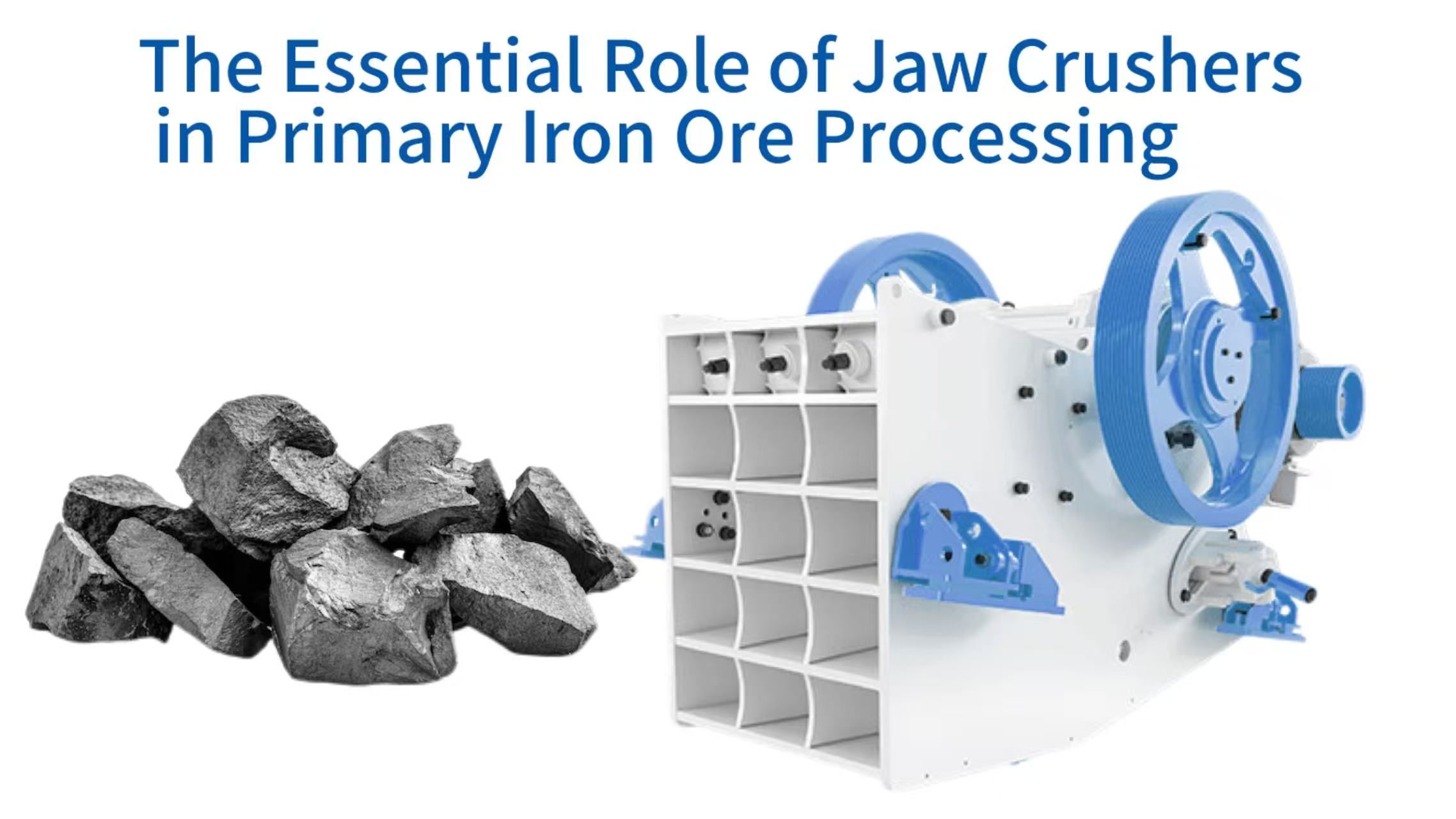
The Essential Role of Jaw Crushers in Primary Iron Ore Processing
Iron Ore Primary Crushing Process Flow
Run-of-Mine Ore
(1-1.5m diameter)
Jaw Crusher
Primary Crushing
Crushed Ore
(Processable Size)
Secondary/Tertiary Crushing
& Beneficiation
In the complex world of mineral processing, the journey from raw ore to usable material begins with a single critical step: primary crushing. For iron ore, this first stage of size reduction is not merely a matter of convenience but a fundamental requirement that dictates the efficiency and viability of the entire beneficiation plant. The material that emerges from the earth after blasting consists of massive, irregular blocks, some exceeding a meter in diameter. These blocks are far too large for any downstream grinding mill or separation equipment to handle. Therefore, the primary crusher must perform the heavy task of reducing this run-of-mine material to a more manageable size. Among the various machines available for this purpose, the jaw crusher has established itself as the universal standard for the first processing stage in large-scale iron ore operations. Its dominance in this specific role stems from a combination of factors including its ability to accommodate extremely large feed sizes, its robust construction capable of withstanding the high compressive forces of hard ore, its operational reliability, and its economic efficiency over the long term. This article provides a comprehensive examination of why the jaw crusher is uniquely suited for this demanding application, exploring the fundamental relationship between iron ore properties and crusher design, the mechanical principles that enable efficient size reduction, the functional advantages that translate into operational benefits, the various configuration options available to plant designers, the economic considerations that influence equipment selection, and the technological advancements shaping the future of primary crushing.
The Physical Demands of Iron Ore: Why Primary Crushing Requires Specialized Equipment
Key Physical Properties of Iron Ore
The selection of any crushing equipment must begin with a thorough understanding of the material it will process. Iron ore presents a unique set of physical challenges that directly influence the design requirements of a primary crusher. It ranks among the hardest and most abrasive materials commonly encountered in the mining industry. The Protodyakonov hardness coefficient for typical iron ores falls within the range of 12 to 20, and certain varieties, such as taconite or banded iron formations, can exhibit even greater hardness values. This high hardness means that the crusher must be capable of generating and withstanding immense forces to fracture the rock. Additionally, iron ore often contains significant quantities of quartz and other silicate minerals within its gangue, which contribute to an extremely high abrasiveness index. This abrasiveness subjects the crushing surfaces to severe wear, requiring the use of specialized wear-resistant materials and robust design configurations that can tolerate continuous, high-intensity contact with hard, sharp particles. A crusher intended for iron ore must therefore combine substantial crushing force with exceptional durability.
The physical dimensions of run-of-mine iron ore present another critical design parameter. Blasting operations in large open-pit mines produce fragments that can easily reach diameters of 1.2 to 1.5 meters. The primary crusher must accept these massive blocks without obstruction, making the size of its feed opening a defining characteristic. Equipment intended for this role features feed openings measured in meters rather than centimeters, with widths and depths specifically engineered to accommodate the largest anticipated fragments. This requirement for a large feed opening inherently limits the types of machines suitable for primary crushing. Furthermore, the primary crushing stage sits at the very beginning of the entire mineral processing flow sheet. Its performance sets the throughput ceiling for the entire plant. If the primary crusher cannot maintain the required feed rate, every downstream process from conveying to grinding to separation will be starved of material. This position demands not only high capacity but also exceptional reliability, as any unscheduled downtime at this stage forces the entire production line to halt, creating immediate and substantial economic losses. The jaw crusher, through its relatively simple mechanical design and robust construction, directly addresses each of these demanding requirements.
Hardness and Abrasiveness Characteristics of Iron Ore
The mechanical properties of iron ore place it in the category of extremely challenging materials for size reduction equipment. The high compressive strength means that the crusher must apply significant force to initiate and propagate fractures through the ore particles. This force requirement translates directly into the need for heavy-duty construction throughout the machine, from the main frame to the bearings and shafts. The abrasive nature of the ore, exacerbated by the presence of hard quartz particles, means that the surfaces contacting the material experience continuous wear. The crushing teeth or plates must resist this abrasion while maintaining their profile to ensure effective gripping and breaking of the rock. Jaw crushers address this challenge through the use of thick manganese steel liners on both the fixed jaw plate and the movable jaw. These liners possess the unique property of work hardening under impact and pressure, becoming harder and more wear-resistant as they crush abrasive materials. This characteristic makes them particularly well-suited to the demands of iron ore, where high pressure and high abrasivity combine to create a severe operating environment that would quickly destroy lesser materials.
Large Fragment Size and Feed Opening Requirements
The scale of material produced by modern blasting techniques in iron ore mining directly dictates the minimum dimensions required for primary crushing equipment. Large-diameter blast holes and extensive patterns yield a product with a top size that can exceed one meter in any dimension. Any crusher positioned to receive this material must have a feed opening large enough to accept the largest of these blocks without bridging or blocking. The width of the feed opening, typically measured at the top of the crushing chamber where the material first enters, must be substantially greater than the largest expected fragment. Jaw crushers excel in this regard, with large models featuring feed openings of 1500 millimeters or more in width and comparable depth. This generous opening allows haul trucks to dump directly into the crusher hopper, from which the material slides into the crushing chamber without the need for prior grizzly screening or secondary breaking of oversize blocks. This direct acceptance capability simplifies the mine-to-crusher interface, reduces the need for auxiliary equipment, and ensures a smooth flow of material from the pit to the processing plant.
Core Objectives of the Primary Stage: Capacity and Reliability
The primary crushing stage occupies a unique position within the beneficiation plant hierarchy. It serves as the gateway through which all material must pass, and its operational characteristics therefore define the maximum sustainable throughput of the entire facility. Achieving the design capacity of the plant requires a primary crusher capable of processing thousands of tons of ore per hour, day after day, with minimal interruption. The jaw crusher meets this demand through a combination of high instantaneous capacity and exceptional mechanical reliability. Its simple reciprocating motion, driven by a robust eccentric shaft and flywheel system, delivers consistent crushing force with every cycle. The machine contains relatively few moving parts compared to other types of crushers, reducing the number of potential failure points. Regular maintenance typically focuses on wear part replacement and lubrication, tasks that are well understood and can be scheduled during planned downtime. This inherent reliability, combined with the ability to handle surge loads and occasional oversize material, makes the jaw crusher the preferred choice for ensuring that the entire beneficiation plant can operate at its designed capacity.
Comparative Suitability of Different Crusher Types
While several types of crushers exist within the mineral processing industry, each possesses characteristics that suit it to specific applications, and few can match the jaw crusher for iron ore primary crushing. Gyratory crushers can serve as primary units and offer certain advantages in extremely large installations, but they come with significantly higher capital costs, more complex installation requirements, and larger physical footprints that limit their application to the largest mines. Impact crushers, which rely on high-velocity collisions to fracture rock, suffer from prohibitively rapid wear of their blow bars and impact plates when processing highly abrasive iron ore, making them economically impractical for this application. Hammer crushers face similar wear-related limitations. Cone crushers, while excellent for secondary and tertiary crushing of hard rock, have feed openings that are too small to accept run-of-mine material directly. The jaw crusher therefore occupies a unique position in the equipment lineup, offering the ideal combination of large feed opening, high capacity, wear resistance, mechanical simplicity, and economic efficiency that makes it the undisputed standard for primary iron ore crushing.
The Mechanical Foundation: Core Operating Principles of Jaw Crushers
Jaw Crusher Operating Cycle
Eccentric shaft rotation drives pitman/movable jaw forward
Movable jaw compresses ore against fixed jaw (crushing stroke)
Ore fractures when internal stress exceeds compressive strength
Movable jaw retracts (return stroke) - crushed ore falls by gravity
Cycle repeats (hundreds of times per minute) for continuous crushing
The effectiveness of the jaw crusher in processing hard iron ore stems directly from its fundamental mechanical design, which has been refined over more than a century of industrial use. The machine operates on a surprisingly simple principle that belies the sophistication of its engineering. At its heart, the jaw crusher is a compression machine that uses a reciprocating motion to apply gradually increasing pressure to the rock until it fractures. This section examines the key mechanical elements that enable this process and the engineering principles that optimize its performance. Understanding these fundamentals provides insight into why this particular configuration has proven so durable and effective for the most demanding crushing applications.
The basic structure of a jaw crusher consists of a fixed jaw plate mounted rigidly within the main frame and a movable jaw plate attached to a pitman that swings back and forth. The crushing chamber, the space between these two jaws, tapers from a wide opening at the top to a narrower discharge opening at the bottom. A drive system, typically comprising an electric motor connected through V-belts to a flywheel and eccentric shaft, provides the motive force. As the eccentric shaft rotates, it causes the pitman and the attached movable jaw to move through a cyclic path. During the forward stroke, the movable jaw approaches the fixed jaw, compressing any material caught between them. During the return stroke, the jaw moves away, allowing the crushed material to fall downward by gravity toward the discharge opening. This simple cyclic motion, repeated hundreds of times per minute, transforms large blocks of hard ore into smaller, more manageable pieces suitable for downstream processing. The elegance of this design lies in its direct mechanical approach to the problem of size reduction, applying force exactly where and when it is needed without complex linkages or hydraulic systems.
Structural Components and Operating Cycle
The jaw crusher comprises several key structural elements, each engineered to withstand the immense forces generated during crushing. The main frame forms the rigid backbone of the machine, typically constructed from heavy steel plate welded into a box-section structure or cast as a single piece of high-strength steel. This frame must resist the crushing forces without deflection, maintaining precise alignment of the bearings and jaw mounts. The fixed jaw mounts directly to the front of this frame, while the movable jaw assembly, including the pitman, hangs from the eccentric shaft supported in heavy-duty bearings mounted in the frame side walls. A toggle plate connects the bottom of the pitman to an adjustable toggle block on the rear of the frame. This toggle plate serves the dual purpose of transmitting the crushing force from the pitman to the frame and acting as a mechanical fuse, designed to break if uncrushable material enters the chamber, thereby protecting the more expensive components from damage. The entire system operates in a continuous cycle, with each rotation of the eccentric shaft producing one crushing stroke and one discharge stroke, processing a steady stream of material through the chamber.
The Crank-Double Linkage and Compression Mechanism
From a mechanical engineering perspective, the jaw crusher functions as an application of the crank-double linkage mechanism. The eccentric shaft serves as the crank, converting rotational motion from the motor into the reciprocating motion of the pitman. The pitman itself acts as the connecting rod in this system, and the toggle plates form the linkages that transmit motion and force to the movable jaw. This arrangement provides a mechanical advantage that multiplies the force applied at the eccentric shaft, generating the immense compressive forces required to fracture hard iron ore. The crushing process relies on compression rather than impact or attrition. The rock is caught between the two jaws and subjected to gradually increasing pressure as the movable jaw advances. This pressure continues to build until the internal stresses within the rock exceed its compressive strength, at which point the rock fractures along planes of weakness. This compression-based approach proves highly efficient for hard, brittle materials like iron ore, as it concentrates the applied energy directly into the fracture process with minimal waste.
Deep Chamber Design and Throughput Optimization
Modern large-scale jaw crushers incorporate deep chamber designs that significantly enhance their processing capabilities. The term deep chamber refers to a crushing cavity with increased height relative to its width, creating a longer path for material to travel from the feed opening to the discharge point. This extended path length increases the number of compression cycles each particle experiences as it descends through the chamber, resulting in more effective size reduction and a finer product. The chamber profile is not simply straight but typically features a curved shape optimized to maintain effective gripping of the rock throughout its descent. Engineers use sophisticated simulation tools to analyze material flow through various chamber geometries, refining the shape to maximize throughput while minimizing wear and power consumption. The optimized chamber design ensures that rock particles remain in contact with the crushing surfaces for the maximum possible time during each cycle, improving energy transfer and crushing efficiency. This attention to chamber geometry contributes substantially to the high throughput capacities that characterize modern primary jaw crushers.
Flywheel Function: Energy Storage and Smooth Operation
One of the most visually distinctive features of large jaw crushers is the pair of massive flywheels mounted on the ends of the eccentric shaft. These flywheels serve a critical function in the machine's operation, storing rotational energy during the return stroke and releasing it during the crushing stroke. During the return stroke, when the movable jaw moves away from the fixed jaw and no crushing occurs, the motor continues to turn the eccentric shaft, accelerating the flywheels and storing energy in their rotating mass. During the forward crushing stroke, when the jaw meets the resistance of the rock, the flywheels release this stored energy, helping to drive the shaft through the high-torque portion of the cycle. This energy storage and release mechanism smooths out the power demands on the motor, preventing the current spikes that would otherwise occur with each crushing stroke. The flywheels also provide rotational inertia that helps the crusher maintain speed when encountering exceptionally hard or large pieces of ore, improving its ability to handle the inevitable variations in feed material. This simple but effective engineering solution contributes significantly to the smooth, efficient operation of the jaw crusher under the demanding conditions of primary iron ore crushing.
Operational Advantages: Key Functional Benefits in Primary Crushing
Key Operational Advantages of Jaw Crushers (Weighted Impact)
Core
Advantages
High Throughput Capacity (35%)
Large Feed Opening (25%)
Structural Robustness (18%)
Adjustable Discharge Setting (14%)
Operational Flexibility (8%)
The widespread adoption of jaw crushers for primary iron ore crushing stems not merely from their ability to perform the basic task of size reduction but from the comprehensive set of functional advantages they bring to the operation. These benefits extend across multiple dimensions of plant performance, from raw capacity and material handling flexibility to structural durability and product control. Each of these functional attributes contributes directly to the economic viability of the beneficiation plant, making the jaw crusher an integral component of successful mineral processing operations. This section examines these key functional benefits in detail, illustrating how they translate into practical advantages for the plant operator.
The jaw crusher delivers exceptional processing capacity, with large models capable of handling throughputs exceeding 1500 tons per hour under continuous operation. This high capacity derives from the machine's ability to accept and process a steady stream of material without the need for batch feeding or surge control. The continuous, reciprocating action of the jaws creates a constant flow of crushed product, feeding downstream conveyors and equipment at a consistent rate. This steady output simplifies the design of the material handling system and ensures that secondary and tertiary crushers receive a uniform feed. The combination of high instantaneous capacity and consistent output allows beneficiation plants to achieve their design throughput targets reliably, maximizing the return on the substantial capital investment represented by the entire processing facility. For operations processing tens of millions of tons of ore annually, the difference between 90 percent and 95 percent availability at the primary crusher translates into millions of dollars in additional production over the life of the mine.
Massive Throughput Capacity and Production Continuity
The throughput capacity of modern jaw crushers represents the culmination of decades of design refinement aimed at maximizing productivity. Large primary units feature crushing chambers engineered to accept and process ore at rates that would have seemed impossible just a generation ago. This capacity results from the combination of wide feed openings that accept large quantities of material, deep chambers that provide extended crushing zones, and optimized jaw geometries that maximize the number of crushing cycles per minute. The continuous flow of material through the machine ensures that downstream processes receive a steady supply of crushed ore, enabling them to operate at peak efficiency. This production continuity proves essential for large-scale operations where any interruption in feed cascades through the entire plant, causing losses that compound with each hour of downtime. The jaw crusher's ability to maintain this flow hour after hour, shift after shift, forms the foundation upon which reliable plant performance is built.
Extensive Feed Opening and Oversize Material Accommodation
The generous dimensions of the jaw crusher feed opening provide an operational flexibility that proves invaluable in the mining environment. This wide aperture accepts the full range of material produced by blasting, including the occasional oversize block that exceeds the nominal top size. The ability to handle such material without blockage eliminates the need for secondary blasting or mechanical breaking of oversize rocks at the crusher, operations that introduce safety risks and cause production delays. The feed opening also accommodates the inevitable variations in blast quality, providing a buffer against inconsistent fragmentation that might otherwise starve the crusher of feed or overwhelm it with excessive fines. This tolerance for feed variability simplifies mine operations and reduces the pressure on blasting crews to achieve perfect fragmentation every time. The wide opening further facilitates the passage of material containing clay or moisture, reducing the risk of choking that can plague machines with more restricted feed arrangements.
Robust Structural Integrity for High-Load Conditions
The structural design of jaw crushers reflects a fundamental understanding of the forces generated during hard rock crushing and the need to contain these forces within a rigid framework. Engineers specify main frame construction using materials and geometries that provide exceptional strength while managing weight for practical transport and installation. Finite element analysis guides the placement of reinforcing ribs and the selection of plate thicknesses to ensure that stresses remain within safe limits at all points in the structure. The bearing housings, shaft mounts, and toggle seat areas receive particular attention, as these points concentrate the crushing forces and transmit them to the frame. The resulting structure exhibits the stiffness necessary to maintain precise alignment of moving parts under full load, ensuring consistent performance and long component life. This robust construction enables the jaw crusher to withstand the extreme conditions of primary crushing day after day, year after year, providing the reliable service that large-scale mining operations require.
Adjustable Discharge Setting for Product Size Control
The ability to adjust the discharge setting provides plant operators with a valuable tool for optimizing crusher performance and responding to changing conditions. The closed side setting, which defines the minimum gap between the jaws at the bottom of the crushing chamber, directly controls the maximum particle size in the crusher product. Adjusting this setting changes the product size distribution, allowing operators to match the crusher output to the requirements of downstream processes. Traditional adjustment methods use shims or hydraulic cylinders to change the position of the toggle seat, altering the geometry of the crushing chamber. Hydraulic adjustment systems offer the advantage of rapid, push-button setting changes that can be made without stopping the crusher, minimizing downtime when product specifications change. This flexibility proves particularly valuable when processing ore from different parts of the mine that may require different product sizes for optimal performance in subsequent grinding and separation stages.
Application Configurations: Integrating Jaw Crushers into Beneficiation Plants
The jaw crusher does not operate in isolation but forms an integrated component of the complete beneficiation plant, interacting with feed systems, screens, conveyors, and secondary crushers in a coordinated process flow. Plant designers have developed various configuration options that optimize the jaw crusher's role within the broader context of the operation. These configurations reflect differences in ore characteristics, plant scale, site conditions, and operator preferences, demonstrating the flexibility of the jaw crusher as a primary unit. This section explores the common application scenarios and configurations that plant designers employ to maximize the effectiveness of jaw crushers in iron ore beneficiation.
The simplest and most common configuration positions the jaw crusher as a standalone primary unit in an open circuit arrangement. In this setup, haul trucks dump run-of-mine ore directly into the crusher feed hopper, from which it passes through the crusher and discharges onto a conveyor belt for transport to downstream processing. This straightforward arrangement minimizes equipment count and simplifies operation, making it suitable for a wide range of plant sizes and ore types. The jaw crusher's high reliability ensures that this simple system can maintain continuous operation with minimal supervision. For plants requiring tighter control over primary product size, designers may incorporate screening into the circuit. Pre-screening removes fines from the feed before they enter the crusher, reducing wear and increasing effective capacity. Closed-circuit arrangements return oversize material from a screen to the crusher for additional reduction, guaranteeing that all product meets a specified maximum size. Each configuration offers specific advantages that plant operators can match to their particular requirements.
Independent Primary Station with Open Circuit Operation
The independent primary crushing station represents the most straightforward approach to integrating a jaw crusher into the beneficiation flow sheet. This configuration positions the crusher at a convenient location relative to the mine haulage roads, typically with a ramp allowing trucks to dump directly into the feed hopper. A vibrating feeder or apron feeder below the hopper meters material into the crusher, controlling the feed rate to match the crusher's capacity and preventing surge loading. The crushed product discharges onto a conveyor system that transports it to the next stage of processing, which may be a secondary crushing plant, a stockpile, or directly to the grinding mills. This simple arrangement minimizes capital investment in auxiliary equipment while providing reliable, high-capacity primary crushing. The open circuit operation means that no material returns to the crusher, simplifying control and eliminating the need for recirculation conveyors. For many iron ore operations, this straightforward configuration provides the optimal balance of cost and performance.
Closed Circuit Systems with Integrated Screening
Applications requiring precise control over primary product size may benefit from closed circuit operation, in which the crusher works in conjunction with screening equipment. In this arrangement, the crusher discharge passes over a vibrating screen that separates the material into two fractions. Material finer than the screen opening passes through as finished product, while oversize material returns to the crusher for additional reduction. This recirculation continues until all material has been reduced below the screen opening size. Closed circuit operation guarantees that the final product meets a specified maximum dimension, providing assurance to downstream processes that they will receive material of consistent size. The screen can also perform pre-screening duty, removing fines from the fresh feed before they enter the crusher and thereby reducing the load on the crushing chamber. While the additional equipment increases capital cost and complicates operation, the improved product control justifies this investment for plants processing ore that requires consistent feed to downstream processes.
Mobile Crushing Applications in Large Open Pit Mines
The development of mobile crushing technology has opened new possibilities for integrating jaw crushers into large-scale mining operations. Mobile jaw crusher plants mount the crusher, along with feed hoppers and discharge conveyors, on a mobile chassis that can relocate as the mining face advances. This mobility allows the crusher to move closer to the active mining area, dramatically reducing the distance that haul trucks must travel to deliver ore. The reduction in haul distance translates directly into lower fuel consumption, reduced truck requirements, and decreased road maintenance costs. Mobile jaw crusher plants designed for large-scale mining feature robust construction capable of withstanding the rigors of frequent relocation while maintaining the crushing performance expected of stationary units. The economics of mobile crushing become increasingly favorable as mine size increases and haul distances grow, making this approach attractive for large open pit iron ore operations seeking to optimize their material handling costs.
Integration with Secondary and Tertiary Crushing Equipment
The jaw crusher forms the first stage in a multi-stage crushing circuit that progressively reduces ore to the final product size required for grinding. Following primary crushing, the material typically passes through secondary and sometimes tertiary crushing stages before reaching the grinding mills. The choice of equipment for these downstream stages depends on the ore characteristics and the desired final product size. For hard, abrasive iron ore, cone crushers represent the standard choice for secondary and tertiary duty, offering the combination of high capacity, good product shape, and wear resistance suited to this application. The jaw crusher's product, with its consistent size distribution and minimal fines, provides ideal feed for these secondary units. Some circuits may incorporate high-pressure grinding rolls or impact crushers in later stages for specific applications, but the jaw crusher remains the universal starting point, reducing run-of-mine ore to a size that downstream equipment can process effectively.
Economic Analysis: Investment Returns and Operating Costs
Economic Performance of Jaw Crushers
The selection of primary crushing equipment ultimately rests on economic considerations, weighing capital costs against operating expenses and long-term productivity. The jaw crusher's widespread adoption for iron ore primary crushing reflects its favorable position in this economic equation, offering operators the combination of reasonable initial investment and low ongoing operating costs that maximizes return on capital. This section examines the various economic factors that influence equipment selection and demonstrates how the jaw crusher's characteristics translate into financial benefits for the beneficiation plant.
The economic analysis of crushing equipment must consider the full lifecycle cost, including initial purchase price, installation expenses, operating costs such as power and wear parts, maintenance requirements, and the value of production achieved over the equipment's service life. The jaw crusher performs well across all of these metrics. Its relatively simple construction keeps manufacturing costs moderate compared to more complex machines, while its robust design ensures a long service life measured in decades rather than years. Operating costs remain low due to efficient power consumption and manageable wear part replacement expenses. The high reliability translates into maximum production time, ensuring that the plant achieves its design throughput consistently. When all of these factors are considered together, the jaw crusher emerges as the most economically attractive option for primary iron ore crushing in the vast majority of applications.
Power Consumption Advantages per Ton of Product
Electricity represents one of the largest operating expenses in any beneficiation plant, and the primary crushing stage contributes significantly to total power consumption. The jaw crusher's compression-based crushing mechanism efficiently converts electrical energy into fracture work, minimizing losses to heat, noise, and elastic deformation. Operating data from large-scale installations indicates that primary jaw crushers processing iron ore typically consume between 0.3 and 0.5 kilowatt-hours per ton of material processed. This specific energy consumption compares favorably with alternative primary crushing technologies, offering savings that accumulate over millions of tons of production. For a plant processing 10 million tons of ore annually, a difference of just 0.1 kilowatt-hour per ton represents annual electricity cost savings of hundreds of thousands of dollars. The jaw crusher's efficient power utilization thus contributes directly to improved operating margins throughout the life of the operation.
Wear Part Consumption and Maintenance Economics
The wear parts of a jaw crusher, primarily the fixed and movable jaw liners, represent the major ongoing maintenance expense for the machine. The rate at which these liners wear depends on the abrasiveness of the ore, the crusher settings, and the metallurgy of the liners themselves. Modern high-manganese steel liners, properly specified for the application, can achieve service lives measured in months under continuous operation before requiring replacement. When the cost of a set of liners is amortized over the thousands or millions of tons processed during their life, the resulting cost per ton typically falls in the range of $0.10 to $0.20, a modest expense relative to the value of the product. The toggle plate, which serves as a sacrificial overload protection device, represents a minimal additional cost. This manageable wear part expense, combined with the simplicity of replacement procedures that minimize downtime, contributes significantly to the favorable operating economics of jaw crushers in iron ore service.
Reliability Contribution to Production Assurance
The jaw crusher's reputation for high reliability translates directly into economic value through production assurance. A machine that operates consistently at its rated capacity, with minimal unscheduled downtime, enables the beneficiation plant to achieve its design throughput and meet its production targets. The financial impact of even a single day of unplanned downtime at the primary crusher can reach hundreds of thousands of dollars in lost production, not including the costs of recovery and catch-up. The jaw crusher's simple mechanical design, with few moving parts and well-understood failure modes, minimizes the risk of unexpected breakdowns. Scheduled maintenance, including liner changes and bearing lubrication, follows predictable patterns that plant operators can plan around. This predictability and reliability provide the foundation for achieving the high utilization rates that modern beneficiation plants require to remain competitive in global iron ore markets.
Capital Cost Comparison and Long-Term Value
When evaluating equipment options for primary crushing, plant designers must consider both initial capital expenditure and the long-term value delivered over the equipment's life. Jaw crushers offer a capital cost advantage over alternative primary crushers such as gyratory units, with purchase prices typically 40 to 50 percent lower for comparable capacity. The lower cost extends to installation, where the jaw crusher's smaller footprint and simpler foundation requirements reduce civil works expenses. Throughout its operating life, the jaw crusher continues to deliver value through lower maintenance costs, higher reliability, and efficient power consumption. When discounted cash flow analysis compares the lifetime economics of different options, the jaw crusher consistently demonstrates superior returns for the majority of iron ore applications. This combination of reasonable initial investment and favorable operating economics makes it the value leader in primary crushing equipment.
Technological Evolution: Advancing Jaw Crusher Capabilities
The jaw crusher, despite its long history and apparently simple design, continues to benefit from ongoing technological advancement. Manufacturers and researchers pursue improvements across multiple fronts, from materials science to control systems, seeking to enhance performance, reduce costs, and expand capabilities. These technological developments ensure that the jaw crusher remains competitive and continues to meet the evolving demands of the iron ore industry. This section examines the key technological trends shaping the future of jaw crusher design and application.
The pace of technological change in crushing equipment has accelerated in recent years, driven by advances in related fields such as materials science, sensor technology, and data analytics. These developments enable crusher designs that were impossible just a generation ago, with improved performance characteristics that directly benefit the end user. Hydraulic systems have replaced mechanical adjustments for many functions, providing faster, more precise control. Electronic monitoring and control systems give operators unprecedented visibility into machine health and performance. New wear materials extend component life and reduce maintenance frequency. Modular construction techniques simplify installation and replacement. Each of these advancements builds upon the fundamental strengths of the jaw crusher while addressing historical limitations, creating machines that are more capable, more efficient, and easier to maintain than their predecessors.
Hydraulic Systems for Setting Adjustment and Protection
Modern large jaw crushers increasingly incorporate hydraulic systems that enhance both operational flexibility and equipment protection. Hydraulic adjustment mechanisms allow operators to change the crusher setting rapidly and precisely, either manually through push-button controls or automatically through the control system. This capability proves valuable when ore characteristics change or when different product sizes are required for different processing campaigns. Hydraulic overload protection systems provide a more sophisticated alternative to the traditional toggle plate fuse, using hydraulic cylinders that can relieve pressure when uncrushable material enters the chamber, allow the material to pass, and then automatically reset to the operating position. This protection eliminates the downtime previously required for toggle plate replacement after overload events, improving availability and reducing maintenance costs. The integration of hydraulic systems represents a significant advance in jaw crusher technology, building upon the proven mechanical foundation while adding capabilities that improve operability and protect the investment.
Intelligent Control and Real-Time Performance Optimization
The application of modern control technology to jaw crushers has transformed these machines from simple mechanical devices into intelligent, responsive components of the beneficiation plant. Sensor systems monitor key operating parameters including crusher power draw, bearing temperatures, vibration levels, and setting position, providing operators and control systems with real-time information about machine status. This data enables condition-based maintenance approaches that replace fixed-interval servicing with maintenance triggered by actual component condition, reducing unnecessary work while preventing unexpected failures. Advanced control algorithms can automatically adjust feed rates to maintain optimal crusher loading, maximizing throughput while preventing overload conditions. Some systems can even analyze power consumption patterns to detect changes in ore hardness or liner wear, providing early warning of conditions that might affect performance. This intelligence layer, built upon the robust mechanical foundation of the jaw crusher, creates a machine that is not only powerful but also smart, adapting its operation to changing conditions for optimal results.
Advanced Materials Extending Wear Life
Materials science continues to advance the performance of jaw crusher wear components, with new alloys and manufacturing techniques delivering substantial improvements in wear life. Traditional manganese steel, while still widely used, has been enhanced through optimized alloy compositions and heat treatment processes that improve both initial hardness and work-hardening characteristics. Composite materials incorporating ceramic particles within a metal matrix offer wear resistance several times that of conventional alloys, though at higher cost that limits their application to the most severe wear zones. Advanced casting techniques enable the production of complex liner geometries that optimize material flow and crushing efficiency while maintaining the strength needed for severe service. The practical result of these material advances is longer liner life, fewer change-outs, and lower operating costs for the end user. As new materials continue to emerge and their costs decline, the economic benefits will extend to an ever-wider range of applications.
Large-Scale and Modular Configurations for Modern Mines
The trend toward ever-larger mining operations has driven the development of jaw crushers with capacities that would have seemed extraordinary just a few decades ago. Machines now in service can process more than 3000 tons of ore per hour, feeding the largest beneficiation plants with a single primary unit. These giant crushers incorporate all of the technological advances discussed previously, scaled up to handle the massive forces and extreme duty cycles of high-tonnage operations. Alongside this trend toward larger individual machines, modular design approaches have gained popularity for applications requiring flexibility in deployment and replacement. Modular crushers break the machine down into transportable modules that can be shipped more easily and assembled more quickly on site. This approach proves particularly valuable for remote locations or for operations requiring periodic relocation of crushing equipment. The combination of large-scale capacity and modular flexibility ensures that jaw crushers can meet the diverse needs of modern iron ore operations, from massive centralized plants to smaller, more agile operations.
Specialized Solutions from Experienced Manufacturers
Comprehensive Jaw Crusher Solution Process
Pre-Sales Engineering
(Ore Testing & Sizing)
Application-Specific
Design Optimization
Manufacturing &
Quality Assurance
Installation &
Commissioning
After-Sales Support
& Parts Supply
The selection of a jaw crusher represents only one part of the equipment decision facing a beneficiation plant developer. Equally important is the choice of a supplier capable of providing not just a machine but a comprehensive solution encompassing proper sizing, integration support, and long-term service. Experienced manufacturers bring deep knowledge of both the equipment and the application, enabling them to guide customers toward optimal solutions and support them throughout the equipment life cycle. This section examines the value that an experienced partner brings to a jaw crusher investment.
Companies with extensive experience in the design and manufacture of crushing equipment, such as MSW Technology with its 15 years of industry involvement, accumulate knowledge that directly benefits their customers. This experience encompasses thousands of installations across diverse applications, providing insights into what works and what doesn't under various conditions. Engineers draw upon this knowledge base when designing new machines, incorporating features proven to enhance reliability and performance while avoiding configurations that have caused problems in the field. The result is equipment that reflects lessons learned from real-world operation, not just theoretical design. For the customer, this experience translates into confidence that the equipment will perform as expected and that the supplier understands the practical realities of their application.
Deep Industry Experience and Technical Expertise
Fifteen years of continuous engagement with the crushing industry provides a manufacturer with perspective that cannot be gained through shorter experience. This timeline encompasses multiple generations of equipment design, allowing engineers to observe which innovations proved durable and which faded away. It includes exposure to a wide range of applications, from small quarries to the world's largest mines, building understanding of how equipment performs under different conditions. It involves countless service calls and troubleshooting exercises, building knowledge of failure modes and maintenance best practices. This accumulated expertise informs every aspect of the manufacturer's operations, from initial design concepts through final assembly and testing. When a customer engages such a manufacturer, they benefit from this depth of experience, receiving equipment and support informed by decades of cumulative learning about what makes crushing equipment successful in the field.
Application-Specific Design Optimization
No two iron ore deposits are identical, and optimal crusher performance requires attention to the specific characteristics of each application. An experienced manufacturer approaches each new project with an understanding that standard designs may require modification to achieve best results. The crushing chamber profile may be optimized for the fracture characteristics of a particular ore type. Jaw plate tooth geometry can be selected to maximize grip on slippery or slabby feed materials. Motor power and drive arrangements are sized to match the specific duty cycle expected at the installation. This application-specific engineering ensures that each crusher delivers performance matched to its particular operating conditions, rather than forcing the application to adapt to a generic design. The result is equipment that achieves higher throughput, longer wear life, and better product quality than would be possible with a one-size-fits-all approach.
Comprehensive Pre-Sales Engineering Support
The value of an experienced manufacturer extends well beyond the equipment itself to encompass the engineering support provided during project development. Before any metal is cut, the manufacturer's engineers work with the customer to define requirements, analyze ore samples, and develop process flow sheets that optimize the integration of the crusher into the overall plant. Material testing determines the crushability and abrasiveness of the specific ore, providing data essential for proper equipment sizing and selection. Computer simulations model the expected performance of various configurations, allowing comparison of alternatives before commitment to a design. Detailed foundation drawings and installation specifications ensure that site preparation proceeds correctly. This comprehensive pre-sales engineering support reduces project risk and increases confidence that the final installation will meet performance expectations. For the customer, this support represents value that extends far beyond the equipment itself, contributing to project success from the earliest stages.
Responsive After-Sales Service and Parts Availability
The relationship between manufacturer and customer continues long after the equipment ships, with after-sales support playing a critical role in long-term success. Experienced manufacturers maintain service organizations capable of responding quickly when issues arise, minimizing the downtime that can cost customers dearly. Technical support hotlines provide immediate access to expertise for troubleshooting and problem resolution. Field service engineers can travel to sites for complex repairs or major maintenance events, bringing specialized knowledge and tools. Parts inventories ensure that replacement components are available when needed, with stocking strategies designed to balance immediate availability against inventory carrying costs. Scheduled service programs help customers optimize maintenance practices and extend equipment life. This comprehensive after-sales support infrastructure, developed over years of industry presence, provides customers with confidence that their investment will be protected throughout its operating life.