High Bearing Temperature Troubleshooting for Impact Crushers

Impact crushers utilize high-speed rotors and impacting forces to reduce various materials into smaller, uniform particles. These robust machines are essential in aggregate production, mining operations, and recycling applications. Bearing systems within impact crushers represent critical components that support rotational movement and absorb substantial operational stresses. Elevated bearing temperatures indicate potential problems that require immediate attention to prevent catastrophic failure and extended downtime. This comprehensive guide examines the systematic approach to diagnosing and resolving bearing overheating issues through mechanical analysis, lubrication optimization, and advanced monitoring technologies.
Engineering Impact and Diagnostic Standards for Bearing Overheating
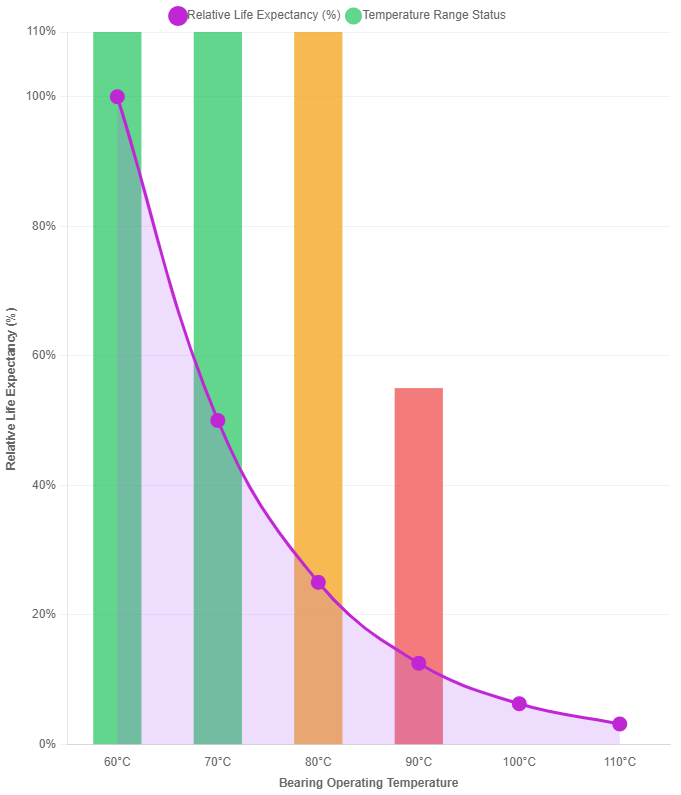
Bearing temperature abnormalities serve as crucial indicators of underlying mechanical issues that can significantly impact crusher performance and longevity. The relationship between operating temperature and bearing life follows an exponential pattern, where every 10°C increase above the recommended operating range potentially reduces bearing life by up to 50%. International standards provide clear guidelines for acceptable temperature ranges, with most industrial bearings designed to operate between 65°C and 80°C under normal conditions. Modern diagnostic approaches combine multiple monitoring techniques to detect temperature anomalies before they progress to complete failure, enabling proactive maintenance interventions.
Exponential Impact of Temperature Rise on Equipment Longevity
The relationship between operating temperature and bearing service life demonstrates a non-linear characteristic that accelerates degradation at elevated temperatures. Research indicates that operation at 90°C reduces bearing life expectancy by approximately 75% compared to operation at 70°C. This accelerated deterioration occurs due to multiple factors including lubricant oxidation, loss of material hardness, and increased clearance from thermal expansion. Continuous operation at temperatures exceeding 100°C can cause permanent damage to bearing raceways and rolling elements within just a few hours, emphasizing the critical importance of temperature monitoring and control.
International Standards for Bearing Temperature Monitoring
Global standards organizations have established comprehensive guidelines for bearing temperature monitoring and acceptable operational limits. These standards specify measurement methodologies, calibration requirements, and alarm threshold settings based on bearing type, size, and application. For impact crushers, the recommended maximum operating temperature typically ranges between 80-85°C, with automatic shutdown triggers activating at 90-95°C to prevent catastrophic failure. Regular temperature validation using certified instrumentation ensures compliance with these standards and maintains operational safety margins.
Infrared Thermal Imaging Applications in Anomaly Detection
Infrared thermography has emerged as a powerful diagnostic tool for identifying temperature abnormalities in crusher bearing systems. Advanced thermal cameras can detect temperature variations as subtle as 0.1°C across bearing housings, revealing early signs of lubrication problems or misalignment. Regular thermal imaging surveys conducted during operation provide baseline data for comparison and help identify developing issues before they become critical. The technology particularly excels at identifying localized hot spots that might indicate inadequate lubrication, contamination, or mechanical binding within the bearing assembly.
Vibration Spectrum Analysis Correlation with Temperature Issues
Vibration analysis provides complementary data to temperature monitoring, offering insights into the mechanical conditions that contribute to overheating. Specific vibration frequencies correlate with particular failure modes, such as inner race defects typically appearing at 0.6 times rotational frequency or outer race defects at 0.4 times rotational frequency. The combination of vibration spectrum analysis and temperature trending allows maintenance teams to distinguish between lubrication-related overheating and mechanically-induced heating. Advanced monitoring systems integrate both vibration and temperature data to provide comprehensive equipment health assessments and predictive maintenance recommendations.
Mechanical Dynamics Analysis of Core Failure Causes
The complex mechanical dynamics within impact crushers create multiple potential failure pathways that manifest as bearing overheating. Rotational speeds typically ranging from 500 to 1000 RPM generate significant centrifugal forces that must be properly managed through precision balancing and alignment. The rotor assembly, often weighing several tons, creates substantial inertial forces that bearings must support while maintaining precise clearances. Impact forces from material crushing generate shock loads that can momentarily exceed design parameters, testing the resilience of the entire bearing system.
Lubrication System Failure Mechanisms and Pathways
Lubrication system malfunctions represent the most common cause of bearing overheating in impact crushers. Five primary failure pathways include oil film rupture from excessive load or speed, viscosity breakdown from temperature extremes, contamination from external particles, additive depletion from extended service, and flow restriction from clogged passages. Each failure mode produces distinct temperature signatures and progression patterns. For example, viscosity breakdown typically causes gradual temperature increases over several operating hours, while complete flow restriction from blockage can cause temperature spikes exceeding 20°C within minutes.
Dynamic Load Amplification from Rotor Imbalance
Rotor imbalance creates dynamic forces that amplify bearing loads exponentially with rotational speed. Even minor imbalance in a crusher rotor rotating at 800 RPM can generate forces exceeding 20% of the static load on bearings. This increased loading directly translates to higher operating temperatures through increased friction and elastic deformation of bearing components. The relationship between imbalance magnitude and temperature rise follows a quadratic pattern, meaning that doubling the imbalance quadruples the additional heat generated. Regular dynamic balancing ensures that residual imbalance remains within manufacturer specifications, typically between G2.5 and G6.3 for impact crusher applications.
Friction Coefficient Changes from Improper Bearing Preload
Incorrect bearing preload establishes conditions for either excessive friction from over-preloading or impact damage from under-preloading. Over-preloading increases rolling element contact stress, elevating operating temperatures through increased friction and reduced lubricant film thickness. Under-preloading allows excessive internal movement, generating impact forces and vibration that convert to heat energy. The optimal preload setting creates sufficient internal stiffness to maintain proper alignment while minimizing friction losses. Temperature monitoring provides the most reliable indication of proper preload adjustment, with optimal settings typically resulting in operating temperatures 10-15°C above ambient conditions during run-in periods.
Lubrication System Optimization and Control Strategies
Proper lubrication represents the most effective means of controlling bearing temperatures and ensuring long-term reliability. Modern impact crushers employ sophisticated lubrication systems that continuously monitor and adjust lubricant delivery based on operating conditions. These systems must accommodate varying operational parameters including rotational speed, material throughput, and environmental conditions. The selection of appropriate lubricant viscosity represents a critical decision, with ISO VG 68 to VG 150 grades typically recommended for impact crusher bearings depending on operating temperatures and rotational speeds.
Viscosity-Temperature Relationship and Selection Criteria
The relationship between lubricant viscosity and operating temperature follows a logarithmic pattern that significantly impacts bearing performance. Lubricants with high viscosity indices maintain more stable viscosity across temperature ranges, providing better protection during both startup and normal operation. The optimal viscosity for most crusher bearings falls between 13 and 19 centistokes at operating temperature, requiring initial viscosities of approximately 100-150 centistokes at 40°C to achieve this range. Advanced synthetic lubricants can extend the effective temperature range by 20-30°C compared to mineral-based oils, particularly valuable in applications with wide ambient temperature variations.
Pressure and Flow Dynamics in Circulating Oil Systems
Circulating oil systems must maintain precise pressure and flow characteristics to ensure adequate lubrication without excessive energy consumption. Typical systems operate at pressures between 1.5 and 3.0 bar, delivering oil flow rates of 5-15 liters per minute per bearing depending on size and speed. Pressure differential monitoring across filters provides early warning of contamination buildup, with increases beyond 0.5 bar indicating the need for filter replacement. Flow sensors verify proper lubricant delivery to each bearing, with flow reductions of more than 15% triggering maintenance alerts. These monitoring points combine to ensure continuous adequate lubrication under all operating conditions.
Contamination Control and NAS Filtration Standards
Particle contamination represents a significant threat to bearing longevity, with hardness particles as small as 5 microns capable of causing abrasive wear. The National Aerospace Standard (NAS) 1638 establishes contamination classes ranging from 00 (cleanest) to 12 (dirtiest), with impact crusher bearings typically requiring NAS Class 7 or cleaner oil. Achieving this cleanliness level requires multi-stage filtration including 10-micron absolute filters followed by 3-micron polishing filters. Online particle counters continuously monitor contamination levels, automatically diverting flow through auxiliary filters when contamination exceeds preset thresholds. Regular oil analysis provides verification of filtration effectiveness and identifies wear metals before they reach critical concentrations.
Mechanical Structure Enhancement Technical Solutions
Structural modifications to bearing housings and support systems can significantly improve heat dissipation and reduce operating temperatures. The crusher frame must provide sufficient stiffness to minimize deflection under load while allowing thermal expansion without inducing additional stresses. Modern finite element analysis techniques enable optimization of housing designs for both structural integrity and thermal performance. Strategic placement of cooling fins and heat transfer surfaces enhances natural convection cooling, while internal passages can accommodate circulating cooling fluids for extreme applications.
Bearing Housing Stiffness Optimization for Thermal Management
Bearing housing stiffness directly influences thermal performance by controlling deflection under load and maintaining proper alignment. Housing designs incorporating reinforced ribs and strategic material distribution can reduce thermal deformation by up to 40% compared to conventional designs. The use of materials with matched thermal expansion coefficients for housing and bearing components minimizes internal clearance changes during temperature fluctuations. Advanced computational modeling allows designers to predict thermal behavior under various operating conditions, optimizing housing geometry for minimum temperature rise while maintaining structural integrity under impact loads.
Precision Dynamic Balancing Procedures and Standards
Rotor balancing to precision levels significantly reduces bearing loads and associated operating temperatures. Modern balancing equipment can achieve residual imbalance levels below 1.0 mm/s velocity, corresponding to G1.0 balance quality grade. This precision balancing reduces vibration-induced heating and allows operation closer to design limits without temperature concerns. Multi-plane balancing techniques address complex rotor assemblies, compensating for both static and dynamic imbalance components. The implementation of in-situ balancing capabilities enables periodic correction without disassembly, particularly valuable for rotors subject to uneven wear or material buildup during operation.
Cooling System Design and Aerodynamic Optimization
Effective cooling system design requires integration of heat transfer principles with the aerodynamic constraints of crusher operation. Forced air cooling systems typically provide 200-500 W/m²K heat transfer coefficients, sufficient for most applications when properly designed. The strategic placement of cooling fans and ducting ensures adequate airflow across all heated surfaces without creating excessive pressure drops. Computational fluid dynamics simulations optimize airflow patterns, eliminating hot spots and ensuring uniform cooling. For extreme operating conditions, auxiliary liquid cooling systems can provide heat removal capacities exceeding 2000 W/m²K, maintaining bearing temperatures within safe operating ranges even during peak loads.
Intelligent Monitoring and Predictive Maintenance Systems
Advanced monitoring technologies have transformed bearing temperature management from reactive to predictive approaches. Wireless sensor networks continuously track temperature variations at multiple points throughout the bearing system, providing comprehensive thermal mapping. These systems employ algorithms that distinguish between normal operational heating and abnormal temperature patterns indicative of developing problems. The integration of temperature data with other operational parameters creates a holistic view of equipment health, enabling maintenance planning before failures occur.
Wireless Temperature Monitoring Network Implementation
Modern wireless temperature monitoring systems utilize networks of strategically placed sensors that communicate through mesh network topology for reliability. These systems typically sample temperatures at 1-5 minute intervals, providing sufficient resolution to track trends without excessive power consumption. Sensor placement follows thermal modeling recommendations, with measurements taken at bearing outer rings, housing surfaces, and lubricant return lines. The wireless infrastructure eliminates cabling challenges in rotating equipment applications while providing flexibility to add measurement points as needed. Data transmission through industrial-grade protocols ensures reliability in electrically noisy crusher environments.
Artificial Intelligence Applications in Temperature Prediction
Machine learning algorithms analyze historical temperature data alongside operational parameters to predict future bearing temperatures with remarkable accuracy. These systems typically utilize recurrent neural networks or long short-term memory architectures that recognize patterns in time-series data. Training on several months of operational data enables predictions of temperature trends under various operating conditions, with typical accuracy within ±2°C for predictions 24 hours ahead. The AI models continuously improve through reinforcement learning, adapting to changing operating conditions and component wear patterns. Early warning systems trigger alerts when predicted temperatures approach predetermined thresholds, allowing preventive actions before overheating occurs.
Maintenance Interval Optimization Using Operational Data
Predictive maintenance systems dynamically adjust maintenance schedules based on actual operating conditions rather than fixed time intervals. Algorithms analyze temperature trends, vibration data, and lubricant condition to estimate remaining useful life of bearing components. This approach typically extends maintenance intervals by 20-40% while reducing unplanned downtime by up to 70%. The systems prioritize maintenance activities based on criticality, ensuring that resources are allocated to components with the highest risk of failure. Integration with enterprise resource planning systems enables automatic scheduling of maintenance activities and ordering of required parts, optimizing the entire maintenance workflow.
Engineering Case Studies and Solution Validation
Real-world applications demonstrate the effectiveness of comprehensive bearing temperature management strategies across various operating conditions. Documented case studies provide valuable insights into successful implementation of monitoring systems, lubrication improvements, and mechanical modifications. These examples span different impact crusher configurations, material types, and environmental conditions, offering proven solutions that can be adapted to specific operational requirements. The collective experience from these applications continues to refine best practices and drive technological advancements in bearing temperature control.
Limestone Processing Operation Temperature Resolution
A large limestone processing facility experienced recurring bearing overheating in multiple impact crushers, causing unscheduled downtime and reduced production capacity. Investigation revealed multiple contributing factors including inadequate lubrication flow rates, housing distortion under load, and insufficient cooling airflow. The comprehensive solution involved upgrading lubrication systems to provide 30% higher flow rates, reinforcing bearing housings with additional structural support, and installing high-efficiency cooling fans. These modifications reduced operating temperatures by 18°C and increased mean time between failures from 1,200 to over 4,000 operating hours, demonstrating the effectiveness of addressing multiple contributing factors simultaneously.
Cooling System Enhancement for Basalt Crushing Applications
Basalt crushing operations present particular challenges due to the material's abrasiveness and the resulting high crusher loads. One operation documented a 40% reduction in bearing life compared to specifications, primarily attributed to operating temperatures consistently exceeding 90°C. The implemented solution combined upgraded lubrication with advanced cooling system modifications. The installation of vortex tube cooling units provided targeted cooling to bearing housings, while heat exchanger additions improved overall heat rejection capacity. These changes maintained bearing temperatures below 80°C even during peak production periods, extending bearing life to meet manufacturer specifications despite the challenging operating conditions.
Bearing Protection Strategies for Mobile Crushing Equipment
Mobile impact crushers operating in remote locations require particularly robust bearing protection systems due to limited maintenance capabilities and variable operating conditions. One documented implementation utilized integrated temperature monitoring with satellite communication for remote diagnostics. Automatic lubrication adjustment based on real-time temperature readings optimized lubricant delivery across varying ambient conditions. The system incorporated redundant cooling mechanisms including fan-assisted convection and optional water spray cooling for extreme conditions. This comprehensive approach reduced bearing-related downtime by 85% while extending service intervals to match planned maintenance schedules, significantly improving operational efficiency in remote applications.