Understanding How EU Impact Crusher Solves Particle Size Irregularity in Sand and Gravel Aggregate Production
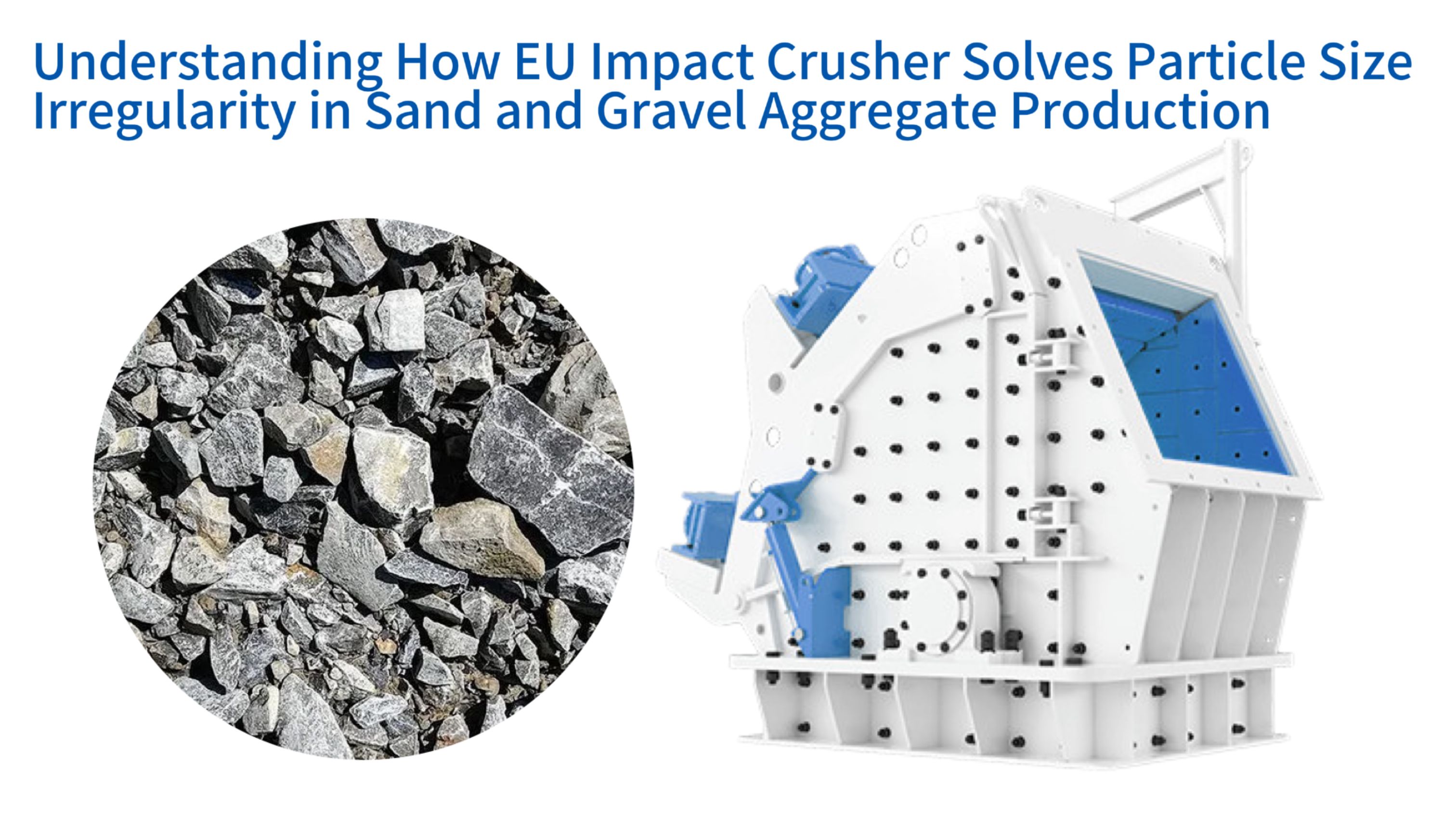
EU Impact Crusher: 4 Steps to Solve Aggregate Particle Size Irregularity
Uniform Feeding
Multi-stage Impact Crushing
Parameter Precision Adjustment
Stable Uniform Aggregate Output
This page explores the role of the EU impact crusher in modern aggregate production, with a specific focus on how the equipment addresses the widespread issue of uneven particle size. It examines the operational principles behind the machine, the practical methods used to achieve uniform gradation, and the ways in which consistent particle size contributes to overall production efficiency. The discussion also includes real-world application examples, routine maintenance practices, and the long-term value that stable particle size control brings to aggregate operations.
The Importance of Particle Size Uniformity in Sand and Gravel Aggregate Production
Economic Loss Composition Caused by Poor Gradation
40% Material Waste & Re-crushing
25% Extra Energy Cost
20% Customer Loss
15% Maintenance Loss
In sand and gravel aggregate production, particle size uniformity serves as one of the primary indicators of product quality. When aggregate particles vary too widely in size, the material becomes difficult to work with in downstream applications such as concrete mixing or road base construction. A mixture containing both oversized particles and excessive fines does not compact evenly, which can lead to structural weaknesses in finished projects. Producers who fail to maintain consistent gradation often face rejected shipments, increased material waste, and higher operational costs associated with re-crushing or screening out off-spec material.
The demand for tightly controlled aggregate gradation has intensified as construction standards become more stringent. Infrastructure projects now routinely specify narrow particle size ranges to ensure predictable performance in concrete, asphalt, and other engineered materials. For aggregate producers, this means that equipment must do more than simply reduce rock size—it must deliver a predictable distribution of particle dimensions with minimal variation. The economic implications are substantial, as consistent gradation directly affects yield, customer satisfaction, and the ability to command premium pricing for high-quality products.
The Relationship Between Gradation and Concrete Performance
Concrete mix design depends heavily on the particle size distribution of aggregates. When coarse aggregates vary excessively in size, the voids between larger particles become irregular, requiring more cement paste to achieve proper filling. This not only increases material costs but also affects the strength development and long-term durability of the finished concrete. Uniform aggregate gradation allows for more efficient packing, reducing the cement content needed while maintaining or improving structural performance. Understanding this relationship helps explain why crushing ratio directly influences the usability of finished aggregate products.
For ready-mix concrete producers, inconsistent aggregate shipments introduce variability that complicates mix design and quality control. Each load of aggregates that falls outside specified gradation limits forces adjustments to batching proportions, increasing the risk of non-conforming concrete. By ensuring that aggregates meet strict particle size specifications at the source, crusher operators provide downstream customers with a reliable input material that supports consistent concrete production.
Economic Costs of Poor Particle Size Control
The financial impact of uneven particle size extends beyond simple waste. When a crusher produces excessive fines, a portion of the valuable material becomes unsalable for many applications, effectively reducing the yield from each ton of feed. Conversely, when oversized particles remain in the product, additional screening and recrushing steps become necessary, consuming extra energy and equipment capacity. These inefficiencies accumulate quickly in large-scale operations where throughput is measured in hundreds or thousands of tons per day. Maintaining proper crushing capacity requires careful attention to particle size management throughout the production process.
Beyond direct processing costs, poor gradation affects customer relationships and market positioning. Aggregate buyers increasingly require certification of particle size compliance, and suppliers who cannot consistently meet specifications risk losing contracts to competitors with better process control. The cost of reworking off-spec material, managing customer complaints, and maintaining excess inventory of multiple grade fractions further erodes profitability for producers who rely on outdated or poorly configured crushing equipment.
Traditional Equipment Limitations in Gradation Control
Conventional crushing equipment often lacks the precision needed to produce uniformly graded aggregates. Older impact crusher designs, for example, typically provide limited adjustment capability for controlling the relationship between impact force and particle size. Operators may find that changing one parameter affects multiple aspects of product gradation in unpredictable ways, making it difficult to dial in the exact specifications required for different applications. The result is a constant trade-off between throughput and product quality that limits overall efficiency.
Jaw crushers and older cone crusher configurations face similar challenges when tasked with producing well-graded aggregate. Their crushing mechanisms, which rely primarily on compression, tend to produce more elongated and flaky particles compared to impact-based crushing. This particle shape characteristic further complicates gradation control, as flat or elongated pieces behave differently in screening operations and affect the packing density of finished aggregates. Modern aggregate specifications increasingly emphasize both particle size and shape, placing additional demands on crushing equipment.
How Poor Gradation Affects Screening and Material Handling
Particle size irregularities create operational difficulties throughout the aggregate processing system. Screens become less efficient when feed material contains a wide range of particle sizes, as the presence of near-size particles can blind screen openings and reduce throughput. Oversized particles that escape the crushing stage can damage downstream equipment or require manual removal, creating safety hazards and production interruptions. The cascading effects of poor gradation control ultimately limit the overall efficiency of the processing plant. Proper feed size management is essential for maintaining consistent screening performance.
Material handling systems also suffer when gradation is inconsistent. Conveyor systems may experience uneven loading, with surges of coarse material causing spillage or belt wear while fines accumulate in transfer points. Stockpiles built from poorly graded aggregates tend to segregate during stacking, with larger particles rolling to the edges and fines concentrating at the center. This segregation means that even material produced within specification can become non-uniform by the time it is loaded for shipment, requiring additional blending steps that add cost and complexity.
Operational Principles of EU Impact Crusher for Aggregate Production
EU Impact Crusher Working Principle Flow
The EU impact crusher operates on a fundamental principle of controlled impact energy applied to material as it passes through multiple crushing zones. Unlike compression-based crushers that rely on gradual pressure application, the impact crusher delivers instantaneous energy transfer that fractures rock along natural cleavage planes. This approach produces particles with better cubical shape characteristics while allowing operators to influence particle size distribution through adjustments to rotor speed, impact curtain settings, and the configuration of crushing chambers. The machine's design specifically targets the production of uniformly graded aggregate for construction applications.
At the core of the EU impact crusher's capability for gradation control is its ability to apply impact energy in a graduated manner. Material entering the crushing cavity first encounters the rotor, where blow bars accelerate it toward the primary impact curtain. The force of this initial impact determines whether material breaks immediately or continues through additional crushing stages. By controlling the gap between the rotor and impact curtains, operators adjust the severity of crushing applied at each stage, creating a predictable relationship between input material characteristics and output gradation.
Mechanism of Multi-Stage Impact Crushing
The multi-stage crushing configuration within the EU impact crusher creates distinct zones where particle size reduction occurs through different mechanisms. In the initial stage, material receives high-energy impacts that break larger pieces regardless of their structural weaknesses. Particles that survive this stage move into secondary crushing zones where reduced impact energy targets the remaining oversized material. This staged approach prevents over-crushing of material that has already reached target size while ensuring that all particles receive sufficient processing to meet specifications.
The arrangement of multiple impact curtains provides a natural gradation control mechanism that operates continuously without requiring external classification equipment. As material moves through the crushing chamber, the decreasing gap between successive impact curtains creates a size-discriminating effect. Particles that have been reduced sufficiently pass through to the discharge area, while those requiring additional size reduction remain in the active crushing zones. This internal classification function contributes to the machine's ability to produce consistent gradation across varying feed conditions.
Rotor Speed and Its Effect on Particle Size Distribution
Rotor speed represents one of the primary control variables for influencing particle size distribution in the EU impact crusher. Higher rotor speeds increase the kinetic energy transferred to material during impact, producing finer overall gradation with a higher proportion of smaller particles. Lower rotor speeds reduce impact energy, resulting in coarser output that may be suitable for applications requiring larger nominal aggregate sizes. The ability to select rotor speed independently of other machine settings provides operators with a straightforward method for shifting the entire particle size curve. Understanding how to balance speed with discharge size requirements is essential for optimal performance.
The relationship between rotor speed and particle size is not simply linear but follows predictable patterns that experienced operators can leverage for precise control. Changes in rotor speed affect not only the mean particle size but also the shape of the gradation curve, influencing the distribution of material across sieve sizes. This characteristic allows operators to fine-tune the machine's output to match specific aggregate specifications by selecting rotor speeds that produce the desired balance between coarse and fine fractions.
Impact Curtain Adjustment for Gradation Refinement
The adjustable impact curtains in the EU impact crusher provide a secondary layer of gradation control that complements rotor speed selection. By changing the gap between the rotor and each impact curtain, operators modify the intensity of crushing applied at different stages of the process. Tighter gaps increase the impact force applied to material, producing finer output, while larger gaps allow more material to pass through with less size reduction. The ability to adjust each curtain independently enables precise shaping of the final gradation curve. Components such as the impact plate must be maintained properly to ensure consistent adjustment capability.
Independent adjustment of primary and secondary impact curtains gives operators exceptional flexibility in responding to changes in feed material characteristics. When processing harder rock that resists breakage, moving the primary curtain closer increases the initial impact energy to ensure adequate size reduction. For softer materials prone to over-crushing, increasing the primary curtain gap while tightening secondary curtains maintains overall reduction while protecting the desired coarse fraction. This adaptability makes the EU impact crusher effective across a wide range of aggregate applications.
How Crushing Chamber Configuration Shapes Particle Uniformity
The geometry of the crushing chamber in the EU impact crusher contributes significantly to the uniformity of the final product. The chamber is designed to promote particle-on-particle interaction, where material already within the specified size range helps break incoming larger pieces without sustaining damage itself. This autogenous crushing action reduces the production of excessive fines while ensuring that all material receives sufficient processing to achieve proper shape characteristics. The result is a more balanced gradation with fewer extreme particle sizes.
Chamber design also influences the residence time of material within the crushing zones, which affects the degree of size reduction applied to each particle. Well-designed chambers create a flow pattern that moves material through the machine at an optimal rate, providing sufficient opportunity for breakage without retaining particles longer than necessary. This balance between throughput and reduction efficiency supports consistent gradation even when feed rates vary, as the chamber's inherent flow characteristics maintain uniform processing conditions. The rotor design works in concert with chamber geometry to achieve this balance.
Practical Methods for Achieving Consistent Gradation with EU Impact Crusher
Key Methods to Improve Aggregate Gradation Uniformity
Achieving consistent particle size gradation with the EU impact crusher begins with proper machine setup before production starts. Operators must establish baseline parameters that reflect the specific material characteristics and target specifications for the application. This includes selecting appropriate rotor speeds, setting impact curtain gaps, and configuring any optional features such as third impact curtains or specialized blow bar configurations. The initial setup phase creates the foundation upon which ongoing gradation control efforts are built. MSW Technology, with over fifteen years of experience in crushing equipment manufacturing, has developed comprehensive setup protocols that help operators achieve optimal gradation from the first production run.
Throughout production, maintaining consistent gradation requires attention to feed material characteristics and machine performance. Variations in feed size, moisture content, or material hardness can shift the gradation curve even when machine settings remain unchanged. Experienced operators monitor product samples regularly, using the results to make incremental adjustments that compensate for these variations before they result in off-spec material. This proactive approach to gradation control reduces waste and ensures consistent product quality.
Pre-Operation Setup for Optimal Gradation Control
Before beginning a production run, operators should verify that the EU impact crusher is configured correctly for the intended application. This includes confirming that blow bars are properly oriented and show acceptable wear levels, as worn blow bars reduce impact effectiveness and shift gradation toward coarser output. Impact curtain settings should be measured and recorded to establish a baseline that can be referenced when adjustments become necessary. The machine's rotor should be balanced to ensure smooth operation at the selected speed, as vibration can affect impact consistency and accelerate wear. Regular inspection of the frame structure also helps maintain alignment and stability during operation.
Feed preparation also plays a crucial role in achieving consistent gradation. The crusher performs best when feed material is relatively uniform in size and free of contaminants such as soil or clay that can interfere with impact breakage. Pre-screening to remove fines before they enter the crusher can improve gradation control by preventing over-crushing of material that already meets specifications. Proper feed rate control ensures that the crushing chamber operates at designed capacity, maintaining the internal flow patterns that support uniform particle size reduction.
Parameter Adjustment Techniques for Different Material Types
Different rock types respond differently to impact crushing, requiring specific parameter adjustments to achieve target gradation. Limestone and other softer sedimentary rocks break relatively easily, allowing for higher rotor speeds and closer impact curtain gaps without creating excessive fines. Harder materials such as granite or basalt require different treatment, with slower rotor speeds and larger impact curtain gaps often producing better gradation characteristics. Understanding these material-specific responses enables operators to select optimal settings from the start of production.
Variations within a single material type also require consideration during parameter adjustment. Rock with abundant natural fracture planes may require less impact energy to break than massive, unfractured material of the same composition. Moisture content affects breakage behavior as well, with wet material requiring different impact settings than dry material to achieve the same gradation. Experienced operators account for these variations by making small, incremental adjustments based on observed product characteristics rather than relying solely on standard settings.
Real-Time Monitoring and Gradation Verification
Continuous monitoring of product gradation during production allows operators to maintain consistent output even as feed conditions change. Regular sampling and sieve analysis provide quantitative data that guides parameter adjustments. Modern production environments increasingly incorporate automated sampling systems that provide frequent gradation data without interrupting production, enabling rapid response to developing trends before they result in out-of-spec material. This data-driven approach to gradation control significantly improves consistency compared to periodic manual sampling.
Integration of monitoring data with machine control systems represents the next frontier in gradation management. Sensors that track rotor speed, impact curtain position, and material flow can provide real-time feedback that helps operators maintain optimal conditions. When combined with regular product sampling, this information creates a complete picture of machine performance and product quality. MSW Technology has incorporated these principles into its equipment designs, drawing on fifteen years of industry experience to develop impact crushers that support precise gradation control across diverse operating conditions.
Common Gradation Problems and Corrective Actions
When product gradation deviates from specifications, operators must identify the root cause and apply appropriate corrective measures. Excessively coarse output often indicates that impact energy is insufficient, which may result from worn blow bars, excessive impact curtain gaps, or rotor speeds that are too low. Addressing these issues through component replacement or parameter adjustment typically restores proper gradation without requiring major machine modifications. The blow bar condition is particularly critical, as worn bars lose their ability to effectively accelerate material.
Excessive fines in the product present a different set of potential causes. High rotor speeds, tight impact curtain gaps, or feed material that is already friable can all contribute to over-crushing. In some cases, reducing rotor speed or increasing impact curtain gaps resolves the issue while maintaining acceptable reduction ratios. When these adjustments prove insufficient, operators may need to consider modifications to feed preparation or screening practices to remove fines before they enter the crushing chamber.
Real-World Applications of EU Impact Crusher in Aggregate Production
EU Impact Crusher Application Effect Comparison
Aggregate producers across diverse operating environments have implemented the EU impact crusher to address particle size uniformity challenges. These applications range from small quarries producing specialized aggregate grades to large-scale operations supplying millions of tons annually for infrastructure projects. The common thread across these installations is the recognition that consistent gradation drives customer satisfaction and operational efficiency. Each application demonstrates how proper equipment selection and operation translate into measurable improvements in product quality.
Documentation from these applications provides valuable insights for producers considering equipment upgrades or new installations. The experiences of other operators highlight the importance of proper parameter selection, regular maintenance, and attentive operation in achieving target gradation. By understanding how similar operations have addressed their particle size control challenges, new users can avoid common pitfalls and accelerate their learning curve with the EU impact crusher.
Mid-Size Aggregate Producer Transitioning from Jaw and Cone Configuration
One mid-size aggregate producer operating a limestone quarry replaced a traditional jaw and cone crusher combination with a single EU impact crusher for secondary crushing duties. Prior to the change, the operation struggled with inconsistent gradation that required extensive screening and recrushing of off-spec material. The jaw and cone configuration produced material with significant flakiness and a bimodal particle size distribution that complicated downstream screening. Production efficiency suffered as operators constantly adjusted settings in attempts to meet specifications.
After installing the EU impact crusher, the operation achieved immediate improvements in gradation consistency. Single-pass product from the impact crusher met specifications that previously required recrushing of up to 30 percent of the material. The improved particle shape also enhanced screening efficiency, allowing the operation to increase throughput without adding screening capacity. These changes translated into measurable cost savings through reduced energy consumption, lower wear parts costs, and decreased labor requirements for manual intervention.
High-Volume Production Facility Processing Variable Feed Materials
A large aggregate facility processing multiple rock types from different quarry faces faced persistent gradation challenges due to feed variability. The operation originally used separate crushing lines configured for specific material types, but this approach required frequent shutdowns to reconfigure equipment when switching between sources. The facility sought a solution that could accommodate material variations without sacrificing product quality or production efficiency. The EU impact crusher was selected for its ability to adapt to changing feed characteristics through straightforward parameter adjustments.
Implementation of the EU impact crusher enabled the facility to consolidate production onto a single crushing line while maintaining consistent gradation across material types. Operators developed adjustment protocols that allowed rapid transitions between processing limestone, dolomite, and harder sandstone materials. The result was a 25 percent reduction in downtime associated with material changeovers and improved overall equipment utilization. The facility now consistently produces aggregate meeting strict gradation specifications regardless of the raw material being processed.
Specialized Application for High-Specification Asphalt Aggregate
An aggregate operation supplying material for high-performance asphalt mixes required exceptional gradation control beyond standard construction specifications. Asphalt aggregate demands tight control of both particle size distribution and particle shape, as these factors directly affect binder consumption and pavement durability. Traditional crushing equipment could not consistently meet the stringent specifications, limiting the operation's ability to serve this premium market segment. The operation turned to the EU impact crusher for its documented capability in producing well-graded, cubical aggregate.
The specialized application required fine-tuning of both rotor speed and impact curtain configurations to achieve the precise gradation curve specified by asphalt mix designs. Through systematic testing and parameter optimization, the operation developed settings that consistently produced aggregate with 90 percent cubical particles and gradation within 5 percent of target values. This capability opened new market opportunities for the operation, allowing it to command premium pricing for specialty aggregate products while reducing material waste from out-of-spec production.
Integration with Mobile Crushing Operations
Mobile crushing operations face unique challenges in maintaining gradation consistency due to varying site conditions and frequent equipment moves. A contractor providing on-site aggregate crushing for road construction projects implemented EU impact crushers on mobile platforms to address these challenges. The ability to quickly adjust crusher parameters as feed conditions changed from one project to the next proved essential for maintaining product quality across diverse applications. The mobile configuration also required robust component design that could withstand the rigors of frequent transport and setup.
The contractor's experience demonstrated that the EU impact crusher's gradation control capabilities transfer effectively to mobile applications. Operators developed standardized setup procedures that achieved consistent gradation within the first hour of production at each new site. The reduced need for recrushing and screening compared to previous equipment configurations improved project economics and allowed the contractor to complete projects faster. The combination of mobility and precise gradation control enabled expansion into new markets requiring certified aggregate products.
Maintenance Practices That Preserve Gradation Control Capability
Maintenance Flow to Ensure Stable Gradation Control
Maintaining consistent particle size gradation requires attention to equipment condition beyond basic operational parameters. Wear components that have exceeded their useful life can introduce variability that no amount of parameter adjustment can compensate for. Regular inspection and timely replacement of critical wear parts ensure that the EU impact crusher continues to deliver the gradation control performance for which it was designed. Operators who integrate wear monitoring into their maintenance programs achieve more consistent product quality over extended production periods.
The relationship between equipment condition and gradation control creates a compelling case for proactive maintenance practices. Rather than waiting for performance degradation to become apparent in product quality, operators can use wear measurement data to predict when component replacement will be needed. This approach prevents unexpected shifts in gradation that can result in out-of-spec production and allows maintenance activities to be scheduled during planned downtime periods.
Blow Bar Wear and Its Impact on Gradation
Blow bars represent one of the most critical wear components affecting gradation control in the EU impact crusher. As blow bars wear, their ability to accelerate material and deliver effective impact energy diminishes. This wear results in a gradual coarsening of the product gradation that may not be immediately apparent to operators focused on other parameters. Regular measurement of blow bar wear and comparison to baseline performance helps operators anticipate when replacement will be necessary to maintain target gradation.
The pattern of blow bar wear also provides diagnostic information about crusher operation and feed conditions. Uneven wear across the length of the blow bar may indicate feed distribution problems that can affect gradation consistency. Excessive wear on the leading edge of blow bars suggests operating conditions that may benefit from rotor speed adjustment or changes to feed characteristics. Attention to these wear patterns enables operators to address underlying issues that affect gradation control beyond simple component replacement.
Impact Curtain Condition and Adjustment Precision
The condition of impact curtains directly affects the precision with which operators can control product gradation. Worn impact curtain surfaces lose their ability to effectively break material, requiring tighter settings to achieve the same reduction. This compensation reduces the usable adjustment range and may accelerate wear on other components. Regular inspection of impact curtain surfaces and replacement when wear reaches prescribed limits ensures that the full adjustment range remains available for gradation control.
The mechanical systems that position and hold impact curtains also require attention to maintain adjustment precision. Loose mounting hardware, worn adjustment mechanisms, or damaged positioning indicators can result in inaccurate curtain positioning that undermines gradation control efforts. Calibration of curtain position indicators and verification of adjustment mechanism function should be part of regular maintenance routines. MSW Technology, drawing on fifteen years of crushing equipment manufacturing experience, designs impact curtain systems that maintain adjustment precision even under demanding operating conditions.
Rotor Balance and Bearing Condition Monitoring
Rotor balance affects impact consistency in ways that influence product gradation. An unbalanced rotor creates vibration that reduces impact effectiveness and can cause uneven wear of blow bars and impact curtains. Regular monitoring of rotor balance through vibration analysis helps detect developing issues before they affect product quality. When balance issues are identified, operators can schedule corrective maintenance rather than accepting degraded gradation performance.
Bearing condition also plays a role in maintaining consistent rotor speed and impact energy. Worn bearings increase friction and can allow rotor deflection that affects impact geometry. Temperature monitoring of bearings provides early warning of developing problems that could affect gradation control. Operators who include bearing condition in their preventive maintenance programs experience fewer unexpected interruptions in gradation consistency and longer equipment service life.
Feed Arrangement and Wear Pattern Management
The arrangement of feed material entering the crusher affects wear distribution and gradation consistency. Concentrated feed that does not distribute evenly across the rotor width creates uneven wear patterns that compromise gradation control over time. Operators should monitor feed distribution and adjust feed arrangements as needed to maintain even loading across the rotor. Proper feed distribution extends component life and supports consistent gradation throughout production runs.
Feed material characteristics also influence wear patterns that affect gradation control. Variations in moisture content, fines content, or material hardness can accelerate wear in specific areas of the crushing chamber. Operators who track wear patterns in relation to feed characteristics develop insights that help optimize both feed preparation and crusher operation. This continuous improvement approach to wear management supports sustained gradation control capability across varying operating conditions.