The Definitive Technical Comparison: Why Cone Crushers Excel Over Impact Crushers for High-Hardness Granite Processing
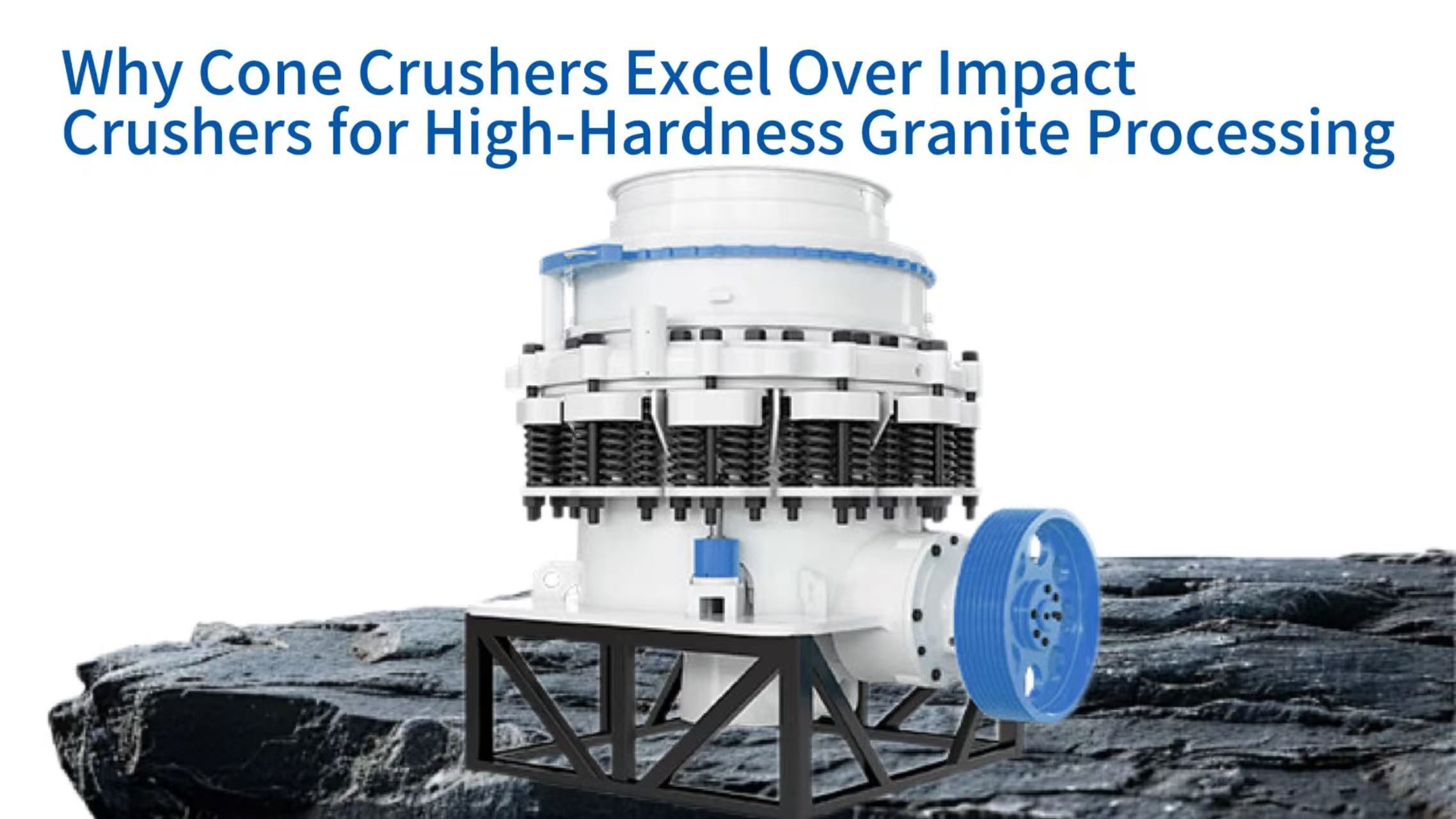
The selection of appropriate comminution equipment within the mining and aggregate production sectors constitutes a fundamental decision that dictates the economic viability and operational stability of a project. Granite, recognized as a prevalent igneous rock, exhibits substantial mechanical strength and abrasiveness, typically registering a Mohs hardness value ranging from six to seven. This inherent material property imposes rigorous demands on the processing machinery. A critical juncture in the design of a granite crushing circuit is the selection of equipment for the secondary and tertiary crushing stages, specifically the decision between a cone crusher and an impact crusher. This article delivers an exhaustive technical examination of the operational principles, economic considerations pertaining to wear components, product morphology, and system configuration strategies. It elucidates why the cone crusher represents the superior and more sustainable technological choice for processing high-hardness granite, guiding stakeholders toward optimized, cost-effective comminution solutions that enhance long-term profitability.
Foundational Operational Principles: The Incompatibility of Impact Forces with High-Strength Lithologies
Crushing Mechanism Comparison: Cone vs Impact Crusher for Granite
Cone Crusher (Compression Lamination)
Slow, oscillatory mantle movement
Applies gradual compressive force (150-250 MPa range)
Inter-particle stress propagation
Targets internal micro-fractures in granite
Efficient energy conversion
High tons/kWh ratio for hard rock
Impact Crusher (High-Velocity Impact)
Rapid rotor/blow bar rotation
Creates high-velocity impact forces
Surface-level energy absorption
Poor penetration into granite's crystalline structure
Energy waste (heat/noise)
Low efficiency for hard rock applications
The primary selection criterion for any crushing apparatus resides in the fundamental compatibility between its mechanical principle of operation and the physical characteristics of the target material. Granite, characterized by its high compressive strength and crystalline structure, interacts with applied forces in a distinct manner. The subsequent analysis delineates the fundamental differences between the lamination crushing mechanism inherent to cone crushers and the impact comminution method employed by impact crushers when applied to hard, abrasive granite.
The Mechanics of Inter-Particle Lamination in Cone Crushers
Cone crushers operate on the well-established principle of inter-particle lamination or compression crushing. Within the crushing chamber, a rotating eccentric drives the mantle in an oscillatory motion against the stationary concave. This action does not strike the rock; rather, it applies a progressively increasing compressive force to a bed of material. This pressure propagates through the rock particles, exploiting internal micro-fractures and structural weaknesses. For a dense, competent rock like granite, this method of applying sustained, high-magnitude stress is exceptionally effective in inducing particle fracture along natural planes, a process often termed volume breakage. The energy is transmitted deeply and efficiently into the material structure, a principle thoroughly examined in resources discussing the cone crusher components that facilitate this unique action.
The Comminution Mechanism of Impact Crushers and its Inherent Limitations
Impact crushers achieve size reduction through a fundamentally different process: high-velocity impact. A rotor fitted with blow bars accelerates feed material to high speeds, projecting it against stationary impact plates or other rock particles. This kinetic energy transfer results in shattering upon collision. While this mechanism offers a high reduction ratio and is exceptionally efficient for processing materials with lower compressive strength and good friability, such as limestone or recycled concrete, it proves to be mechanically inefficient when applied to granite. The extreme hardness of granite means the impact force is largely absorbed at the surface level, leading to poor energy transfer and rapid deterioration of the impacting components, particularly the blow bars which suffer from high-stress abrasion.
The Criticality of Stress Matching in Rock Fracture
From a geotechnical and materials engineering perspective, the efficacy of a crushing mechanism is contingent upon its ability to match the stress profile to the rock's failure mode. Granite possesses high compressive strength, typically between 150 and 250 megapascals, enabling it to withstand significant static or slowly increasing pressure. However, its resistance to concentrated, dynamic impact loads is relatively lower, though the energy required to initiate fracture via impact remains substantial. A cone crusher applies a distributed, gradually intensifying stress field that engages the entire particle, efficiently utilizing its compressive strength limits to initiate bulk fracture. Conversely, the impact crusher delivers a highly localized, transient force that struggles to penetrate the competent crystalline structure of granite, resulting in energy being dissipated as heat and noise rather than productive size reduction. Understanding these principles is fundamental to grasping the concept of feed size appropriateness for each machine type.
Energy Conversion Efficiency in Comminution Processes
The efficiency with which a crusher converts electrical energy into useful rock breakage is a critical economic parameter, often measured in tons produced per kilowatt-hour consumed. In this regard, cone crushers demonstrate a marked superiority when processing hard materials like granite. The laminating principle ensures that the applied mechanical energy is primarily directed toward propagating cracks within the rock structure, leading to a high energy-to-breakage conversion rate. In contrast, impact crushers processing hard granite dissipate a significant portion of input energy as waste heat, excessive noise, and the accelerated wear of machine surfaces. This inefficiency translates directly into higher operational electricity costs per ton of finished product, a factor that becomes increasingly significant over the lifespan of a quarrying operation and relates directly to the desired crushing capacity of the plant.
Economic Analysis of Wear Components: A Determinant of Long-Term Profitability
Impact Crusher Blow Bars
Lifespan:
20-100 Hours
High-velocity impact causes rapid gouging wear on hard granite
Annual Cost Impact (1,000,000 Tons Processed)
Cone Crusher Total Wear Cost
$300,000 - $500,000
Impact Crusher Total Wear Cost
$1,500,000 - $3,000,000
Cost Difference: $1,000,000+ per year - enough to recover cone crusher's higher initial cost in 6-12 months
For any mining or quarrying enterprise, the operational expenditure associated with processing equipment, particularly the cost of replacing wear-resistant parts, forms a substantial portion of the overall budget and directly impacts project profitability. When processing highly abrasive materials such as granite, the longevity of these consumable components becomes the paramount consideration in equipment selection. This section provides a quantitative and qualitative comparison of the wear characteristics exhibited by cone and impact crushers when operating in identical hard rock applications.
Wear Mechanisms of Cone Crusher Liners: Mantle and Concave
The primary wear components in a cone crusher are the mantle, which is the movable element, and the concave, which is the stationary upper liner. The wear mechanism here is predominantly high-pressure grinding and abrasion. As the mantle gyrates, it compresses the rock bed against the concave. Although the pressures are immense, the motion is relatively slow and continuous. High-quality liners, typically cast from manganese steel alloys, benefit from a phenomenon known as work hardening. Under repeated compressive stress, the surface layer of the liner becomes significantly harder and more resistant to further wear. This allows a set of cone crusher liners to operate for hundreds, and in some cases thousands, of hours processing abrasive granite before replacement is necessary, with the main frame providing the robust support needed for this prolonged operation.
The Accelerated Wear Fate of Impact Crusher Blow Bars and Liners
The wear life of impact crusher consumables, specifically the blow bars and impact plates, presents a stark contrast. These components operate in a regime of high-velocity impact and severe gouging abrasion. The blow bar, rotating at high speed, strikes the granite with immense force, effectively using its own surface to break the rock. This results in a rapid removal of material from the bar's working face. In many high-hardness granite applications, a set of blow bars may have an operational life measured in mere tens of hours before requiring replacement or reversal. The frequency of this maintenance task not only incurs high costs for the replacement parts themselves but also leads to significant production losses due to downtime.
Quantitative Cost Analysis: Calculating Cost Per Ton
To illustrate the economic impact, consider a theoretical crushing plant processing granite with a target output of two hundred tons per hour. The wear part cost attributed to the cone crusher in this scenario might average between thirty and fifty US cents for every ton of material produced. This relatively low figure reflects the extended lifespan of its manganese steel liners. In contrast, an impact crusher attempting to process the same granite feed would likely incur wear part costs significantly higher, potentially ranging from one dollar and fifty cents to three dollars per ton. This difference of one dollar or more per ton is economically profound. For an operation processing one million tons annually, this single factor represents a potential difference of one million US dollars in operating profit, underscoring the critical nature of correct mining and quarrying equipment selection.
Operational Impact of Maintenance Frequency and Downtime
Beyond the direct cost of replacement parts, the indirect costs associated with maintenance frequency are equally significant. Scheduled maintenance on a cone crusher, such as liner change-out, is typically an infrequent event, often aligning with other planned plant shutdowns. This allows for predictable budgeting and minimizes unexpected production losses. The frequent blow bar changes required by an impact crusher processing hard granite, however, lead to recurrent, unscheduled downtime. Each intervention necessitates stopping the entire production line, securing the equipment, and performing a labor-intensive task. These cumulative periods of inactivity represent lost revenue that is difficult to recover, further widening the economic advantage of the cone crusher in hard rock applications and highlighting the importance of understanding the cone crusher types available for different duties.
Product Morphology: Meeting the Specifications of Modern Construction Material Standards
The modern construction industry, particularly the ready-mix concrete and asphalt sectors, imposes increasingly stringent specifications on the shape of coarse aggregates. The parameter of flakiness index, which measures the proportion of particles with a specific thickness to length ratio, is critical. Aggregate shape directly influences the workability, strength, and durability of the final construction material. This section evaluates and contrasts the capabilities of cone and impact crushers to produce granite aggregates that meet these high morphological standards.
Particle Shaping Capabilities of Modern Multi-Cylinder Cone Crushers
Contemporary cone crusher design, especially in multi-cylinder hydraulic models, has evolved significantly to address the demand for superior particle shape. Engineers optimize the crushing chamber geometry, known as the chamber profile, and adjust the eccentric throw to enhance the shaping effect. Within the chamber, the inter-particle compression is combined with a degree of attrition, a grinding action that effectively abrades the sharp edges off freshly fractured particles. This process encourages the production of a more cubical product. While historical perceptions may have favored impact crushers for shape, advanced cone crushers have successfully narrowed, and in many applications, closed this gap, consistently producing granite aggregates with flakiness indices that satisfy the most demanding specifications for high-performance concrete.
The Deterioration of Impact Crusher Shape Performance on Hard Rock
Impact crushers are rightfully celebrated for their ability to produce excellent cubical shapes when processing soft to medium-hard, non-abrasive materials like limestone. This success stems from the principle of particle breakage along natural fractures upon impact. However, this performance does not reliably translate to hard, abrasive granite. The extreme resistance of granite leads to uneven and rapid wear of the blow bars and impact plates. As these components wear, the geometry of the crushing chamber and the trajectory of the thrown rock change unpredictably. This dynamic wear pattern results in inconsistent particle breakage, often leading to an increase in the proportion of elongated and flat particles within the product. The resulting product grade may fail to meet the quality control standards required for high-value construction projects.
The Influence of Micro-Cracking on Final Concrete Integrity
The process by which a rock is broken can influence the internal integrity of the resulting aggregate particles. The compressive forces within a cone crusher generate a network of micro-cracks within the material as it fractures. These micro-cracks, while potentially a point of consideration, can also provide a textured surface that promotes a stronger mechanical bond with cement paste in concrete. Conversely, the violent impact forces in an impact crusher can induce more extensive internal damage or create smooth fracture surfaces. From the perspective of final concrete performance, aggregates produced by a well-controlled compression process often demonstrate reliable and predictable behavior, contributing to the long-term structural integrity of the cured material.
Operational Control for Optimizing Granite Aggregate Shape
Experienced plant operators can leverage the adjustability of a cone crusher to fine-tune the particle shape of the final granite product. A primary control parameter is the closed side setting, which determines the minimum distance between the mantle and concave at the bottom of the chamber. Reducing this setting increases the compressive force applied to the material and subjects the particles to more crushing cycles within the chamber before they are discharged. This practice, when combined with a properly designed screening circuit that returns oversize material to the crusher for another pass, effectively transforms the cone crusher into a shaping tool. This ability to exert precise control over the discharge size and particle morphology is a key advantage in producing premium-grade construction aggregates.
The Classic Granite Crushing Circuit: The Rationale Behind the Jaw-Cone Configuration
Standard Granite Crushing Circuit: Jaw-Cone Configuration
Quarry Blasting
Raw granite boulders
> 1000mm diameter
Primary Jaw Crusher
Reduction to
150-300mm
Vibrating Screen
Size classification
& removal of fines
Cone Crusher
Final reduction & shaping
to specification size
Final Screening
Closed-circuit operation
100% specification compliance
Key Warning: Replacing the cone crusher with an impact crusher in this circuit leads to rapid wear (blow bars: tens of hours), inconsistent product quality, and frequent unscheduled downtime - creating a production bottleneck for granite processing.
The design of an efficient and reliable crushing plant is not merely an assembly of machines; it is a carefully engineered system that adheres to the logical progression of particle size reduction. For materials as demanding as granite, the configuration of primary, secondary, and tertiary stages must be optimized for material flow and mechanical compatibility. This section explains why the combination of a jaw crusher for primary reduction followed by a cone crusher for secondary and tertiary reduction constitutes the industry standard for hard rock processing.
The Primary Role of the Jaw Crusher as a Foundation
Run-of-mine granite, extracted directly from the quarry face through blasting, often contains massive boulders exceeding one meter in diameter. The first machine in the processing chain, the primary crusher, must be capable of accepting and reducing these largest fragments. The jaw crusher is uniquely suited to this task. Utilizing the same fundamental principle of compressive force, a jaw crusher features a large feed opening and a robust mechanism designed to handle immense stresses. It reliably breaks down the largest granite boulders to a more manageable size, typically in the range of one hundred fifty to three hundred millimeters, creating a consistent and suitable feed stream for the downstream secondary crusher.
Seamless Material Transfer to the Secondary Cone Crusher
The output material from a primary jaw crusher, after passing through appropriate screening, possesses characteristics that are ideal for feeding into a cone crusher. The particle size distribution is relatively uniform and falls well within the designed feed size limits of most secondary cone crushers. This compatibility is not coincidental; it reflects a fundamental understanding of the crushing process. The jaw crusher performs the heavy initial reduction, preparing the material for the more specialized laminating action of the cone crusher. This two-stage approach ensures that each machine operates within its optimal efficiency range, maximizing the overall energy utilization of the entire plant, with the movable jaw of the primary crusher doing the initial heavy work.
The Failure Mode of Jaw-Impact Circuits in Granite Applications
In an attempt to reduce initial capital expenditure, some project planners consider substituting the secondary cone crusher with an impact crusher, creating a jaw-impact configuration. Experience in the field consistently demonstrates the inadequacy of this approach for hard granite. The impact crusher, subjected to the high work index of granite, rapidly becomes the performance bottleneck of the entire plant. Its productivity declines sharply as wear components degrade, the product size becomes coarser and less controlled, and the frequency of maintenance interventions escalates. The plant struggles to maintain target throughput and product quality, ultimately leading to financial losses and the inevitable requirement for a costly and disruptive equipment replacement, highlighting why the aggregate processing industry standard remains the jaw-cone configuration.
The Integral Role of Screening and Closed-Circuit Operation
A fully functional jaw-cone crushing plant invariably incorporates a multi-deck vibrating screening system. The entire output from the cone crusher is directed to this screen. Here, the material stream is separated into distinct size fractions, with particles meeting the final product specifications directed to stockpiles. Critically, any oversized material that remains too large is not wasted; it is conveyed back to the cone crusher for another cycle of reduction. This closed-circuit configuration is essential for quality assurance. It guarantees that every ton of material leaving the plant as a finished product has successfully passed through the final sizing screen, ensuring one hundred percent conformity to the required specifications, a principle that guides crushing solutions for demanding materials.
Application in Mobile Crushing Environments: Adapting the Principles to Modern Operational Demands
Mobile Crushing Solutions for Granite Applications
Mobile Cone Crusher Plant
Best For: Secondary/tertiary processing of granite at remote quarry sites or infrastructure projects
Key Benefits: Track/wheeled mobility, rapid deployment (hours), consistent product quality
Operational Advantages: Low wear rates, high uptime, integrated screening system
Typical Throughput: 50-300 tons/hour (granite)
Spare Parts Requirement: Low (liner replacement every hundreds/thousands of hours)
Mobile Impact Crusher
Best For: Soft rock (limestone), C&D waste recycling - NOT recommended for granite
Limitations for Granite: Rapid blow bar wear, high operational costs, inconsistent product quality
Logistical Issues: Frequent spare parts requirement problematic in remote locations
Typical Throughput: 30-150 tons/hour (granite - rapidly declining)
Spare Parts Requirement: High (blow bar replacement every tens of hours)
Integrated Mobile Solution (Jaw + Cone)
For large-scale linear infrastructure projects (highways, dams) requiring granite aggregate at multiple locations:
Mobile Jaw Crusher (Excavation Site)
Initial reduction of blasted granite boulders
Transport to Mobile Cone Plant
Closer to point of use for final sizing/shaping
High-Quality Aggregate
Meets construction specifications at point of use
The evolution of the construction and mining industries has seen a significant rise in the utilization of mobile crushing plants. These self-contained units offer unparalleled flexibility for on-site processing in diverse scenarios, from urban demolition projects to remote mine sites. The selection of the appropriate crusher type for the mobile chassis, particularly when the target material is granite, remains governed by the same physical and economic principles as stationary plants, though with additional logistical considerations.
The Mobile Cone Crusher Plant as a Solution for Hard Rock
For contractors operating in smaller granite quarries or engaged in projects requiring processing at multiple, dispersed locations, the mobile cone crusher plant represents an optimal solution. These units integrate a high-performance cone crusher and a matching screen onto a tracked or wheeled chassis. This configuration eliminates the substantial time and cost associated with constructing concrete foundations and installing fixed conveying systems. A mobile cone plant can be driven directly to the rock face, commence production within hours of arrival, and be relocated just as easily when the extraction front advances, providing a level of operational agility that is impossible with stationary installations.
The Appropriate Domain of Mobile Impact Crushers
Mobile impact crushers have carved a substantial niche for themselves in specific sectors. Their design, characterized by a large feed opening and high reduction ratio, makes them exceptionally effective for applications such as recycling construction and demolition waste, processing concrete and asphalt rubble, and acting as primary crushers in soft rock quarries, particularly limestone. Their mobility and speed are key advantages in these transient or urban environments. However, when the material type shifts to high-hardness granite, the inherent wear and efficiency disadvantages of the impact crusher persist, regardless of whether it is mounted on a mobile chassis or a stationary foundation. The rapid wear of blow bars becomes even more problematic in a remote location where spare parts supply chains are long and unreliable.
The Integrated Mobile Jaw and Mobile Cone Solution
Major infrastructure projects, such as the construction of long-distance highways or large dam foundations, often necessitate the production of vast quantities of high-quality aggregate at multiple points along the project route. In these complex scenarios, the most effective strategy involves a fleet of mobile equipment operating in concert. A mobile jaw crusher can be deployed at the excavation site to perform the initial reduction of blasted granite. The resulting material is then transported to a mobile cone crusher plant located closer to the point of use for final sizing and shaping. This fully mobile, multi-stage approach combines the fundamental efficiency of the jaw-cone crushing principle with the logistical flexibility required by large-scale, linear construction projects.
Comprehensive Techno-Economic Evaluation: The Strategic Advantages of Cone Crushers
Cone vs Impact Crusher - Techno-Economic Performance Matrix
Strategic Conclusion: The cone crusher's higher initial capital cost is offset within 6-12 months by lower operational expenses. Over a 5-year lifecycle, it delivers a net profit advantage of $10M+ compared to impact crushers for granite processing - making it the only financially viable long-term choice.
Synthesizing the technical, operational, and economic analyses presented throughout this discussion, it becomes evident that the selection of a cone crusher for high-hardness granite processing is not merely a technical preference but a strategic business decision. The true measure of any capital investment in heavy machinery is its contribution to the enterprise's long-term value and competitive position. This concluding section aggregates the key advantages into a holistic assessment of the value proposition offered by cone crushers.
Foundation for Reliable and Continuous Production
The robust mechanical construction, sophisticated lubrication systems, and hydraulic overload protection features of modern cone crushers collectively contribute to exceptional operational reliability. These machines are engineered for continuous, high-intensity duty cycles, capable of running for extended periods without unscheduled interruptions. This inherent reliability provides the foundation for a dependable aggregate production operation. It enables the plant operator to confidently commit to supply agreements, secure in the knowledge that the production core of the operation can consistently deliver the required tonnages, thereby ensuring a predictable revenue stream and maintaining strong customer relationships.
Achieving a Lower Total Cost of Ownership Over the Equipment Lifecycle
While the initial purchase price of a cone crusher of a given throughput capacity is frequently higher than that of a comparable impact crusher, this initial cost differential must be evaluated within the framework of total cost of ownership. When accounting for the multi-year operational lifespan of the equipment, the cone crusher's advantages in wear part longevity, reduced downtime, and superior energy efficiency translate into a significantly lower cumulative cost. This analysis, which considers the complete lifecycle from procurement through decommissioning, reveals the cone crusher to be a financially prudent investment that delivers substantial returns over time, validating its selection for long-term crusher machine investments.
Alignment with Evolving Environmental and Quality Compliance Standards
Regulatory landscapes concerning industrial emissions, noise, and final product quality are becoming progressively more stringent across global markets. The operational characteristics of the cone crusher align favorably with these evolving standards. Its enclosed crushing chamber and controlled operation facilitate the integration of effective dust suppression and collection systems, aiding in environmental compliance. Furthermore, the consistent and high-quality aggregates it produces meet the demanding specifications for modern high-strength concrete and critical infrastructure, ensuring market access and premium pricing for the material produced.
Preservation of Capital Asset Value and Secondary Market Liquidity
In the capital-intensive world of heavy machinery, the residual value of an asset at the end of its primary service life is a tangible economic consideration. Industrial equipment markets demonstrate clear preferences based on brand reputation and equipment type suitability. A well-maintained cone crusher from a reputable manufacturer, with a documented service history primarily involving hard rock like granite, typically retains a significant portion of its original value and enjoys robust demand in the secondary equipment market. Conversely, an impact crusher that has endured the extreme wear of processing granite often holds negligible residual value, as its core components will be heavily worn, limiting its future utility and representing a near-total loss of the initial capital investment. Companies like MSW Technology, with over fifteen years of dedicated field experience in designing and supporting crushing solutions for hard rock applications, understand these long-term economic drivers intimately. Their expertise in optimizing plant configurations ensures that clients not only achieve immediate production goals but also maximize the lifecycle value of their equipment investment, building operations that are both technically sound and economically resilient for the future.