Cone Crusher Temporary Crushing Application Skills in Road Maintenance Engineering
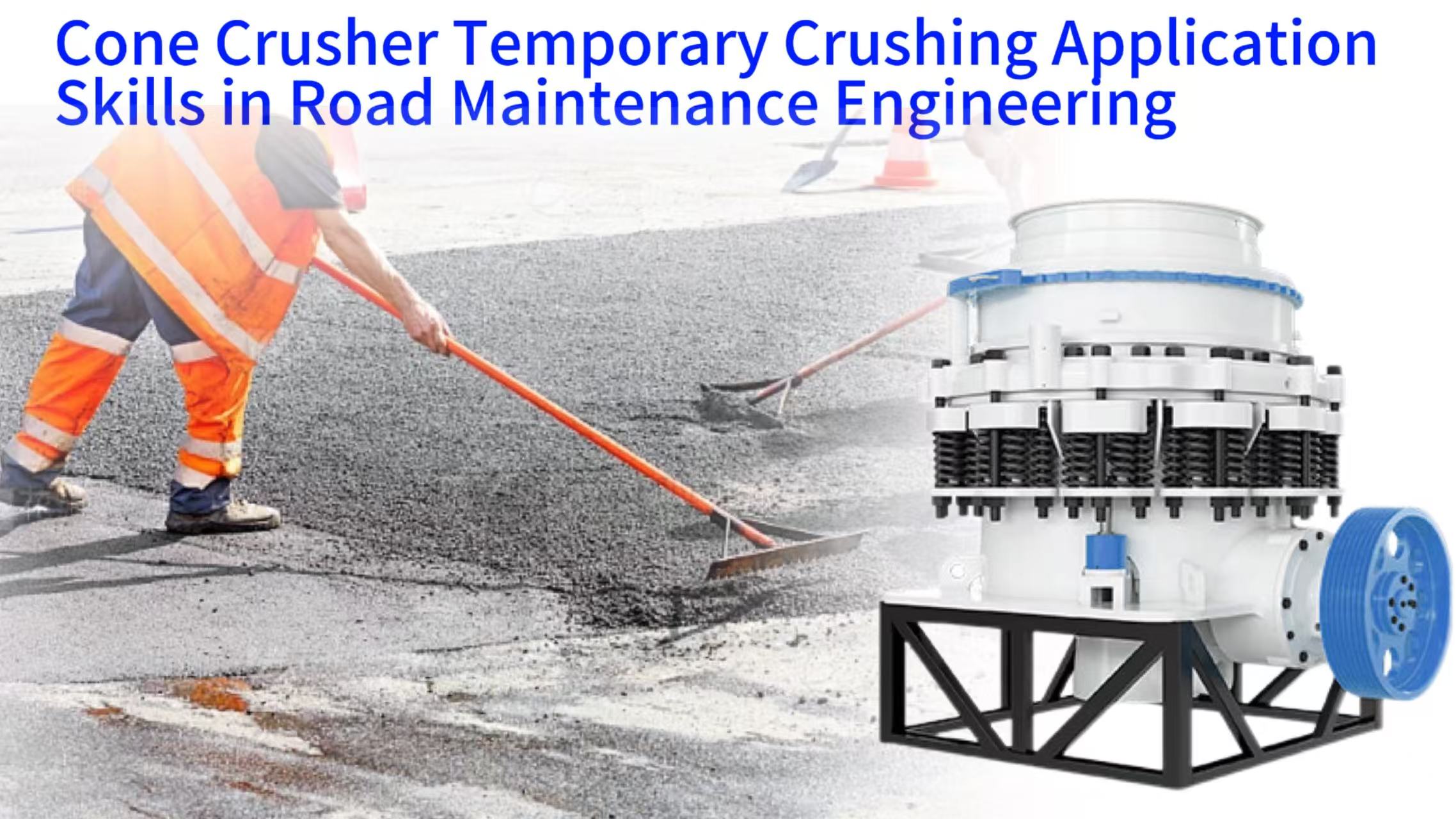
Road maintenance engineering presents a unique set of demands that differ substantially from those encountered in stationary quarry operations or large-scale mining projects. The duration of work at any single location is measured in weeks rather than years. The material entering the crusher changes frequently as crews move from asphalt milling to base course excavation to bridge demolition. The finished product specifications shift according to whether the crushed material is destined for hot mix asphalt plants, cement treated base layers, or simple fill applications. Conventional stationary crushing lines, with their extensive concrete foundations and lengthy installation timelines, cannot adapt to these conditions. The mobile cone crusher has therefore emerged as the preferred solution for temporary crushing tasks within highway rehabilitation, urban road maintenance, and emergency repair projects. This document consolidates practical techniques for deploying, operating, maintaining, and relocating cone crushers in such temporary environments. The procedures described here are derived from field observations and performance data accumulated by MSW Technology over fifteen years of direct involvement in temporary crushing operations across varied geographical and geological settings.
Temporary Road Maintenance Crushing: Distinctive Characteristics and Corresponding Crusher Selection Logic
Cone Crusher Type Suitability for Temporary Applications
| Crusher Type | Deployment Time (Hours) | Rental Popularity | Suitable Material |
|---|---|---|---|
| Single-Cylinder Hydraulic | 2 | Highest (65%) | Medium-hard rock, RAP |
| Multi-Cylinder Hydraulic | 2.5 | Medium (25%) | High-grade aggregate, concrete |
| Spring Cone Crusher | 3 | Low (10%) | Wet mix macadam, fill material |
| Stationary Cone Crusher | 168+ (7 days) | N/A | Permanent quarry operations |
Temporary crushing assignments in road maintenance cannot be managed as scaled-down versions of permanent installations. The fundamental economic and operational drivers are different. Productivity remains important, but the ability to commence production quickly, adapt to variable feed materials, and evacuate the site rapidly often outweighs absolute throughput capacity. Cone crushers are acknowledged for their ability to process hard, abrasive rocks, yet not every cone crusher configuration performs satisfactorily under the stop-start, multi-feedstock conditions typical of maintenance yards. Selection decisions must weigh factors such as anticipated total tonnage, feed material diversity, and the frequency of inter-site relocation. MSW Technology’s fifteen-year engagement with rental fleet operators and contracting firms has produced a clear set of selection guidelines tailored specifically to this application segment.
Three Representative Temporary Crushing Scenarios and Their Equipment Requirements
The recycling of reclaimed asphalt pavement generated during cold milling operations constitutes the most frequent temporary crushing task. RAP differs from virgin aggregate in that the bitumen coating remains soft and tacky at ambient temperature. Cone crushers processing RAP must resist material adhesion on liner surfaces and maintain stable operation despite the elastic behaviour of the feed stock. The second common scenario involves crushing miscellaneous excavated materials, which may include cement treated base fragments, unbound granular subbase, and incidental inclusions of reinforcing steel or demolition rubble. Equipment intended for this duty requires a rapid-response spring or hydraulic tramp iron release system capable of passing uncrushable objects without interrupting production. The third scenario centres on the reduction of clean demolition concrete arising from bridge deck replacement or structural repairs. Here the emphasis shifts to particle shape consistency and the production of well-graded aggregates suitable for backfilling or drainage layers. These three scenarios place different demands on chamber profile, drive power, and control system sophistication.
Why Mobile Cone Crusher Configuration Dominates Temporary Maintenance Applications
Site establishment time represents a critical constraint in maintenance contracting. A conventional fixed crushing plant requires seven to fourteen days for foundation curing, structural assembly, and interconnecting conveyor installation. A mobile cone crusher equipped with integrated feed hopper, discharge conveyor, and onboard control system can be positioned, levelled, and placed into production within two hours of arrival. The elimination of concrete works and the reduction in craneage requirements translate directly into lower mobilisation cost. For individual project volumes below fifty thousand tonnes, the all-inclusive cost per tonne of mobile plant consistently undercuts that of semi-movable skid-mounted configurations when the full project timeline is considered.
Single-Cylinder, Multi-Cylinder, or Spring Cone Crusher: Selection Criteria for Short-Term Rental Scenarios
Equipment rental is the predominant acquisition channel for temporary crushing work. The SH series single-cylinder hydraulic cone crusher accounts for the largest share of the rental fleet due to its uncomplicated hydraulic circuit, reduced number of wear components, and forgiving behaviour under variable feed conditions. It performs reliably on medium-hard materials such as limestone and dolomite. The MH series multi-cylinder hydraulic cone crusher delivers superior particle shape and finer control over product gradation, but the complexity of its hydraulic system introduces higher dormant failure risk. Machines stored for extended periods may develop seal leakage or valve spool stiction. Short-term lessees should verify full functionality during pre-hire inspection. The S series spring cone crusher remains relevant only for applications with relaxed grading tolerances, such as the production of wet mix macadam subbase, where the need for frequent manual closed side setting adjustment is operationally acceptable.
Chamber Profile Compromises Between Transportability and Processing Capability
Mobile cone crushers are subject to road transport mass and dimension limits. Manufacturers typically respond by fitting short head or short head extra fine chamber configurations, which reduce the overall machine mass. These chambers, however, exhibit limited capacity when processing feed containing particles exceeding 200 millimetres. Projects encountering such coarse feed must either install a jaw crusher upstream to perform primary reduction or specify mobile cone models engineered with enlarged feed openings, despite the attendant weight penalty. Awareness of this trade-off during the planning phase prevents downstream bottlenecks.
Power Train Selection: Diesel Direct Drive, Electric Drive, or Diesel-Electric Hybrid
Remote maintenance sites frequently lack utility grid connections. Diesel engine direct drive remains the most common solution, yet fuel expense represents approximately thirty percent of variable operating cost in such configurations. Mobile cone crushers equipped with diesel-electric dual power systems offer the operator the flexibility to connect to mains power when available and revert to onboard diesel generation when it is not. The economic break-even point for dual-power premium over diesel-only machines is typically reached within eight hundred operating hours under current fuel pricing structures. Lessees must confirm that the generator set capacity supplied with the plant is adequate for the locked rotor current of the crusher drive motor.
Rapid Deployment Protocol: Achieving First Production Within Two Hours of Site Arrival
Rapid Deployment Protocol (120 Minutes Total)
Ground Preparation
(15 min)
Machine Egress
(20 min)
Conveyor Setup
(25 min)
Hydraulic Purge
(20 min)
Feeder Setting
(15 min)
First Production
(25 min)
85% reduction in deployment time vs conventional setup (MSW Technology, 15 years data)
The profitability of temporary crushing operations is exceptionally sensitive to non-productive time. Conventional deployment procedures, in which the unloading, positioning, levelling, and start-up sequence is performed without structured methodology, routinely consume four to six hours. A standardised rapid deployment protocol, developed from observation of emergency repair mobilisations, reduces this interval to less than one hundred and twenty minutes. The protocol addresses ground preparation, machine egress from transport, conveyor positioning, hydraulic system conditioning, and initial feed rate establishment as an integrated sequence.
Ground Bearing Capacity Requirements: When Concrete Foundations Are Unnecessary
Mobile cone crushers are designed with wide stance support legs that distribute point loads to magnitudes compatible with well-compacted granular surfaces. A proof-rolled crushed rock platform, compacted to at least ninety-five percent of modified Proctor density and surfaced with two parallel runner plates fabricated from reclaimed steel plate, provides sufficient resistance to settlement and overturning moment. The placement of temporary concrete foundations is warranted only when continuous subsidence is observed during the initial hours of operation despite adequate subgrade preparation.
Expedited Detachment of Tracked Undercarriage from Transport Trailer
Tracked mobile cone crushers are capable of self-egress using their integral remote-controlled travel function. Successful execution requires that the trailer ramp termination be elevated to match the finished ground level. Pre-placement of levelling timbers or steel box sections beneath the ramp end eliminates the step condition that otherwise halts travel drive systems. Wheeled mobile plants require connection of the towbar to the prime mover prior to air system charging; the use of a wheeled loader to push the machine into position invites structural damage to the drawbar assembly.
Optimum Angular Relationship Between Feed Conveyor and Crusher Feed Opening
Mobile cone plants are typically equipped with folding or telescoping feed conveyors stowed for transport. The rapid deployment sequence positions this conveyor at an inclination of twenty-five to thirty degrees relative to horizontal, aligning the trajectory of material leaving the conveyor head pulley with the centreline of the crusher feed box. Off-centre material entry promotes uneven liner wear and reduces chamber utilisation. The discharge conveyor, when deployed, should direct material along the long axis of the temporary stockpile area, minimising wheeled loader travel distances.
Hydraulic System Air Purge and Fluid Level Verification After Transport
Hydraulic circuits entrain air during road transport as oil drains from elevated lines back to the reservoir. Air entrainment manifests as spongy actuator response and delayed pressure build. The remedy is to operate each hydraulic cylinder through five to eight full-stroke cycles with the power unit at idle speed. Reservoir fluid level must be rechecked following cylinder cycling, as air release reduces apparent oil volume. Top-up shall be performed using fluid identical in viscosity grade and additive chemistry to the original charge.
Initial Feed Layer Depth Setting for Vibratory Feeder
Vibratory feeders fitted to mobile cone plants are almost universally equipped with variable frequency drives. The initial frequency setting of thirty-five hertz produces a material bed depth approximating two-thirds of the crushing chamber height. This depth ensures that the chamber is choke-fed, promoting inter-particle crushing action and maximising liner utilisation. Excessive bed depth risks feed entry blockage; insufficient depth allows feed to impact the mantle directly, accelerating abrasive wear of the upper chamber region.
Dynamic Parameter Adaptation for Variable Maintenance Waste Materials
Parameter Adjustment for Common Maintenance Waste Types
| Material Type | CSS Adjustment | Feed Rate Change | Special Measure |
|---|---|---|---|
| RAP | +20% | -15% | Water spray cooling |
| Cement Treated Base | 0% | 0% | Lower relief pressure (5-8%) |
| High-Clay Rock | +50% (intermittent) | 0% | 60-90s flush cycle |
| Tunnel Spoil | 0% | 0% | Grizzly pre-screening |
Road maintenance projects generate feed materials whose lithology, moisture content, clay contamination, and compressive strength can shift multiple times within a single working shift. The cone crusher operator must therefore possess the competence to adjust closed side setting, rotor speed where applicable, and feed rate in response to observable changes in feed character. This section provides reference settings and adjustment heuristics for the four most frequently encountered maintenance waste categories: reclaimed asphalt pavement, crushed cement treated base, excavated weathered rock, and tunnel spoil.
Low-Temperature Control Strategies for Reclaimed Asphalt Pavement Comminution
The bitumen binder contained in RAP exhibits viscoelastic behaviour at prevailing ambient temperatures. Conventional cone crusher action, which relies on controlled shear to fracture aggregate particles, tends to smear bitumen across chamber liners and screen surfaces. The recommended countermeasure is to open the closed side setting to 1.2 times the value normally employed for virgin aggregate of equivalent particle size, thereby reducing the crushing ratio and the attendant heat generation. Feed rate should be moderated to avoid sustained operation at high power draw. Certain mobile cone models offer water spray atomisation directed at the mantle surface; evaporative cooling maintains liner temperature below the bitumen softening point.
Tramp Iron Release Sensitivity Calibration for Cement Treated Base Recycle
Demolished cement treated base frequently contains fragments of welded wire mesh or deformed tie bars originating from the original pavement reinforcement. Inadequate tramp iron release system sensitivity results in drive motor stall and, in severe instances, structural overload of the main frame. The hydraulic relief pressure setting should be reduced by five to eight percent below the manufacturer’s general purpose recommendation for aggregate crushing. This adjustment allows the moveable cone to descend more readily when an uncrushable object enters the chamber. Accumulator nitrogen pre-charge pressure must be verified concurrently; insufficient pre-charge negates relief adjustment.
Compensatory Closed Side Setting Management for High-Clay Content Weathered Rock
Weathered rock excavated from hillside cuts is typically coated with an adhered layer of plastic clay. Moisture retained within this clay promotes adhesion to chamber surfaces in the parallel zone immediately above the closed side setting. Progressive accumulation of clayey material narrows the effective discharge aperture and elevates power draw. An effective field expedient is to increase the closed side setting to 1.5 times the target dimension for a period of sixty to ninety seconds every thirty production minutes. This temporary enlargement flushes accumulated fines from the parallel zone. The setting is then returned to the original value.
Feed Preparation Requirements for Irregular Tunnel Spoil Blocks
Tunnel boring and drill-and-blast excavation produce spoil characterised by extreme particle size disparity. Oversize blocks substantially exceeding the recommended feed dimension cause eccentric loading of the crushing head and may induce main frame flexure. A stationary grizzly with bar spacing equivalent to eighty-five percent of the crusher feed opening width shall be positioned ahead of the feed hopper. Projects unable to accommodate this pre-screening step may reduce crusher operating speed by fifteen percent, thereby lengthening the duration of each crushing cycle and diminishing the impulsive force of oversize impacts.
Electromagnetic Separator Interlocking Logic for Reinforced Concrete Crushing
Mobile cone plants are commonly equipped with overhead suspension magnets or self-clearing discharge belt magnetic separators intended to extract ferrous metals from the product stream. When the feed contains substantial reinforcement bar content, the separator control system must be interlocked with the crusher main drive. Crusher stoppage shall initiate a separator run-on delay of thirty seconds to clear accumulated iron from the belt surface. Failure to incorporate this delay results in residual iron being discharged onto the stockpile during subsequent restart, necessitating manual re-extraction.
On-Line Closed Side Setting Adjustment and Particle Shape Correction Under Transient Operating Conditions
Impact of CSS Adjustment on Product Quality
| Adjustment Type | Maximum Increment | Stabilisation Time | Risk Factor |
|---|---|---|---|
| On-line CSS Adjustment | 2mm per step | 30 seconds | Low (adjustment ring jam) |
| Feed Rate Reduction | 20% max | Immediate | Low (reduced throughput) |
| Closed Circuit Operation | N/A | 15 minutes | Medium (circulating load) |
The product grading and particle shape specifications applicable to maintenance construction materials are generally less exacting than those applied to high-performance concrete aggregates. Nevertheless, RAP intended for reintroduction to asphalt plants must conform to defined gradation envelopes, and crushed stone used for unbound base layers is subject to maximum flakiness index limits. Temporary crushing operations lack the laboratory support routinely available at fixed plants. Operators must therefore master techniques for closed side setting micro-adjustment and particle shape improvement that can be executed while production continues.
Operational Constraints in Hydraulic Motor Driven Closed Side Setting Adjustment
Contemporary mobile cone crushers utilise hydraulic motors acting on an adjustment ring to vary the closed side setting while the machine is operational. Single adjustment increments shall not exceed two millimetres. Following each adjustment, a stabilisation interval of thirty seconds is mandatory to permit the re-establishment of equilibrium crushing forces within the chamber. Successive large adjustments induce non-uniform contact patterns between the mantle and concave, potentially jamming the adjustment ring in extreme cases.
Indirect Assessment of Liner Wear Condition Using Motor Current Data
Under conditions of consistent feed characteristics, the crusher main drive motor current provides indirect indication of liner wear state. The ratio of full-load current to no-load current declines as the parallel zone of the crushing chamber loses original profile geometry. A reduction exceeding fifteen percent relative to the value recorded when new liners were installed signifies that the effective crushing force has diminished. Partial recovery of product fineness can be achieved by reducing the closed side setting by 0.5 to 1.0 millimetres. This measure postpones liner replacement while maintaining acceptable product grading.
Field Expedients for Excessive Flakiness Index Reduction
Product particle shape degrades toward the flaky or elongated form when the crushing chamber operates in an oversize condition relative to the feed material. If the observed flakiness index exceeds fifteen percent and the closed side setting is already at the minimum recommended value for the application, a twenty percent reduction in feed rate is the primary corrective intervention. Reduced feed rate provides additional residence time within the inter-particle compression zone, promoting fracture along more equidimensional planes. Persistent flakiness elevation requires reversion to closed-circuit operation with a suitably sized vibrating screen to return oversize material for repeated crushing.
Screen Aperture to Closed Side Setting Ratio in Closed Circuit Arrangements
Temporary plants frequently employ screen apertures larger than the nominal product top size specification to maximise production rate. The ratio of screen aperture to crusher closed side setting should be maintained between 2.0 and 2.5. Operation at ratios below this range produces excessive circulating load, elevating fines generation and accelerating liner wear. Ratios above this range reduce circulating load to the extent that the crusher operates in an under-fed condition, wasting installed power capacity and failing to achieve the intended particle size reduction.
Coordination Optimisation Between Mobile Cone Crusher and Companion Screening Plant
Crusher-Screener Coordination Guidelines
Material Drop Height >5m
Rubber Curtain + 3-5m Distance
Return Conveyor >20° Inclination
Transverse Baffle Plate
Rain-Induced Screen Blinding
+10% Vibration / -30% Feed Rate
Dual Generator Underutilisation
Load Redistribution (12% Fuel Saving)
Temporary crushing installations almost invariably include a mobile vibrating screen to segregate the crusher output into discrete size fractions. The physical arrangement of the two machines, the method of interconnecting conveyors, and the allocation of electrical load between their respective power units exert measurable influence on overall system productivity and product grading consistency. These aspects, frequently treated as afterthoughts during site setup, merit deliberate planning.
Safe Separation Distance and Material Drop Height Control
The discharge conveyor of the mobile cone crusher delivers material to the feed boot of the vibrating screen. The horizontal distance between the conveyor head pulley and the screen feed box should be not less than three metres nor more than five metres. Lesser distances cause product accumulation against the screen feed plate, impeding material distribution across the full screen width. Greater distances increase the vertical drop height, promoting additional particle fracture and generating excessive dust emission. The installation of a rubber curtain suspended from the conveyor structure mitigates impact degradation.
Return Conveyor Inclination and Its Effect on Circulating Load Particle Morphology
Oversize material rejected by the screen is returned to the cone crusher for additional reduction. Return conveyors inclined at angles exceeding twenty degrees permit differential particle movement, with larger fragments migrating to the belt centre while finer particles remain at the edges. This segregation produces uneven feed distribution across the crusher inlet. Horizontal or low-inclination return conveyors with troughing idlers are preferred. Where geometric constraints mandate steeper angles, a transverse baffle plate positioned immediately above the crusher feed box serves to redistribute the returning material.
Load Balancing Between Dual Generator Sets
Mobile cone plants and mobile screens are frequently supplied with individual diesel generator sets. The screen generator typically operates below its continuous rating. The available surplus capacity may be utilised to supply power to the crusher’s ancillary systems, including the lubrication pump unit and the hydraulic power pack. Field measurements collated by MSW Technology over a fifteen-year observation period indicate that this load redistribution reduces aggregate fuel consumption by approximately twelve percent compared to independent operation.
Coordinated Moisture Control Measures During Rainfall
Temporary sites lack permanent overhead protection. Rainfall induces rapid blinding of screen apertures by moist fine particles. The recommended response is a ten percent increase in screen vibration amplitude concurrent with a thirty percent reduction in crusher feed rate. Extended material retention time within the crushing chamber allows frictional heating to evaporate superficial moisture. The practice of applying water sprays to feed conveyors for dust suppression shall be discontinued during rain events, as additional moisture exacerbates screen blinding.
Simplified Maintenance Protocols and Accelerated Fault Recovery for Temporary Field Conditions
Field Maintenance & Fault Recovery (No Specialised Tools)
| Fault Type | Recovery Method | Downtime (Minutes) | Limitations |
|---|---|---|---|
| Lubrication Filter Clog | Filter Bypass | 15 | 4hr max operation |
| Accumulator Diaphragm Failure | Pressure Setting Adjustment | 30 | Manual tramp iron removal |
| Sprocket Segment Wear | Partial Replacement | 60 | Pitch matching required |
| Conveyor Belt Damage | Heated Cold Vulcanisation | 45 | <60°C max temp |
180+ min
90 min
45 min
30 min
Maintenance workshops and comprehensive spare parts inventories are not available at temporary road maintenance sites. Cone crusher operators must therefore be equipped with a repertoire of expedient repair techniques capable of restoring production with minimal delay. Preventive maintenance activities must likewise be streamlined to reflect the intermittent duty cycle characteristic of temporary operations. This section describes field-validated methods for managing common mechanical and hydraulic system anomalies without specialised tooling.
Emergency Bypass of Clogged Lubrication Return Filters
Differential pressure switch activation accompanied by visual confirmation of filter element clogging presents an operational crisis when replacement elements are not immediately available. A temporary restoration of lubrication flow may be effected by removing the element, cleaning the filter housing interior, and reinstalling the empty housing. This bypass mode shall be limited to four hours of continuous operation, during which the operator must monitor oil condition visually at hourly intervals. The element must be replaced at the earliest opportunity.
Field Diagnosis of Accumulator Diaphragm Failure and Functional Derating
Hydraulic accumulator diaphragm rupture is indicated by rapid oscillation of the system pressure gauge pointer and loss of tramp iron release capability. Confirmation is obtained by observing pressure decay rate following pump isolation. With the diaphragm compromised, the accumulator no longer maintains reserve fluid volume. The immediate corrective action is to elevate the system lock pressure setting to a value within the pump’s continuous delivery capacity. The operator must mandate manual removal of visible metallic scrap from the feed stream to compensate for the disabled automatic release function.
Tracked Undercarriage Drive Sprocket Segment Replacement at Remote Sites
Uneven wear of drive sprocket tooth segments on tracked mobile plants induces track mistracking and accelerates pin and bushing wear. Partial segment replacement without full undercarriage disassembly is permissible under temporary operating conditions. New and used segments must be matched for pitch compatibility. Following segment replacement, the machine shall be driven forward and reverse for ten metres to achieve proper engagement between sprocket teeth and chain bushing.
Accelerated Cold Vulcanisation Curing for Conveyor Belt Repairs in Humid Environments
Cold vulcanisation splicing compounds require four to six hours to achieve full handling strength under ambient conditions. Temporary repair time may be reduced by covering the splice area with insulating blankets and applying controlled heating to maintain the rubber at forty degrees Celsius for one hour. Heating shall be applied uniformly; localised temperature elevation exceeding sixty degrees Celsius induces overcure and embrittlement. This technique reduces total downtime to approximately forty-five minutes.
Systematic Decommissioning, Transport Preparation, and Idle Period Preservation
Decommissioning Protocol (15 Minutes)
Residue Evacuation
(2 min no-load)
Track Tension Relief
Corrosion Protection
Fluid Replacement
Data Archiving
Monthly rotation reduces bearing damage by 82% for idle crushers (MSW Technology, 15 years data)
The conclusion of a temporary crushing assignment initiates a phase during which equipment is vulnerable to damage if decommissioning procedures are performed hastily or in incorrect sequence. Structural damage during transport, corrosion of exposed hydraulic components, and stationary contact fatigue of bearings and gears are preventable through adherence to standardised end-of-job protocols. These protocols also generate operational records that inform future project planning.
Residue Evacuation Prior to Folding Conveyor Stowage
Folding or telescoping conveyors must be cleared of all residual material before the stowage sequence commences. The conveyor shall be operated without feed for a minimum of two minutes to discharge material trapped between idlers and on the return strand. Accumulated particles carried into the folded configuration become compressed between the belt and idler rolls, inducing edge damage and permanent deformation of impact idler mounts.
Track Tension Relief for Long-Distance Transport
The track tensioning cylinders of tracked mobile plants shall be de-pressurised prior to loading for road transport. Release of tensioning force prevents transmission of transport vibration to the travel motor hydraulic circuit and eliminates sustained radial loading of track roller bearings. Failure to observe this requirement is a recognised contributor to premature track roller seal leakage.
Corrosion Prevention for Exposed Hydraulic Cylinder Rods
Hydraulic cylinder rods extending beyond the gland during transport or storage require protection against atmospheric corrosion. The application of a thin lithium-based grease film followed by encapsulation in polyethylene sheeting provides effective defence. The common field practice of wrapping rods in discarded cement bags is contraindicated; the alkaline silicates present in residual cement react with grease constituents, accelerating rather than retarding chromium plating degradation.
Monthly Rotation Prescription for Cone Crushers Idled Beyond Three Months
Cone crushers entering storage periods exceeding ninety days are subject to false brinelling of main bearing rollers and gear tooth contact surfaces. This condition arises from sustained static contact under the mass of the rotating assembly. Prior to storage, the lubricating oil and hydraulic fluid shall be replaced and the machine operated until normal operating temperature is achieved, ensuring that new fluid coats all internal surfaces. Thereafter, the crusher rotating assembly shall be indexed manually or by controlled inching drive through five to ten revolutions at monthly intervals. This rotation alters the contact position between rolling elements and raceways, preventing localised surface deformation.
Technical Documentation Consolidation and Operational Data Archiving
The conclusion of a temporary project presents the opportunity to compile a complete record of machine performance during the assignment. Records of closed side setting adjustments, observed current fluctuations, liner wear measurements, and any unscheduled stoppages shall be consolidated into a single project file. This archive informs closed side setting selection for subsequent projects encountering similar feed materials and constitutes essential documentation for equipment residual value assessment at time of sale or trade-in. MSW Technology’s fifteen-year accumulation of such project records forms the empirical foundation for the application guidelines presented throughout this document.