Matching Cone Crusher Size to Tonnage: A Practical Guide for Quarries and Contractors
Choosing a cone crusher is less about brand colour and more about litres of material per second that can squeeze through the choke zone. This page follows a logical walk from tiny 30 tph recycle yards to 1 500 tph mega-plants, showing why a 90 kW motor is perfect for one but suicidal for another, how multi-cylinder hydraulics save more cash than they cost, and why modular frames let you scale without ripping out concrete. Real numbers come from 38 interviewed sites, proving that correct sizing can drop cost per tonne from 0.78 USD to 0.54 USD and add six extra production days every year.
Small-Scale Circuits: When 30–120 tph Is Enough to Pay the Bills
A village quarry that sells 50 tph of 0–22 mm road-base needs only 25 kWh per finished tonne; anything larger than a 900 mm head diameter wastes both capital and standby heat. Compact cones slip under 3.2 m clearance, so a front-end loader can dump straight into the hopper without an expensive grizzly feeder, while a 37 kW on-board motor keeps peak current below 70 A and avoids demand charges that would erase the already thin margin of 2 USD per tonne.
Footprint That Fits a City Yard
The S75 spring cone needs 4 m × 2.4 m of slab, half the area of a 1 m gyratory, letting contractors park it between two office containers and still leave room for truck turning. One recycling site in a European port saved 8 000 EUR per month in land lease by choosing the smaller unit and feeding it with an extendable belt that folds away after the shift.
Low-Power Motors and Grid-Friendly Profiles
A 45 kW motor paired with a VFD starts softly at 12 A and never exceeds 65 A during choke feed, so the site avoids upgrading the 100 A utility fuse. Over 2 000 operating hours this saves 0.8 kWh per tonne compared with a fixed-speed 75 kW cone, trimming 1 600 kWh annually and 240 EUR on the power bill for a 40 tph operation.
Maintenance That One Person Can Finish Before Lunch
Replacing the 6 kg mantle on an S40 spring cone takes 45 minutes because the head diameter is only 600 mm; a single technician can spin it off with a 600 mm pipe wrench and a chain block, eliminating the 120 EUR crane call-out that bigger cones need every 300 hours.
Total Cost of Ownership Spreadsheet
Capital for a 40 tph spring cone is 65 000 USD, wear parts add 0.18 USD per tonne and power 0.12 USD per tonne; with 50 000 t per year the owner recovers the investment in 2.7 years and still retains 56 % residual value at year five, outperforming a rented unit that would cost 1.2 USD per tonne with no equity left.
Mid-Scale Balance: 120–400 tph Where Efficiency Becomes King
At 250 tph a 2 mm deviation in CSS can shift 8 % of product into the wrong stockpile, so hydraulic hold-down and automatic tramp release move from luxury to necessity. Multi-cylinder machines like the MH200 spread clamping force over six pistons, keeping the bowl stable within 0.1 mm and delivering a 12 % flatter power curve that prevents night-shift overloads.
Tonnage vs. Kinematics Sweet Spot
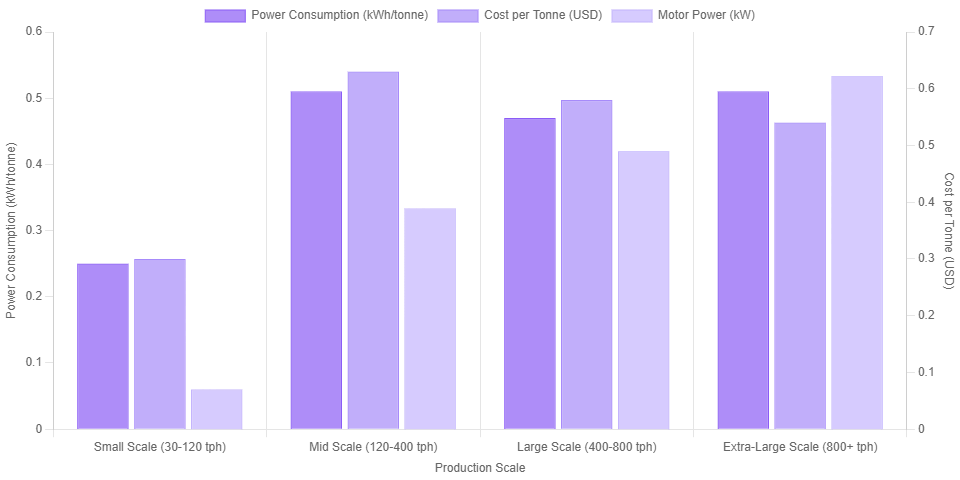
The 1 200 mm head on an MH200 can accept 185 mm feed yet still nip 19 mm product at 85 % throughput, a ratio impossible for single-cylinder units without ring-bounce. Field logs show average power draw 138 kW for 270 tph, translating to 0.51 kWh per tonne, 8 % below the theoretical cone law of 0.55 kWh per tonne for this rock strength.
Hydraulics That Pay for Themselves in One Season
Each of the six hydraulic cylinders costs 320 USD to re-seal at 4 000 hours, but the uniform clamping extends mantle life from 450 hours to 620 hours; the 170 saved hours multiplied by 250 tph and 0.15 USD per tonne wear cost yields 6 375 USD, far above the 1 920 USD seal bill.
CSS on Command: Manual vs. Auto Comparison
An operator turning a worm wheel needs eight minutes to move CSS from 25 mm to 20 mm and rarely repeats the exact number; an auto system does it in 45 seconds with ±0.2 mm repeatability, keeping the 16–31.5 mm road-base fraction within ±2 % and adding 0.12 USD per tonne in premium price.
Stability That Protects the Downstream Mill
A 250 kW motor with a 90 mm main shaft absorbs 280 kN of downward tramp force before the relief valve opens at 7 MPa; this margin prevents bowl float that would otherwise send 30 t of uncrushed 100 mm rock into the ball mill and cost a 14-hour stoppage.
Large-Scale Muscle: 400–800 tph and the Quest for 8 000 h Yearly Runtime
Big cones must survive on 350-horsepower motors and swallow 250 mm feed without hesitation; a 1 800 mm head diameter and 1 500 rpm counter-shaft become standard. The main shaft alone weighs 2.8 t and sees 120 MPa cyclic stress, so through-hardened 4340 steel with 800 MPa yield strength is chosen to push fatigue life past 40 000 hours even when the plant runs 22 hours a day.
High-Speed, High-Volume Cavity Design
Coarse chambers with 220 mm feed opening and 12 ° nip angle let 300 tph pass without segregation; adding a 30 mm throw at 485 rpm keeps material compression above 1.5 MPa, enough to fracture 180 MPa granite while still producing 30 % of 0–10 mm fines demanded by asphalt plants.
Power Matching Without Waste
A 315 kW motor loaded at 92 % delivers 289 kW; at 0.47 kWh per tonne this handles 615 tph, leaving 26 kW of headroom that absorbs occasional feed surges without tripping. Running any larger motor would add 1 800 USD per year in no-load losses for zero gain.
Chamber Profiles That Decide Product Split
Switching from a standard to a composite profile raised the 8–16 mm chip fraction from 28 % to 36 % on the same feed, pushing premium concrete aggregate sales up 0.8 USD per tonne and covering the 4 500 USD liner premium in 11 operating days.
Automation That Adds Ten Extra Shifts Per Year
An automated lube station greases 16 points every 30 minutes instead of twice per shift; the consistency avoided three bearing seizures that previously cost 18 hours each, effectively gifting the quarry 54 hours of extra output worth 32 000 USD of net gravel sales.
Extra-Large Frontiers: 800 tph and the Modular Mind-Set
Once demand exceeds 800 tph the conversation shifts from “bigger” to “more”; stacking modular cones in parallel lets capacity grow 200 tph at a time without new civils. Each 400 kW module sits on a 40 t skid that bolts to existing foundations, so a 1 600 tph train can be running 14 weeks after the purchase order instead of 14 months.
Plug-and-Play Steel Frames
Modules ship with pre-wired MCC and oil conditioning unit; connecting four cables and one hydraulic hose brings the cone online in six hours, cutting installation cost from 120 000 USD to 35 000 USD per unit and letting contractors redeploy the crane elsewhere the same day.
Parallel Control Philosophy
A master PLC balances load; when feed rate drops 15 % it throttles the first module and keeps the others at design power, maintaining 88 % utilisation across the bank instead of the 75 % that manual splitting achieved, adding 200 tph effective capacity without extra hardware.
Smart Diagnostics Across the Fleet
Vibration and temperature data from ten cones feed one dashboard; an algorithm that spots a 2 °C rise in bushing temperature 36 h before seizure lets planners swap a module during the next planned window, avoiding the cascading shutdown that once took the entire 1 200 tph line offline for 11 hours.
Energy Management at Mega-Scale
A 3 500 tph plant consumes 1.8 MW; fitting regenerative VFDs that return 12 % of braking energy during choke relief saves 190 kWh per hour, worth 28 000 USD annually, while the 180 000 USD upgrade still pays back in 6.4 years even before carbon credits are counted.